By Alix Cohen
This may be as dense as the exceptional Tom Stoppard gets with language and ideas. Be ready for an intellectual challenge. Textural interpretation of the classics is examined as passionately as rage against moral structures. Signature humor relieves.
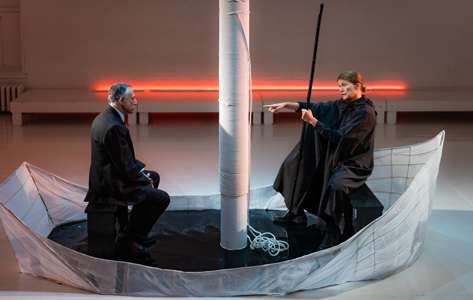
It’s 1936. “I’m dead. Good,” declares British author and poet A.E. Houseman (David Greenspan) taking his seat with black-caped Charon in a boat on the River Styx.
The protagonist is best known for A Shropshire Lad (1896), a slim collection of deceptively simple poems about youth, love, loss, mortality, and the passing of time. Though inexplicably failing his degree, after time in the Civil Service, he would make up courses to become Professor of Latin at University College London.
Housman reflects on school days as an Oxford scholar. He’s cocky and snarky, looking back on most peers as having become either “mechanics or statisticians.” Vision softens, however, with memory of the unrequited love of his life, Moses J Jackson.
“Because I liked you better/Than suits a man to say,/It irked you, and I promised/To throw the thought away….” (an excerpt of one of several poems for Jackson unpublished until the poet’s passing.)
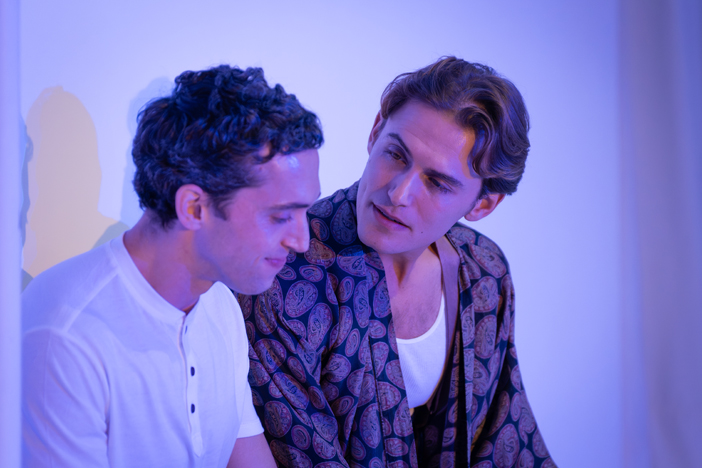
Yaron Lotan (Young Hoiusman) & Jose Espinosa (Moses Jackson)
It was a time when Victorian England harshly persecuted love between men. Oscar Wilde attended Oxford the same years. “His rooms are said to be completely bare except for a vase with a lily,” a student comments. With a scandalous court case and prison sentence, Wilde became the poster boy for persecution.
University chums/fellows also reading classics, pile into the boat with young Housman (Yaron Lotan), now a punter on the Thames. Pollard (an excellent Daniel Liu) is smart and observant, a young man of few incisive words who quotes John Ruskin and Oscar Wilde as readily as Catullus. Pattison (a naturalistic Sam Bolen) is socially at ease. He personifies undergrads who banter, flirt, and gossip. The actor’s later portrayal of Oscar Wilde could be more effete.
Moses Jackson (Jose Espinosa), on science scholarship, is all athletics all the time. A beautiful, beamish boy – and straight- he’s the oblivious secret object of Housman’s love. The actor is splendid. Comradeship remains warm yet plausibly unaware. Espinosa radiates physicality, yet never plays the one dimensionality of a jock.
We watch the boys at work and play. Some are aware of Housman’s infatuation- he’s affectionately warned. “I know very well there are things not spoken of at Oxford,” the young man responds. “We are all dust and dreams.” (Horace, Odes 4.7 contains the lines, “pulvis et umbra sumus-“We are dust and shade.”Housman’s famous translation reads “We are dust and dreams.”)
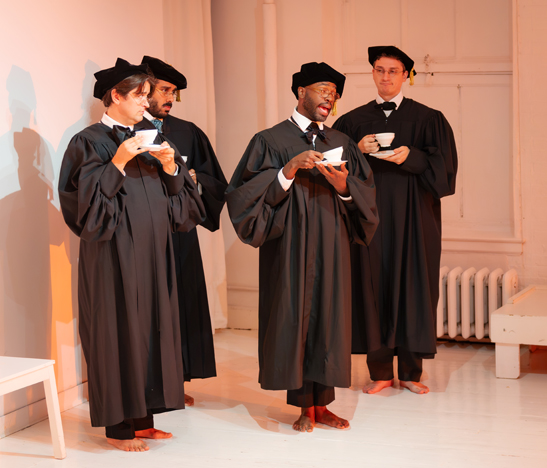
Sam Bolen, Abrar Haque, Leland Fowler, Spencer Lutvak
Dons/businessmen/journalists/authors create a kind of Greek Chorus: These include: Leland Fowler, Sam Bolin, Abrah Haque- more singular as Chamberlain from the patent office, who may have a crush on young Housman, and Spencer Lutvak who draws us in with singular attitude. A quartet of the Dons might be compared to Monty Python. Knees high, they prance around the center, thwacking croquet balls, arguing scholarly points.
One on one conversations between young and old Housman are particularly telling. The student has no idea with whom he’s talking. Housman Sr. is curious and careful. Difference is deftly illuminated. “I would have died for you, but I never had the luck,” Sr. sighs under his breath.
In a 2005 interview with Believer Magazine, Stoppard explained the title and central idea: “The ‘invention’ of love means that we create the person we need to love. Housman’s Jackson and Oscar Wilde’s romantic obsession, Bosie, are inadequate to the enormous emotions invested in them.” The same conversation paralleled Housman’s love for Jackson with his devotion to classical scholarship: both involve what Stoppard called “useless knowledge,” but neither is invalid.
Cleverly staged around what appears to be a (rice paper) boat gently lit from within, the set makes use of a building pillar as its mast. Mooring is aesthetic and credible. (Bridget Lindsay) Characters climb in and out, past and future keeping company. Interaction also occurs around it. White wall benches are the only – quite sufficient- furniture.
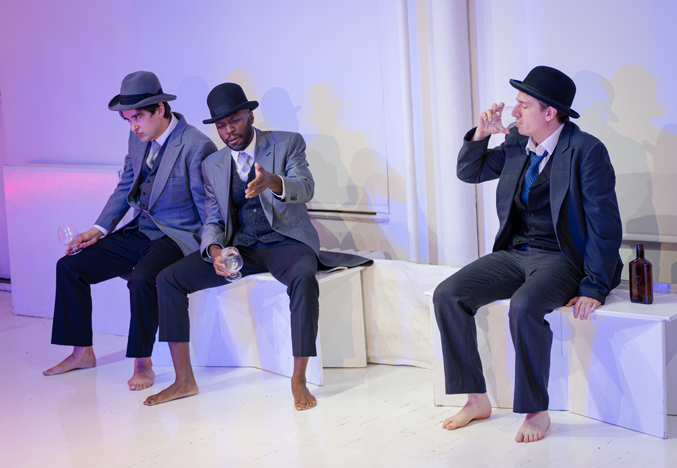
Sam Bolen, Leland Fowler, Spencer Lutvak
Lighting by Paige Seber and Original Music by Julian Hornik are so subtle one hardly notices atmospheric collaboration.
David Greenspan’s AE Housman is powerfully drawn; erudite, pigheaded, fiercely private, rueful, and loyal. Mordant wit crackles. If the actor’s voice rose and fell a little less dramatically, it would be clearer. As his young self, Yaron Lotan manifests seemingly effortless intellect in tandem with enthusiasm, restraint, naïveté and capacity for deep emotion. He’s sympathetic and believable.
Annabel Capper’s Charon evinces cold demeanor and a lower class accent which later becomes patrician as Housman’s sister, wherein she additionally appears to drop years.
Direction (Zachary Elkind) makes brilliant use of the space creating movement and variation that never seems extraneous. Jackson’s races are deftly integrated. Housman’s encountering his younger self takes place indeterminately elsewhere. Elkind has wisely chosen not to differentiate now and then with effects. Though accents vary in verisimilitude, characterization of principals is specific, relationships are clear.
Struggling against a play that could successfully be edited, pacing is, in fact, excellent. At almost three hours, the piece would lose nothing by cutting 30 minutes of reiterating exposition.Stoppard follows tangents without relief. It’s exhausting, but also fascinating, droll, and subtly moving.
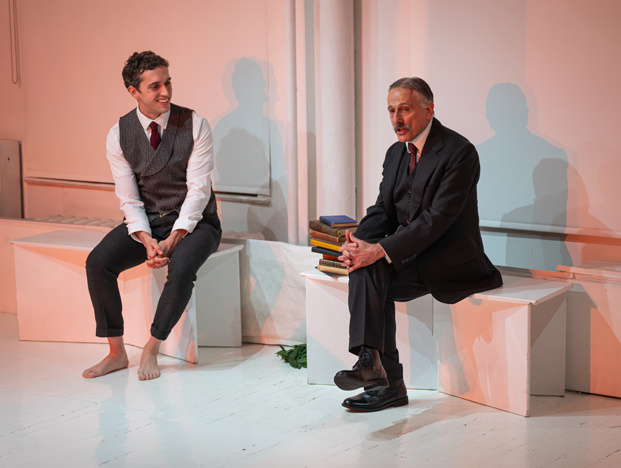
Yaron Lotan (young Housman) & David Greenspan (Old Housman)
Costumes by Alyssa Korol are marvelous. One couldn’t do better on Broadway. Every character is period correct, every piece well tailored. The Dons’ soft, tasseled caps and gowns, the boys’ matching vests and trousers, the few women’s ensembles are all just right. Bare feet (boating?) is an inspired choice.
“When I was one-and-twenty/I heard a wise man say,/“Give crowns and pounds and guineas/But not your heart away;…”
AE Housman A Shropshire Lad
Photos by Paul Lutvak
Opening: David Greenspan (AE Housman) & Annabel Capper (Charon)
The Invention of Love was first presented on Broadway, on March 1, 2001, at the Lyceum Theatre where it ran until June 30, 2001, for a total of 139 performances. Directed by Jack O’Brien, the production secured two Tony Awards.
The Invention of Love by Tom Stoppard
Directed by Zachary Elkind
Theater Lab 357 W 36th Street, 3rd Floor
Though October 3, 2026
Tickets: www.themaptheater.com.