Review by Ron Fassler
I have no master list of the shows I’ve attended in a lifetime of theater going. But if I did, of the classics I’ve seen multiple times, Anton Chekhov’s The Cherry Orchard would be close to the top—and that’s mainly by choice. Though more often disappointed than enchanted, I journey on in search of the perfect production. The usual problem is that because Chekhov’s plays are challenging to get right, it’s crucial they are cast with an ensemble of the highest caliber. Star turns are verboten and everyone must shine together. The only recipe for success is that each actor must find the poetry in the prose, relay it into action, and do so effortlessly. Is that too much to ask?
It pleases me then to report that the new Korean-language North American Premiere of Australian adapter/director Simon Stone’s Cherry Orchard is a success (supertitles of the text in English are projected above the stage). In collaboration with dramaturg Yi Danbi, Stone utilizes Chekhov’s characters and plot, shifting the action from its original 1900 setting. Instead of Czarist Russia, we are in 2026 Seoul, with New York City substituting for Paris, the place from which Song Do-Young (Jeon Do-yeon), a once-wealthy scion, has returned home after an absence of five years.
Here, in this updated scenario, it isn’t just a house and an orchard facing the wrecking ball, but a multi-conglomerate of organizations Do-Young and her older brother Song Jae-Young (Son Sang-kyu) inherited from their father. The precipice on which they stand concerns the potential loss of not only a fortune, but their status, raising the stakes considerably.
All the familiar players from the Chekhov play have been retained but two: Firs, the ancient household servant, and Charlotta, a former governess with little to do who nonetheless remains on the payroll. These two characters, holdovers from better days who have outlived their usefulness, don’t fit in anymore. Surprisingly, they are not missed in this update.
As always, the most vital character in the play is Lopakhin, here transformed into Hwang Doo-Sik (Park Hae-soo), the son of a former chauffeur in the household and now an affluent entrepreneur. It is he who constantly sounds the wake-up call, which goes unheeded, that the family is on the brink of ruin (SPOILER ALERT: it is he who purchases the bad debt of the business and becomes its new owner). He tries to soften the announcement that he will tear down the estate and build a luxury hotel with a gracious gesture: he will replant one of the only still-healthy cherry trees and put it on display in the hotel foyer. “We will see if it survives,” he says.
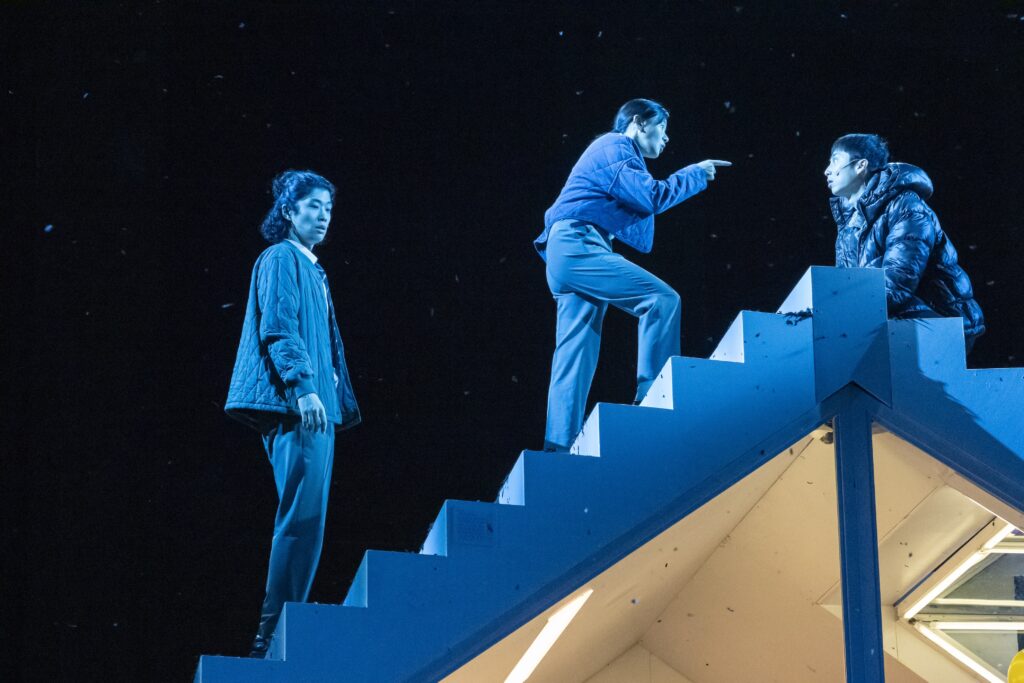
As the director Robert Icke also accomplished with his recent Oedipus on Broadway, this is more than an adaptation. The writing is fresh with few lines retained from any translations of Cherry Orchard that I’ve seen or read. Take a line for Do-Young like, “New York! What a city! That’s a city to be alcoholic in!” While funny and revealing of her hedonistic ways, the modernization of the character still feels connected to Lyubov Andreyevna Ranevskaya, upon whom she’s based. The fact that Do-Young is constantly checking her phone for a text from her lover is exactly the 21st century equivalent of waiting for a telegram. Or take the example of one of Trofimov’s rants (presented here as Byun Dong-Lim), which still carries weight in its rage against the aristocracy. When the young revolutionary warns of the overreaching power of Big Tech, it doesn’t feel out of place, stubbornly connected as it is to everything old being new again.
One of the things that has continually drawn artists to Chekhov’s work is how his characters rarely address their innermost feelings, therefore providing a field day for actors to explore subtext. Some may take issue here with Stone’s writing in that he tends to have his characters speak the subtext out loud. Personally, I found it a refreshing change to have many of them finally say what’s in their hearts.
Standing out in the strong ensemble is Jeon Do-yeon, a major international stage and film star. The recipient of a Best Actress honor from the Cannes Film Festival for Secret Sunshine (2007), she radiates beauty and ennui, perfect for the role of Lyubov/Do-Young. And Park Hae-Soo, most recently the star of Squid Game on Netflix, brings enormous stage presence and leading man vibes to Lopakhin/Doo-Sik. I also especially liked the ways Song Do-Young (Anya in Chekhov’s version), has been rethought. No longer a somewhat simpering ingenue, she is presented here as a young woman of substance, despite her self-professed poor choice in shooting a short about a dead bird—lovely Seagull allusion—while studying film at NYU. Son Sang-kyu does a lovely job in the role.
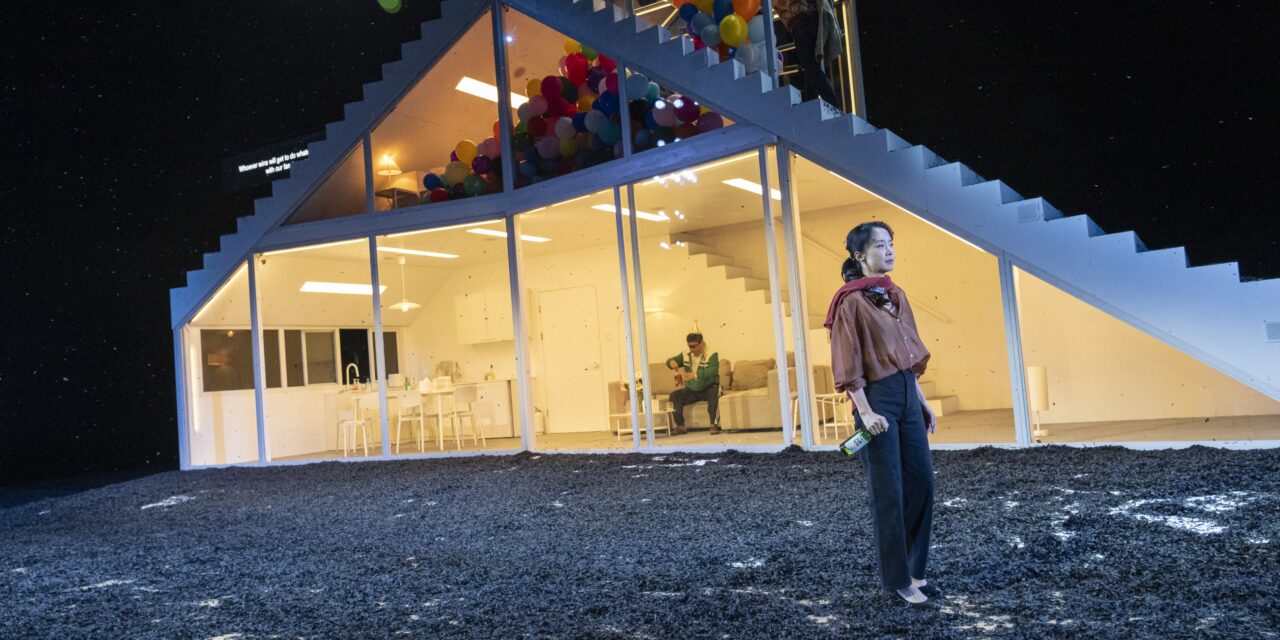
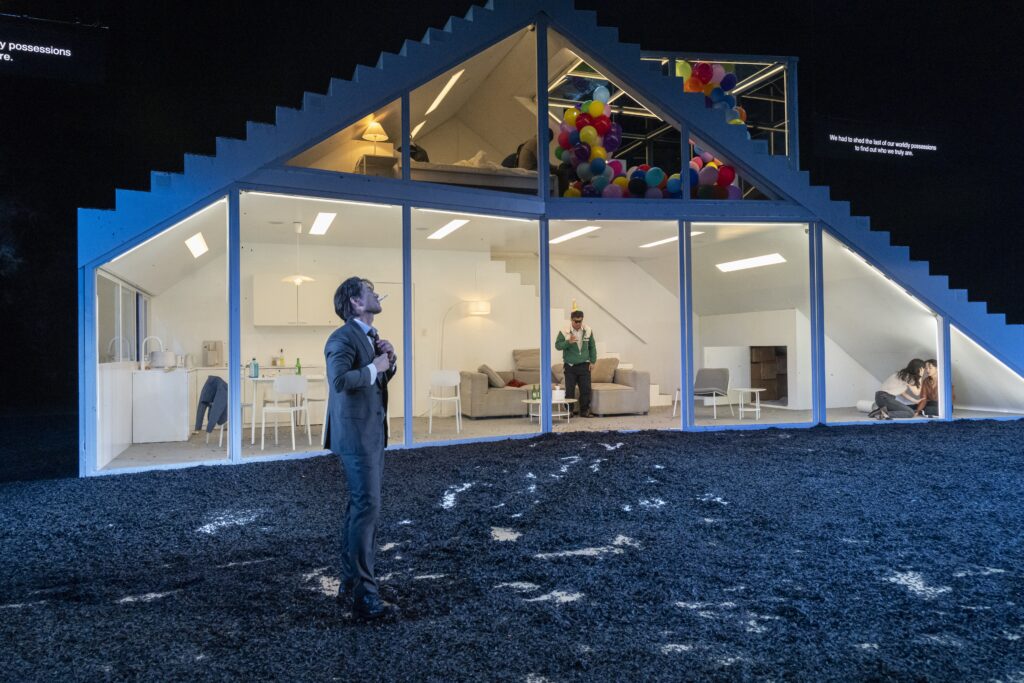
Mention has not been made yet of designer Saul Kim’s beautiful transparent glass house setting, stunning to take in amidst the cavernous Wade Thompson Drill Hall at the Park Avenue Armory. Glass houses are a frequent motif of Stone’s stagings in which he spurs the audience to observe voyeuristically. It works well here even if it does present a major challenge for the sound designer, as much of the action takes place inside the glass. Somehow Jan Young Gyu manages the difficult task with ease. Lighting by James Farncombe and costumes by Mel Page are spot on.
Taking timeless themes and expanding upon them are what every production of a classic should be about. This Korean Cherry Orchard marks an exceptional new path towards making Chekhov bolder and stronger than ever, even after 125 years.
The Cherry Orchard is playing at the Park Avenue Armory, 643 Park Avenue, NYC in a limited engagement now through September 26. For ticket information, please click here.
Photos by Stephanie Berger.
Headline photo: Jeon Do-yeon in The Cherry Orchard.