By Alix Cohen
The United States government has censored – in part- the following from official documents: vulnerable, entitlement, diversity, transgender, fetus, evidence-based, science-based. Books are banned, history “cleansed” and rewritten. We live in an authoritarian age where thinking itself is insidiously changed.
Nora Sorena Casey’s dystopian play is more about words than dreams. Without a common language to say what one means, both individuality and communication break down. Eliminating words transforms ideas. Here the population literally eats words.
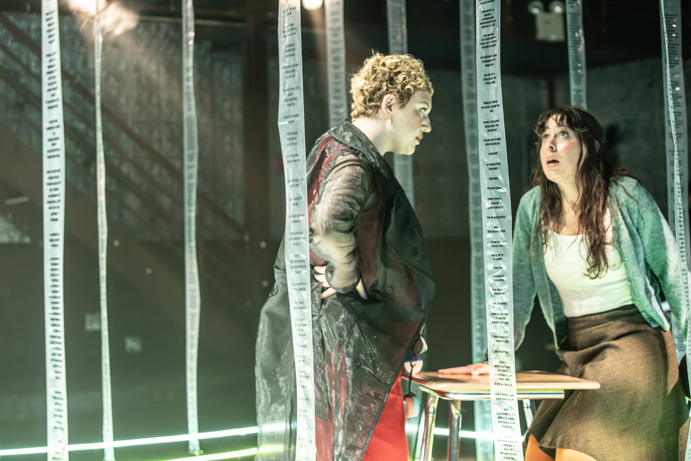
Kat Warnusz-Steckel and Jes Dugger
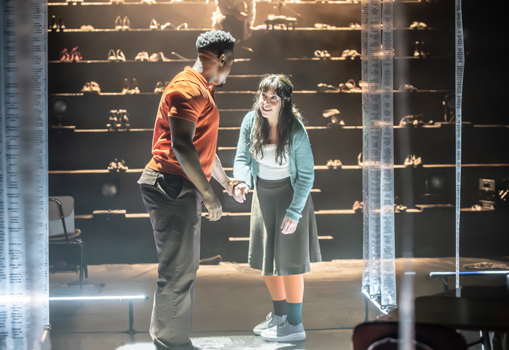
Ellie (Jess Dugger) and Thomas (Bryce Michael Wood) live In a square house with four sides of floor-to-ceiling paper strips acting as ersatz walls. These are the population’s (printed) dreams. If only we could read one in the program or on display outside. Narrow neon tubing near the floor confines the space. They are observed and sometimes addressed by all-seeing/hearing government.
The couple may be married. Neither is quite sure. “I don’t remember things,” he begins. “I think of a drive and concentrate on your fingers so the rest of you will surprise me…” The sky is brown.
Across the venue, a room-width flight of stairs is filled with abandoned pairs of shoes. This is where Chris Jaymes (Narrator) sits in his lab coat occasionally commenting before he joins action.
Ellie gets a job buying dreams at the main “post office.” Clarissa (Kat Warnusz-Steckel) is her boss. Little is articulated/ explained. Dreams are color coded and judged whether worthy. Those purchased are extracted. “Extraction is Incentivized, appreciated, but not required,” her new boss says. Uh huh.
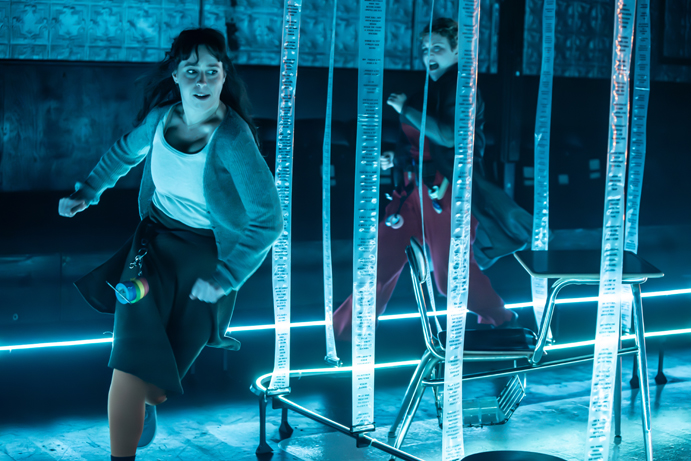
Jes Dugger and Kat Warnusz-Steckel
Thomas goes to the post office ostensibly to sell a dream, but really to check things out. He refuses low payment and leaves intact. As she loses words, his wife increasingly drifts away. The job gives her purpose. Thomas is upset. The phrase “I love you” is commonly parroted to smooth over conflict. It’s meaningless except to Thomas who holds fast to the possibility he actually does love Ellie.
Clarissa is part of an underground group that hopes to disrupt the powers that be. She conscripts Thomas. They’re found out. The Narrator gets involved. He may or may not have known Clarissa before the “reset.” Things build until a second “reset” is forced. Memories are all but wiped.
Director Arthur Makaryan maintains a swift pace. All the actors are focused and credible in context; anxiety and confusion palpable. Use of the central staging area is excellent. The figure on the steps, however, never works.

Chris Jaymes
Thematically timely, the play is nonetheless obscure. Though repetition sets a mood, it also extends half hour too long. Kudos to the playwright for characters speaking around words they might’ve employed.
Scenic and Lighting Design (Christopher Annas-Lee) enhance threatening, futuristic mood.
Sound Designer/Audio Engineer Audrey Chou symbiotically adds to concept with unnerving sounds/music.
I can’t say I understand costume choices which seem from different plays. (Emily White)
Photos by Marina Levitskaya
La Mama Experimental Theatre Club presents
The Censorship of Dreams
An Arte Makar Production
By Nora Sorena Casey
Directed by Arthur Makaryan
Ellen Stewart Theatre 66 East 4th Street