By Carole Di Tosti, Ph.D. …
Happily, the spirits in Animal Wisdom are comical and wise, never fearsome.
By her own definition, Heather Christian, writer/composer of Animal Wisdom, says that her work “defies categorization.” Directed by Kennan Tyler Oliphant, with music direction by Alexandra Crosby, the Southern folk-blues ritual/requiem/mass/séance reveals Christian’s opaque, spiritual journey toward healing, and her expiation of pain through her music and lyrical poetry. Animal Wisdom currently runs at the Signature Center’s Romulus Linney Courtyard Theatre through June 14, 2026.
The Drama Desk Award-winner uses her uniquely particular style of haunting music which fuses Southern folk with gospel, blues and pop to convey emotional trauma and loss. In recalling her memories through striking, poetic lyrics and soulful music, the audience is drawn into what I would describe as a ceremony during which she pays tribute to deceased familial influencers who shaped her life. In her narrative which bridges her sonorous, melodic and sometimes raucous songs, she invites us to examine ourselves in light of her own reflections, examinations and confrontation with her soul pain. Through resonant music she centers her hope to uplift audiences to appreciate our unity with the whole and our specific contribution to it as we attempt to understand our own life’s purpose.
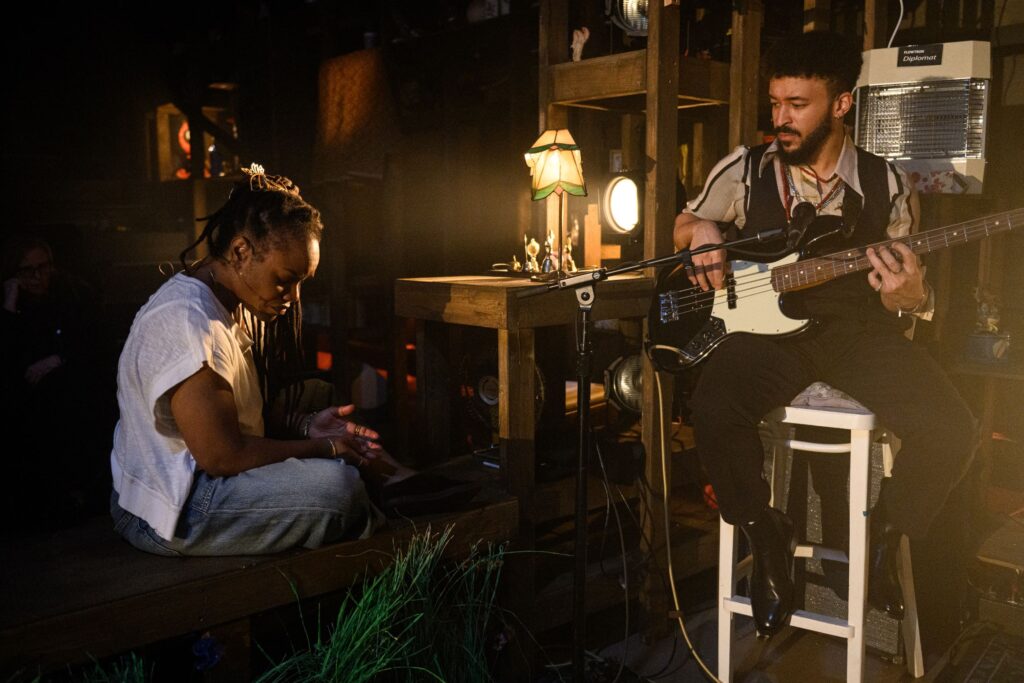
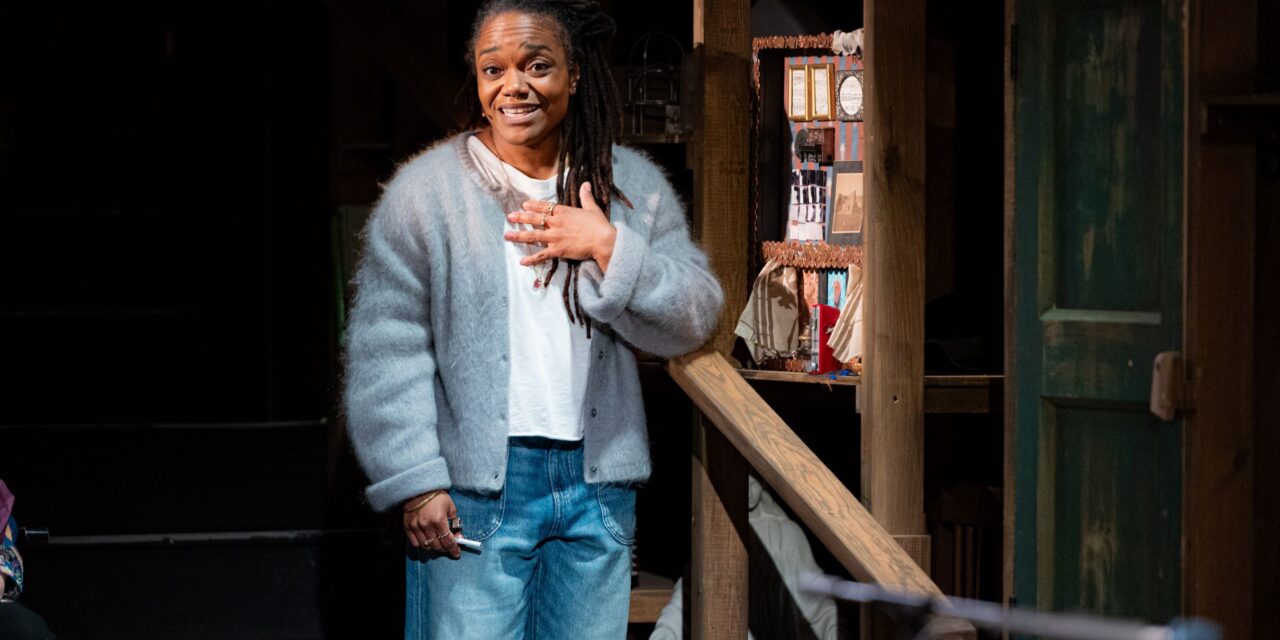
The superb, richly voiced Kenita R. Miller is “H.” Accompanied by band members El Beh (cello), Alexandra Crosby (piano), Francesca Dawis (violin), Caro Moore (percussion), Kris Saint-Louis (bass), and Zack Zaromatidis (guitar), during the first hour of the production we learn about Christian’s home in Natchez, Mississippi. Through song and narration H conjures her great grandmother and grandmother in her matrilineal line (Ella, Heloise), employing the use of altars in Emmie Finckel’s intricate, wooden set design of lattice work and shelving, filled with curios and memorabilia that flanks the audience on two sides. The women were “New Orleans Catholics, who were musicians, suffered migraines and talked to dead people.” From the set, props, flickering lights and lamps interspersed throughout the set, we are massaged into Christians’ consciousness and experience her opaque mystery.
We learn events which reveal that H, just like Ella and Heloise, speaks to the dead, though Heloise speaks via the way of dream visitations. Through songs linked by H’s poetic explanations, we learn about two ghosts, Johanna (“the light”) and Victor (“the dark,”), that Kenita’s H talked to when she lived as a child in the deceased Victor’s house in Natchez. Johanna, an 11-year-old imaginary “angel” protector, helps H deal with the real dead person Victor when he shows up as a “dark” poltergeist. Victor, an organist who formerly owned the house, frightens her and telepathically imposes his name on her psyche when she tries to sleep in the room that once housed his pipe organ. The only other way she deals with him and the nightmares he causes, apart from running to her parents’ bedroom, is to sing to him which quiets his restlessness.
After H discusses her philosophical and spiritual approach toward her life’s journey, she launches into the personal revelation of the woman who impacted her creativity and musical inspiration, her piano teacher Doris, who told her the song she wrote as a child was “monotonous.” Discouraged, H tells us she never wrote a song again until she was 21-years-old. Her various interactions with Doris are enacted humorously by the band members in wigs and smocks because every time Christian’s H visits, “Doris wears a different wig.”
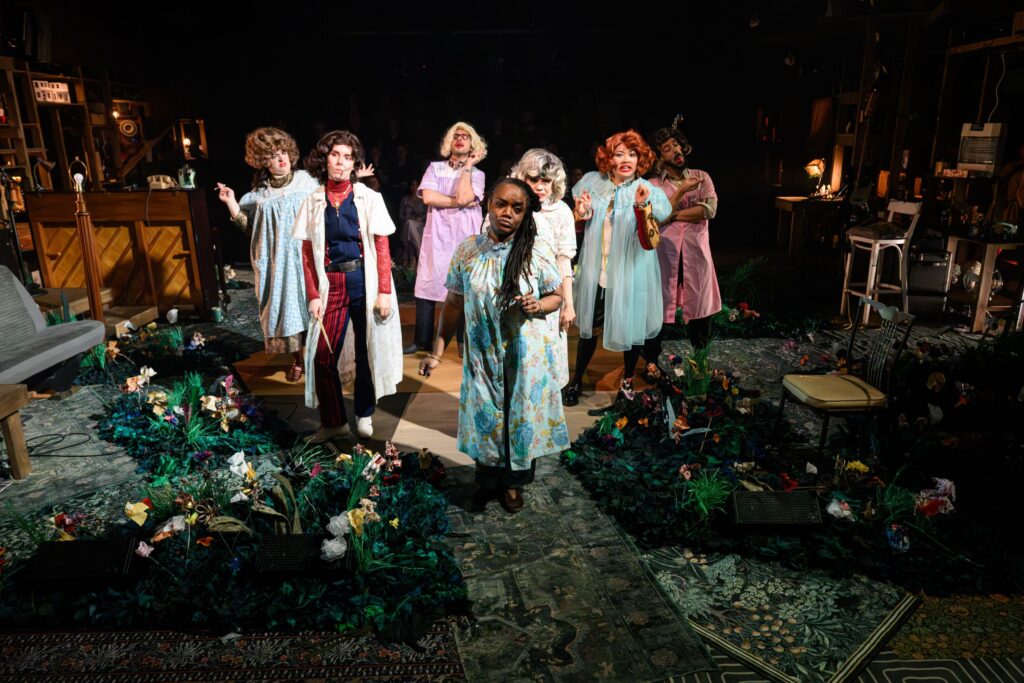
Doris’ impact on her life and music is only magnified by her astounding godfather Myles (a bachelor and bon vivant who once dated Sophia Loren). His spirit inhabits the theatrical space via Caro who becomes his physical proxy. Even more exceptional than Doris, H tells us that her godfather was a linguist with a Ph.D. who was a spy and code breaker during the war. When she was three, he “taught her to read from an illuminated copy of the Rubayait,” and together they “name trees and rocks” and compete with puns. Through him she learns to love words. In an opaque turning point where H has 4 dreams of Myles, she tells us she flies to Louisiana to find he is in a “home” in New Orleans. His being has become like an empty cicada shell.
At this point H mentions her wedding was visited by “a swarm of 7 year cicadas” and it was as if Myles “had thrown his ghost into confetti pieces and was in each and every one of them making a huge ruckus.” But she can’t understand what this genius linguist and lover of words and life is saying to her. And from this moment on, it’s Angus Dei (“Lamb of God”) as Christian turns to the sacred, personal, sacrificial section of her mass/requiem. The remaining work becomes the expiation of her intimate emotions, grief, loss and mourning expressed in folk, ballad and rousing gospel music, involving the production’s community choir members.
In program notes, Christian states, “It’s my life story, as clearly as I can tell it (which is not very clearly at all).” Thrillingly, the music and lyrical poetry bring together tropes about life and death and communing with ancestral spirits to heal. The gospel hymns and vocal harmonies build to an audience immersion in darkness and return to the light in a joyful finale. Christian’s innovative work suggests the function of theater is a process of reconciliation which she invites the audience to interact with and be a part of.
Animal Wisdom runs two hours without an intermission at the Signature Center’s Romulus Linney Courtyard Theatre through June 14, 2026. https://order.signaturetheatre.org/events?view=list
Photos by Ben Arons