Review by Ron Fassler . . .
The early 20th century playwright Elmer Rice, born Elmer Leopold Reizenstein in New York City in 1892, had two dozen plays produced on Broadway in his lifetime over an impressive five-decades. As a student, he loved writing but due to family pressures had to drop out of high school. He skipped college entirely and went to NYU Law School (you could do that in those days, I guess) and went on to practice law and write plays. At age twenty-three, his melodrama On Trial (1914) premiered on Broadway and ran nearly a year which, back in the golden days of 70 Broadway theaters (there are only 41 today), constituted a hit. The encouragement allowed Rice to double down on his legal knowledge writing two more plays, For the Defense and It’s the Law. Though neither were successful, he hit pay dirt again with Counsellor-at-Law (1931), starring Paul Muni and made into a film two years later with John Barrymore. Along the way there were other hits like Street Scene (1929), which he not only directed but also brought him the Pulitzer Prize. Yet it is The Adding Machine (1923), despite only a two-month run that has cemented the playwright’s reputation. An experimental work with its roots in Germanist expressionism— and written in seventeen days—proved far ahead of its time. Audiences didn’t know what to make of it, but Brooks Atkinson, then the dean of American critics, certainly did. He would go on to call it, “the most original and brilliant play any American had written up to that time . . . the harshest and most illuminating play about modern society [Broadway had ever seen].”
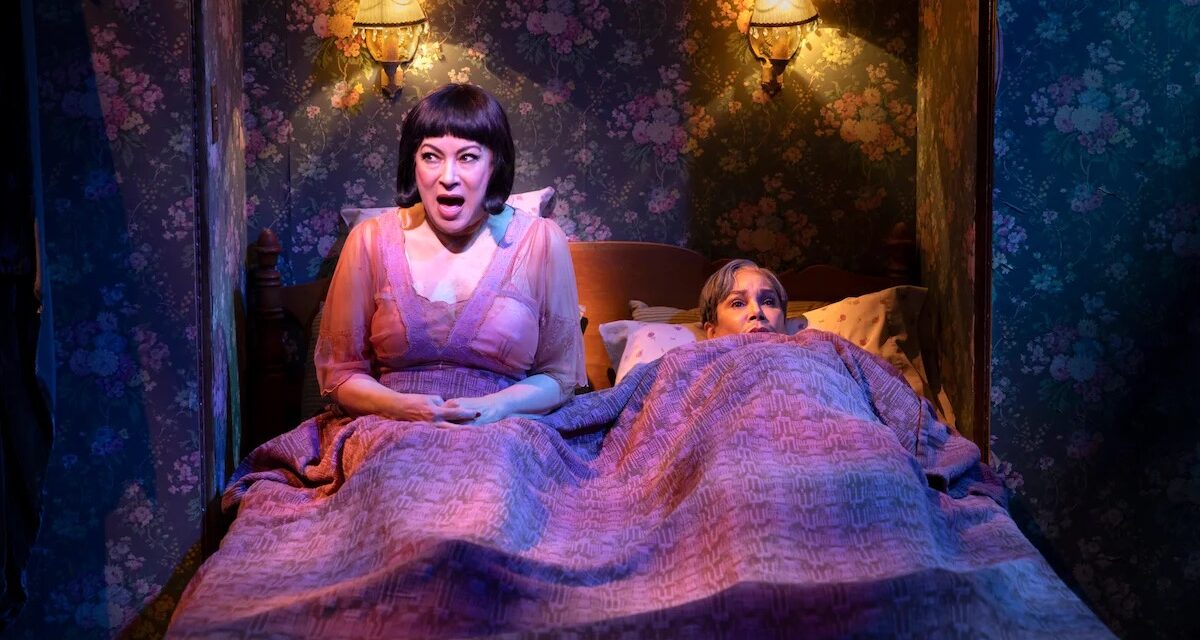
And now, 103 years later, The Adding Machine is being presented by the New Group in their new home at Theatre at St. Clement’s on W 46th Street. With “revisions” by playwright Thomas Bradshaw and as staged by the New Group Founding Artistic Director Scott Elliott, Rice’s play has been given not so much of an update as a facelift. Its protagonist is Mr. Zero (Daphne Rubin-Vega), whose diminutive stature is stuffed into an ill-fitting wig and muddy brown three-piece suit to transform her into something close to the Incredible Shrinking Man. Zero’s wife, Mrs. Zero (Jennifer Tilly), is a shrill shrew who gives him even less satisfaction than his dead-end job of 25 years, adding figures for a non-descript corporation. When he finds out that he is being replaced by an adding machine, Zero’s barely concealed rage boils over and he murders his boss (Michael Cyril Creighton, playing roughly 20 roles). In the play’s second act, set in the Elysian Fields— named for the afterlife in Greek mythology—Zero gets a chance to make good on his repressed desire for his co-worker, Daisy (Sarita Choudhury), who he meets up with after she has killed herself by sticking her head in the oven days after Zero’s execution. But Zero, doomed never to learn anything and continually suffer as a slave to industry, must return to earth as it’s explained he has done repeatedly, due to an endless series of self-inflicted fuckups (he’s a misogynist and a racist, among other ugly “ists”). It’s a grim little story upon which Rice inflicts pockets of humor so as not to entirely alienate an audience. When I was first introduced to it in college in my American Drama class, it fascinated me and I’ve longed to see it staged (I did see its 2008 musical version off-Broadway, which established David Cromer outside his native Chicago). Of course in 2016 it’s timelier than ever with AI replacing more jobs by the minute; similar territory to when the adding machine came along, moving well beyond the human ability to mentally add four columns of figures at a time.
Going back to the text to see what changes Bradshaw has introduced reveal a reverence for what Rice first wrote. Besides condensing what was once a cast of twenty to four, Bradshaw has left closely intact a bitter monologue Zero performs at his trial in which he delivers a rant using racial slurs that include the “N” word, as well as other numerous epithets. Added is Zero’s actual being electrocuted to close the end of the first act, which offers a genuine jolt. For the most part, we get the original dialogue which include such gems as “I have to search just to prove I exist” and “The mark of the slave was on you from the start.” Unfortunately, one thing Bradshaw has chosen to go with is a narrator (Creighton) who is wholly unnecessary. It’s also distressing that the actor doesn’t seem comfortable doing it, though he does acquit himself well hiding behind voices and sketch-like characters the rest of the play to keep the cast size down to something producible (which may be this production’s ulterior motive).
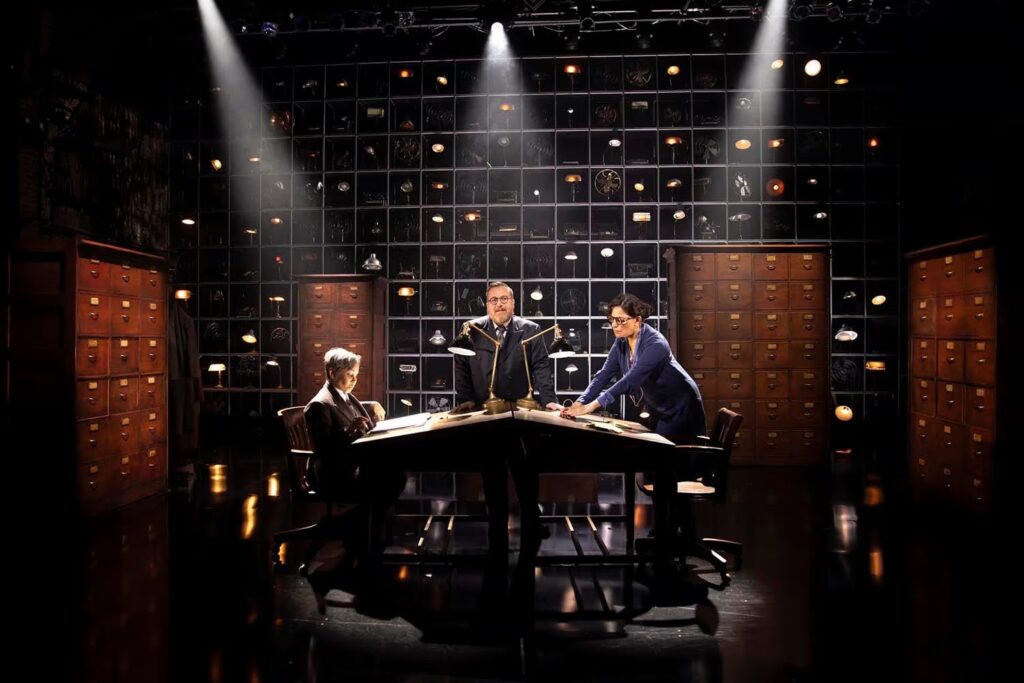
At first, Rubin-Vega appears somewhat insecure portraying a man, but gradually her approach to the part grew on me, as did the idea of a woman playing a man. Ultimately, the casting lent a touch of universality as well as a surrealness which compliments the play. Jennifer Tilly, so effective in many wonderful screen roles over the years (Bullets Over Broadway, Bound), might yet settle into the role of Mrs. Zero. On opening night, it felt like she’s fallen into the trap of portraying the character too one-note and on the nose. The best performance comes from the actor with the least amount of stage time (only two scenes), Sarita Choudhury. Expressive and natural, one can only surmise that director Elliott left her alone while perhaps micro-managing the others, who all force things at times. It’s not the strongest directorial hand, despite a nicely conceived set (Derek McLane), which consists of antique wooden filing cabinets, desks, and chairs, set against a two-story back wall of old table lamps, fans, and other accoutrements of early 20th century office life. Costumes by Catherine Zuber add spice and variety all while projecting dullness (a neat trick), and Jeff Croiter’s lighting is appropriately moody and evocative.

The Elysian Fields scene is not only the best in the play, but the best acted as well. Creighton plays a character named Shrdlu, originally played by a thirty-year-old Edward G. Robinson before fame and fortune in Hollywood, and manages to channel something uncharacteristically subtle and touching. He is aided by Rubin-Vega and Choudhury, who bring deep yearning, sexual desire, abject fear, and a creeping danger that are most effective.
Does The Adding Machine add up to something worth seeing? Despite the flaws delineated here, I think so. Just don’t hold me accountable.
At Theatre at St. Clement’s, 423 W. 46th St., New York; https://thenewgroup.org/events/the-adding-machine-2026-04-15-700-pm/
Photos by Monique Carboni.
Headline photo: Jennifer Tilly and Daphne Rubin-Vega.