Review by Stuart Miller . . .
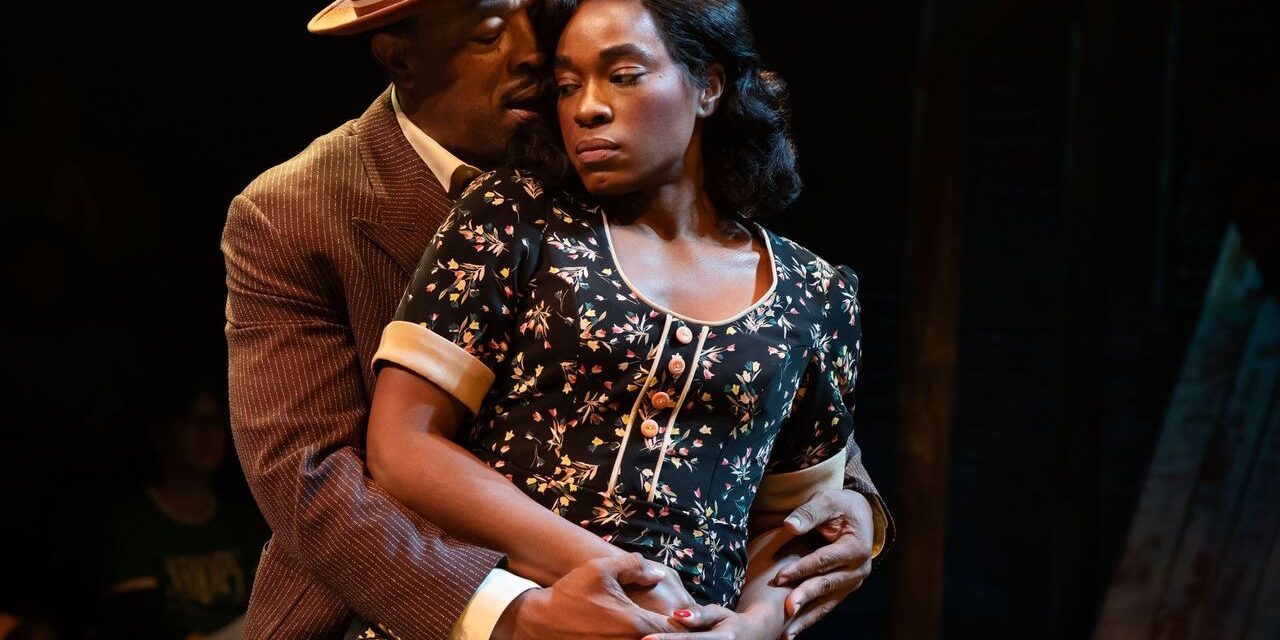
For the third time in thirty years, Ruben Santiago-Hudson has returned to August Wilson’s Seven Guitars, which opened tonight at the Mitzi Newhouse Theatre at Lincoln Center. The director has delivered a masterpiece, a sizzling, emotionally rich revival with perfect casting that constantly crackles with life. It is everything a Wilson play can be and should elevate this underrated play to join more famous works like Fences and Piano Lesson near the top of the Wilson canon.
Thirty years ago, Santiago-Hudson won a Tony Award for Best Featured Actor for his dynamic performance as Canewell in the play’s original Broadway production. Since then he has become the nation’s preeminent interpreter of Wilson’s works: he acted in Gem of the Ocean and was nominated for another Tony earlier this year for his work in a revival of Joe Turner’s Come and Gone, which he’s currently adapting for the screen, having already written the acclaimed screenplay for Ma Rainey’s Black Bottom. As a director, Santiago-Hudson has helmed a previous production of Seven Guitars as well as The Piano Lesson and Jitney.
Wilson wrote ten plays (nine set in Pittsburgh) in his American Century Cycle and Seven Guitars, set in 1948 captures a moment in time after World War II but before the Civil Rights movement when Black America was starting to more openly chafe at the limitations and mistreatment imposed on them by white society. Those issues including police brutality and abuse as well as the limited economic opportunities for Black are ever present in the dialogue but Wilson embeds those topics so firmly in his characters’ experiences that the points never feel didactic.
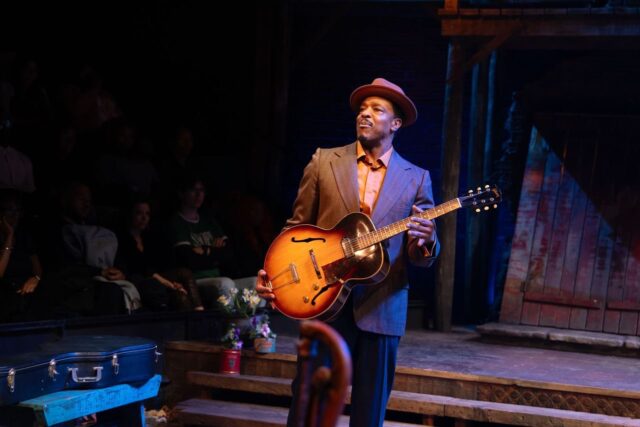
The show revolves around Floyd “Schoolboy” Barton, the effortlessly charismatic musician, whose funeral opens and closes the show. Floyd (Russell Hornsby) finally found musical success in Chicago, but when he came back to Pittsburgh, he was unjustly jailed for ninety days. He’s aiming to return to Chicago to reclaim his star status but needs to get his electric guitar from the pawnshop and persuade his ex, Vera (Kristolyn Lloyd) to take him back and follow him to Chicago. (On his first trip he ditched her for another woman.)
Floyd is determined to make it happen, even as things go awry. He delivers a monologue that seethes with the frustration that must have been so commonly felt in the community back then, a vintage piece of Wilsonian writing in its passion and rhythms:
“I had seven ways to go. They cut that down to six. I say, “Let me try one of them six.” They cut it down to five. Every time I push . . . they pull. They cut it down to four. I say, “What’s the matter? Everything can’t go wrong all the time.” They cut it down to three. I say, “Three is better than two—I really don’t need but one.” They cut it down to two. See . . . I am going to Chicago. If I have to buy me a graveyard and kill everybody I see. I am going to Chicago. I don’t want to live my life without. Everybody I know live without. I don’t want to do that. I want to live with. I don’t know what you all think of yourself, but I think I’m supposed to have. Whatever it is. Have something. Have anything. My mama lived and died she ain’t had nothing. If it ain’t nothing but peace of mind, then let me have that. My mama ain’t had two dimes to rub together. And ain’t had but one stick. She got to do without the fire. Some kind of warmth in her life. I don’t want to live in a cold house. It a cold world, let me have a little shelter from it. That’s all I want. Floyd Barton is gonna make his record. Floyd Barton is going to Chicago.”
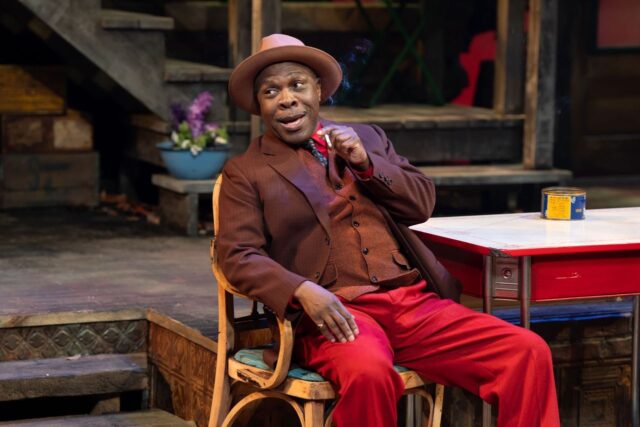
In addition to Floyd and Vera, the play’s backyard gatherings feature a finely detailed collection of friends and relatives.
Canewell (Daniel J. Watts) is a harmonica player and Floyd’s second banana, who also has feelings for Vera (which she may have been returning while Floyd was away).
Red Carter is Floyd’s drummer and friend, a recent father who named his recently born child Mister so white people would have to use a term of respect to address him. (Despite having multiple children, he still flirts nonstop with women of all ages).
Louise (Roslyn Ruff) is “forty-eight going on sixty,” thanks to her world-weary cynicism (although hope still flickers within), but acts as a mother to Vera as well as to Ruby (Chante Adams), her saucy niece, who got in man trouble down south and arrives to start afresh and to Hedley (John Douglas Thompson), her tenant, a West Indian man who has been haunted by mental illness and paranoia, who can turn to violence against man or animal. (He slaughters a noisy rooster at one point to prove a point.)
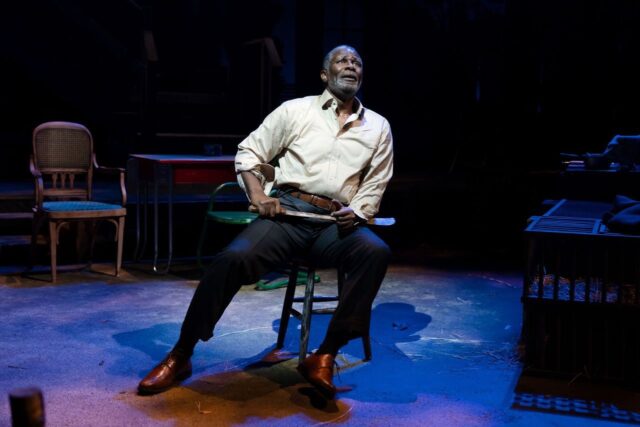
As the play builds toward Floyd’s inevitable death, the plot frequently stays on simmer as Wilson immerses us in the daily lives of his characters as they share their joys and bob and weave around their woes while trying to find their way forward toward fulfillment.
But that sentence is a little unfair to this play and this production: Wilson’s brilliant group portrait and Santiago-Hudson’s ability to elucidate great work from his actors, along with the stellar cast combine so beautifully that you won’t think of Floyd, Vera and the others as “characters” but as “people,” fully embodied, whose lives we just happen to be getting a glimpse of.
Hornsby and Thompson are the most riveting because Floyd and Hedley are the most troubled, and the most dangerous, to themselves and others (Thompson brings his unparalleled understanding of Shakespearean tragedy to Hedley) but everyone is superb. Watching Adams saunter down the stairs is a sensual adventure. Ruff creates an eyeroll with her voice when she speaks, without ever seeming too bitter and Potts holds his own against the memory of the brilliant Stephen McKinley Henderson in Santiago-Hudson’s previous production. Watts captures Canewell’s subservience but also his backbone and is heart-rending in his intimate moments with Vera.
If you watch the actors when they aren’t speaking—which is difficult because each line is delivered with such verve—you’ll see how spontaneous and fully engaged they always seem. When Vera learns a secret about one of the others, Lloyd’s eyes widen as if she has never heard this line uttered before.
Santiago-Hudson’s direction, like Wilson’s writing, is both imaginative—a stick figure chalk drawing of the city skyline looms above the action—and grounded in earthy realism. This includes the simple but homey set but goes all the way down to the chickens that Hedley kills to make sandwiches to sell. There are two live chickens, Marcy and Stevie, in the play, which means that when Hedley kills the (fake) rooster, the moment is infused with more power. How do I know the chickens’ names? Well, attention is paid even to them—check out their cleverly written (presumably ghostwritten) bio in the Playbill’s Who’s Who.
At the Mitzi Newhouse Theatre, 150 W 65th Street, NYC. For further information visit Seven Guitars.
Photos by Julieta Cervantes.