Review by Ron Fassler . . .
In the published text of Bruce Norris’s Downstate, which opened last week at the Booth Theatre, the setting is described as “A group home for sex offenders, downstate Illinois: a single-story house, built in the 1950s or 60s, now deteriorated.” What occurs in that one setting over two hours can only be described as devastating. With roles for eight speaking characters, Norris delves into a world few people want to think about, let alone experience. This production, which originated at Chicago’s Steppenwolf Theatre in 2018, certainly offers its share of pain and suffering, but it also employs a steely wit.
Anyone who has seen Norris’s earlier plays, including the Tony- and Pulitzer-winning Clybourne Park, will attest to his skill as a provocateur. Cleverly sidestepping didacticism, he still manages to poke you in the chest in a way that can leave a bruise. If that’s not your idea of a great evening in the theatre, stay away. If you’re made of stronger stuff, hold on tight: theatre doesn’t get much better than this.
A play about sex offenders will instantly turn off a certain segment of the public. It is, after all, a subject few may choose to think about or see dramatized. The fear that a playwright may be asking you to sympathize with people often categorized as monsters isn’t trivial. But that’s not what Norris is asking for. He’s interested in forcing you to look closely at what comes after offenders have served their debt to society. Where do they go? How do they live? Which guardrails are proper, and which are odious? It’s not a question of forgiveness but of practicality. Most offenders will eventually be released, and we can’t simply lock them away forever.
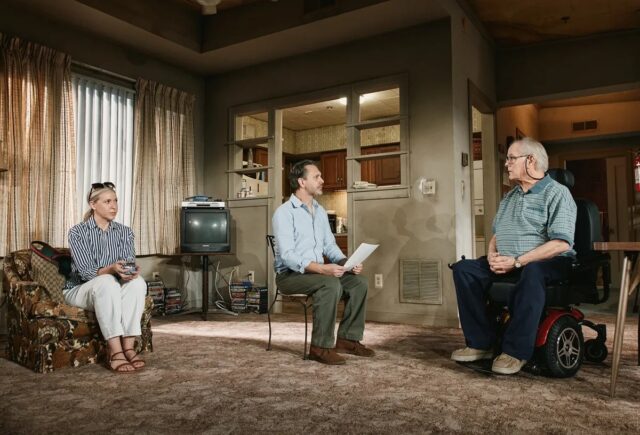
Norris plunges into confrontation the moment the play begins. Andy (Thomas Sadoski), a man in his 40s, reads from a piece of paper to Fred (Francis Guinan), a resident of the home and his former piano teacher, who abused him at age twelve. Fred, described in the text as “not unlike Fred Rogers,” sits in a wheelchair and willingly submits to the interrogation. Andy’s wife, Em (Cassie Beck), is there for moral support and is quicker to anger than her husband. Andy continues to relive his trauma, which has pushed Em into a codependency that has left her worn to shreds. Perhaps Andy gets what he needs from Fred, perhaps not. After a time, they leave.
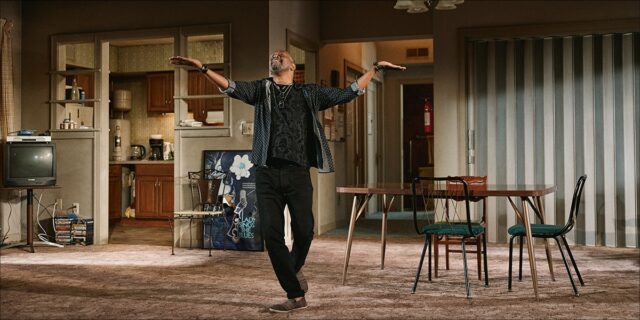
Other offenders who live in the house are introduced in this first scene: Felix (Adrian Martinez), “40s, Latino, heavyset, solitary, silent, and Gio (Al’Jaleel McGhee), “30s, Black, muscular, clean-cut, ambitious. But it is Dee (K. Todd Freeman), “Pushing 60, Black, thin, languid, who blisteringly commands attention from the moment he appears. Searingly witty, and brought to life in Freeman’s extraordinary performance, Dee is unlike any other character in my long experience as a theatregoer. He’s mordantly funny (“Well, you know, the job market is somewhat limited for the elderly black homosexual ex-convict”) and constantly pushes boundaries.
An overworked, weary Latina parole officer, Ivy (Liza Colón-Zayas), oversees the residents. In a scene where she lays out the dos and don’ts hanging over their heads, it becomes clear that their existence is one of harsh reality. Again, Norris isn’t asking for compassion but for understanding. Facts are facts: deal with them.
The play’s first act requires a fair amount of groundwork, but it finishes with a powerful exchange between Ivy and Dee, where the writing rises to a level of transcendence. As she tells him: “And I know y’all got the short straw, and I’m sorry about that, cuz y’all are fucked for life, and you’re never gonna change and that’s a cross y’all gotta bear.” The second act has more of the same, with scene after scene in which Norris gets to the marrow akin to a sudden drop in the stomach. It helps that Norris himself is a fine actor, with an innate talent for truthfulness and naturalism that lets his characters sing.
K. Todd Freeman ingeniously embodies the play’s most intriguing character. Dee is a wounded animal, and Freeman brings dimensions to him that might elude other actors. He should be at the forefront of any Tony Award discussions come spring. No less vivid are Francis Guinan and Thomas Sadoski, both at their career-best. Guinan has played Fred since the play’s Chicago premiere eight years ago, and on through its off-Broadway and London runs, and he brings everything he’s learned in a career of more than fifty years. Stuck in his chair, immovable, he draws you in completely. Sadoski’s straight-from-the-gut work is so painfully raw that it leaves you emotionally wrung out. It’s one of those “how does he does this eight times a week?” performances that appears effortless.
In his Broadway debut, Al’Jaleel McGhee captivates in every scene as Gio. Liza Colón-Zayas, a New York theatre actress to the core who was recently handed the gift of stardom by four seasons on Hulu’s The Bear, is brilliant in a welcome return to the stage. With a voice that commands attention, she is not to be messed with and easily conveys a woman who has seen it all and lives it one day at a time. Adrian Martinez, like Colón-Zayas a veteran of the plays of Stephen Adly Guirgis, is heart-wrenching as Felix. In smaller roles, Cassie Beck strikes the right balance of caring and stridency as Em, and Ivy Wolk is flawless as Effie, a motor-mouthed young co-worker of Gio’s.
Joe Mantello has replaced Pam MacKinnon as director of this production, and having seen both versions, I find it difficult to tell where one stopped and the other started, a testament to the strength of the original staging. Only Freeman and Guinan have been retained from the earlier casts, so Mantello clearly helped shape the work of the new actors, yet nothing feels specifically altered by his restaging. Scott Pask’s scenic design is strikingly similar to the one Todd Rosenthal created at Playwrights Horizons. It feels like a slight that MacKinnon receives no credit in the program, since she directed the play’s three prior productions and presumably worked closely with Norris from its inception.
How lucky are we to have a play this important on Broadway? Norris’s bravery is rarer than it should be these days, as he takes on the touchiest of subjects. That is not only commendable but essential to the arts. To “hold, as ’twere, the mirror up to nature,” in the words of the playwright who brought unprecedented insights to the psychology of man, is the theatre’s purpose, and Downstate does exactly that, and does it unforgettably.
At the Booth Theatre, 222 W 45 Street, NYC from now through February 14, 2027. For further information visit Downstate.
Photos by Emilio Madrid
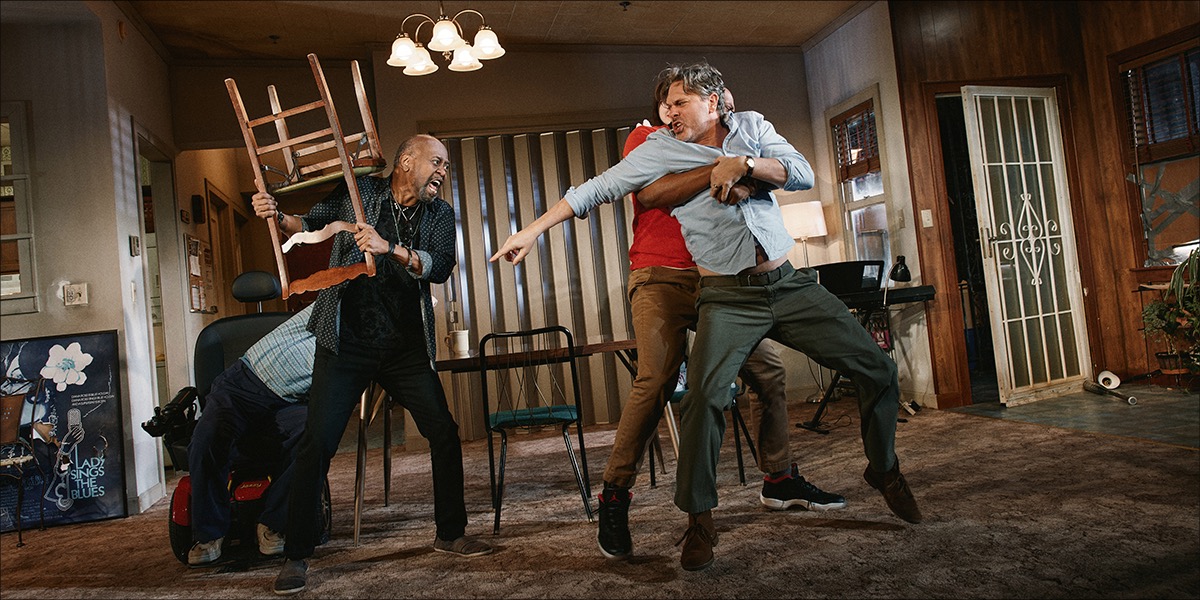
Headline photo: K. Todd Freeman, Al’Jaleel McGhee, and Thomas Sadoski.