Casual notes on show-biz books, memoirs and studies, dust gatherers and hot off the presses.
Book Reviews by Samuel L. Leiter . . .
Diana Forbes-Robertson. My Aunt Maxine: The Story of Maxine Elliott. New York: The Viking Press, 1964. 306 pp.
My current book project, focused on turn-of-the-twentieth-century American theatre in Brooklyn, necessitated immersion in the world of Broadway, a short distance away across the river. At the time, film-making was still a few years shy of establishing anyone as a so-called movie star. All the stars were still stage actors—some later to do films as well—who earned their national fame on Broadway, gaining wider recognition by touring the country in trains, playing small towns and major cities. Not every show had a famous star, and not every star was worthy of stardom; a hierarchy emerged in which only a relative few were considered box-office gold. Some traveled in the same plays year after year, but most always were seeking fresh material, with hit or miss results.
One way of reliving America’s Gilded Age of long-forgotten superstars, and learning about the theater of their times, is through the autobiographies many of them wrote, or the biographies written by others, either more or less contemporaneously or years later. Such books are often flawed because of research fallibilities, hagiographic biases, and literary lapses, but, more often than not, they offer an unparalleled pathway into the off and onstage lives of theatre people, their art, their personalities, their peccadilloes, their trials and triumphs, and the artistic, social, and political worlds they inhabited.
Over the coming months, as time and health permits, this column will examine the accounts of a series of beloved stars who entertained and enlightened our forebears a century and a quarter ago, when marquees blazing great names promised a grand time on the Great White Way.
We’ll start with the great beauty Maxine Elliott; her husband, comedian Nat C. Goodwin; Maude Adams, our first Peter Pan; boxing and theatre impresario William C. Brady and his elegant, Brooklyn-born wife, Grace George; titian-haired divorcée Mrs. Leslie Carter; classical genius Richard Mansfield; theatrical progressive Mrs. Fiske; Shakespeareans E.H. Sothern and Julia Marlowe; Polish-born French beauty Anna Held; William Gillette, the first Sherlock Holmes; John Drew, great-great uncle of Drew Barrymore; versatile Otis Skinner; “I Don’t Care Girl” Eva Tanguay; and leading African-American vaudevillian Bert Williams. You can skip the $2 admission fee, but you can pick up the tab for our after-theater supper at Delmonico’s.
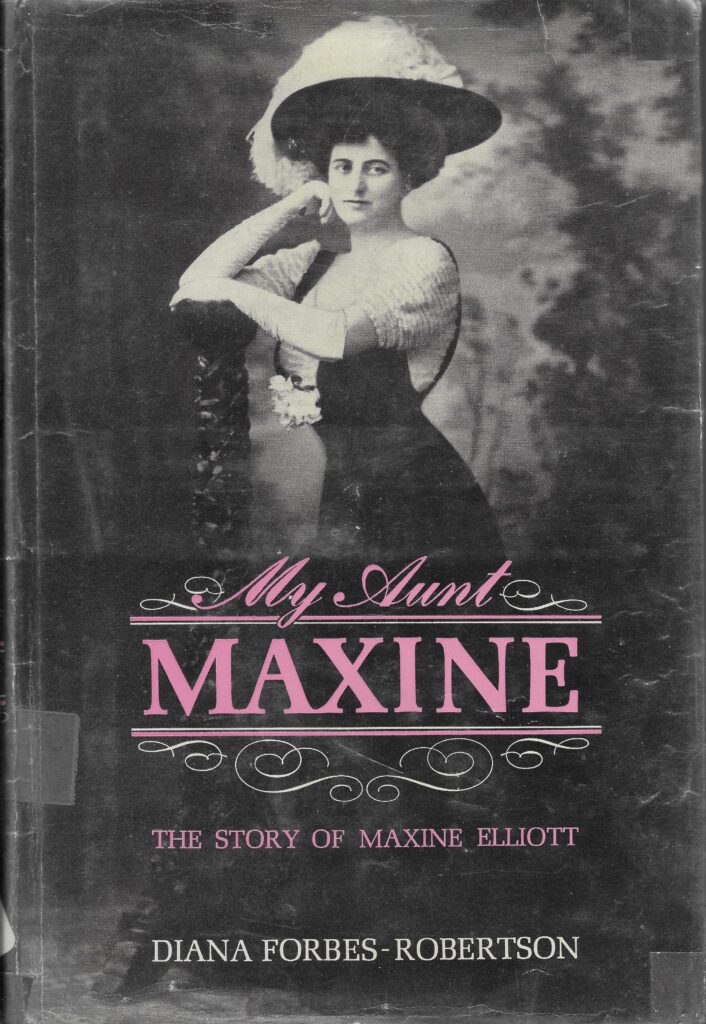
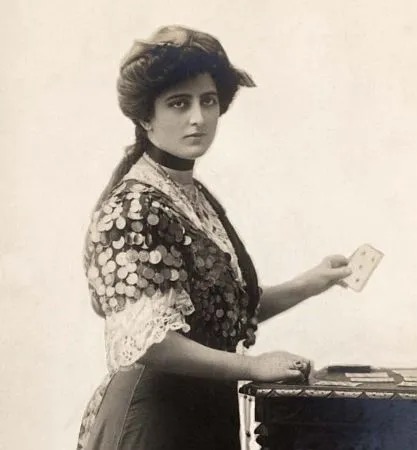
I said above that Maxine Elliott (1868-1940), born Jessie Dermot, the daughter of an Irish ship’s captain (originally MacDermott) from Rockland, ME, was a great beauty, that description being connected with her name in nearly every review of her acting over the three decades from 1890 to 1920. Looking at her photos today reveals how different are today’s standards from those of her Gibson girl heyday, when her buxom, statuesque bearing, noble features, and heavy brow inclined more to what we today might call “handsome.” To her contemporaries, however, she was one of the stage’s most exquisite and gorgeously attired figures, though her acting rarely matched the beauty for which she was celebrated; one admirer even called her a “Venus de Milo with arms.” In My Aunt Maxine, her niece Diana Forbes-Robertson portrays her life vividly, without the reluctance to expose painful episodes often found in a close relative’s account. Forbes-Robertson (1914–1987) was the daughter of Sir Johnston Forbes-Robertson, one of England’s leading actors, and Maxine’s younger sister, Gertrude Elliott. Maxine long supported Gertrude, who ultimately earned greater respect as an actress than her more celebrated sister.
Maxine was a diligent, highly responsible, yet not especially passionate actress whose career was long associated with that of Nat C. Goodwin, one of the most popular comic actors of the day. Considerably older than she, he lived a somewhat notorious life, gambling, drinking, and, allegedly, philandering, but nonetheless earning great sums that made the couple rich, with homes both in New York and England. They eventually divorced, he giving his side of the story in his unconventional memoir, Nat Goodwin’s Book, her story having to wait until her niece’s book, long after Maxine had passed, which doesn’t favor Nat, who ultimately divorced five wives. (Goodwin’s autobiography is next on the docket.)
Maxine, however, was not a seriously devoted artist; despite all the years of starring and touring, playing in both America and England, where she spent many of her later years, she grew tired of it. What she was good at, though, was making money, using her theatrical career and her business acumen to create the bank account of a multi-millionaire, enabling her to mingle with the grandest people, like Kings Edward VII and VIII (the Duke of Windsor) Among her coups was the building for her of Maxine Elliott’s Theatre, with the involvement of financier and close friend J.P. Morgan. She acted there only a few times though, preferring to enjoy it more for its earnings than its availability for her performances.
She owned a vast country estate in England called Hartsbourne Manor, and then had a magnificent, white seaside estate designed for her on the French Riviera by Barry Dierks. Called Chateau de l’Horizon, it was where she continued her lavish lifestyle (and avid bridge playing), smoking and eating as she entertained royalty, wealth, and the highest echelons of business, theatrical, and political society, from Thomas L. Chadbourne to Noel Coward to Winston Churchill.
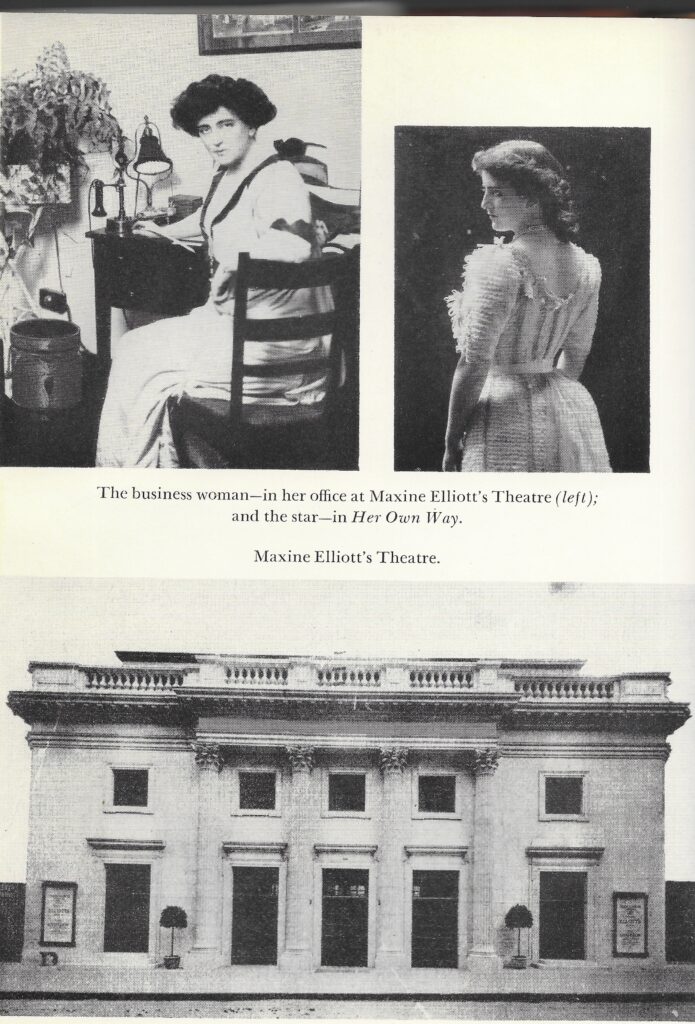
Forbes-Robertson does a superb job of recreating Maxine’s girlhood in Maine; her stage career, beginning with her debut at 22 in Henry Arthur Jones’s The Middleman and including her failure as Portia in The Merchant of Venice (a huge letdown for Goodwin as Shylock); her failed first marriage to an alcoholic lawyer; her tragic May-December relationship with tennis champion Tony Wilding, killed in World War I; her remarkable, self-activated deed of using a barge to bring provisions to needy Belgians during the war; her taste in fashionable clothes; her countless titled friends and endless dinners; her post-retirement avoirdupois; and all the other personal and professional ephemera to bring her subject, who died when Diana was fifteen, to life.
My Aunt Maxine also tells us much about Diana’s famous, but charmingly down-to-earth parents, Sir Johnston Forbes-Robertson and Gertrude Elliott. Her writing is psychologically incisive, her prose elegant yet compelling, and her warm humanity impressively accessible.
Maxine Elliott may not have been one of the great actresses of her generation, but she was unquestionably one of its great personalities, and her niece has given her a biography worthy of the distinction. As much a chronicle of a vanished world of theatrical celebrity, fabulous wealth, and aristocratic privilege as the story of an individual life, My Aunt Maxine is a rewarding theatrical biography, reminding us that the lives of those who once illuminated Broadway can sometimes be even more fascinating than the performances that made them famous.