By Carol Rocamora…
Jethro Compton’s enchanting adaptation of Fitzgerald’s classic reminds us that it’s not how much time we have, but what we do with it.
It’s a long way from Baltimore, Maryland, where the original story took place, to the wild coast of Cornwall, England. But Jethro Compton and his collaborators have embraced F. Scott Fitzgerald’s 1922 fantasy, transplanted it, and transformed it into a timeless Cornish folk opera, burnished with authenticity, beauty and wisdom.
The Curious Case of Benjamin Button, now beginning a luminous run at the Public Theatre after a successful West End stint in London, opens with the sounds of the sea and the banging of bells. The date is December 17, 1918, and something extraordinary has taken place in a tiny cottage high atop the cliffs of the North Cornish coast. A woman named Mary Button has given birth to a six-foot-tall wrinkly old man in a three-piece suit, wearing a bowler hat and carrying a walking stick. His first words: “D’you mind if I smoke?”!
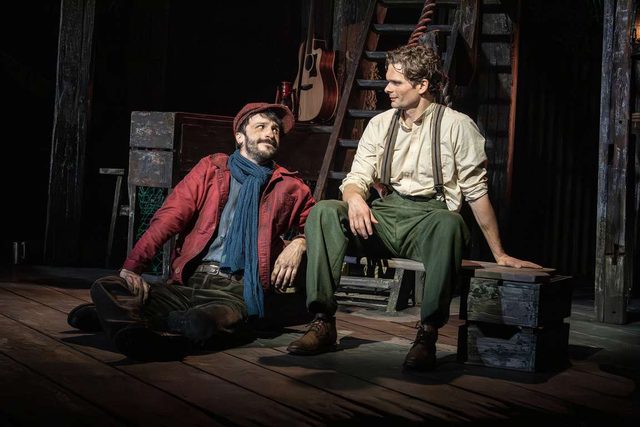
Mary and Roger Button, the shocked parents (Sachiko Mae and Brandon J. Ellis) banish their “son” to an upstairs room. Ashamed, Mary jumps off a sea cliff and commits suicide. Benjamin (Andrew Durant) spends a lonely decade doing crosswords with his dad, singing a sad song (one of many beautiful ones composed by Darren Clark): “I was born so close to dyin’/That it hardly seems worth tryin’ to even live/But all I want is to live a little life.”
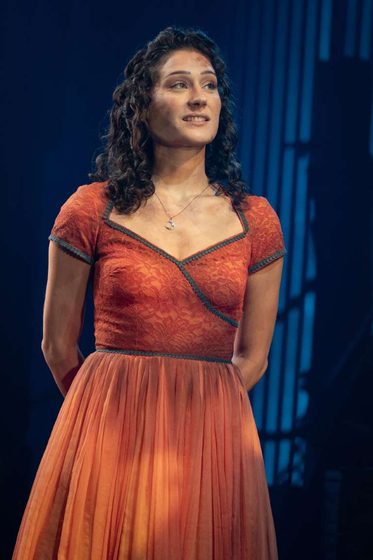
Foro the next two-plus hours, the remarkable story of Benjamin Button’s life “in reverse” is told, chapter by chapter. At the age of twelve, Benjamin (now age 59) leaves home for the first time, goes into the village, enters the Pickled Crab drinking house, and meets Elowen Keene (Kelsee Kimmel), a waitress and the love of his life. He visits each Friday for the next four years (Benjamin is now 55, Elowen is 20). They leave their respective homes but lose track of each other. Benajmin works for eight years on a fishing boat. History intervenes, and he enlists in the war. The night before he leaves (June 6, 1944), they meet again in a dance hall and spend their first night together. Benjamin becomes a father; they marry. In 1948, we see them playing with their young son Locryn (Kris Saint-Louis) on the beach. They. are now both the same age (40) for the first and only time. “Do you ever wish you could stop time?” Elowen sings to him.
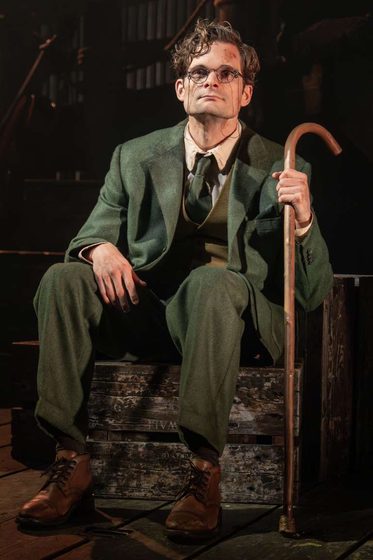
Two years later their second child is born, a daughter Lowen (Claire-Frances Sullivan), who dies in a tragic drowning at the age of seven. Devastated by guilt, Benjamin leaves his family in 1958 (at the age of 30) and sets out on a seafaring journey that would last more than five years. In 1963, at the age of 25, he returns to Cornwell, to find his middle-aged wife dying of cancer. “There’s still time,” she sings. “A life cannot be measured by its years.” –
Swept by the tides of time and fate, the play flows to its remarkable conclusion. At the age of nineteen, Bejamin moves into the spare room in his son Locryn’s house. Together they visit the Pickled Crab every Friday night. In 1972, at the age of seventeen, Benjamin become as grandfather. In 1978, at the age of ten, he and his granddaughter play on the beach (he also reconnects with his father, now 101). On December 17, 1988, Benjamin Button – “a child unlike any child who had been born before…or since” – no longer remembers anything.
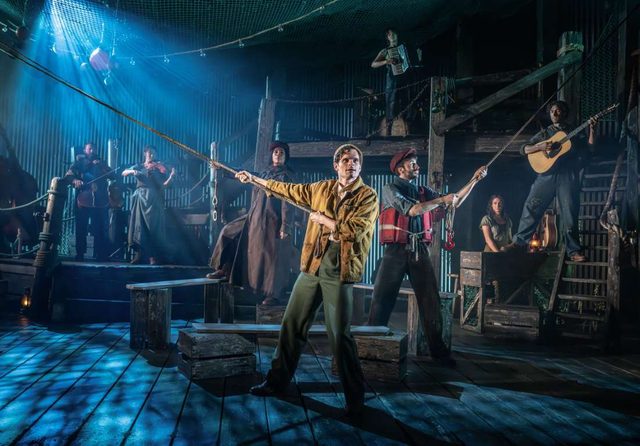
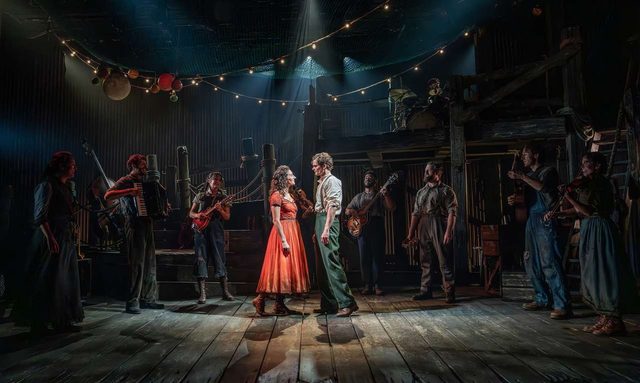
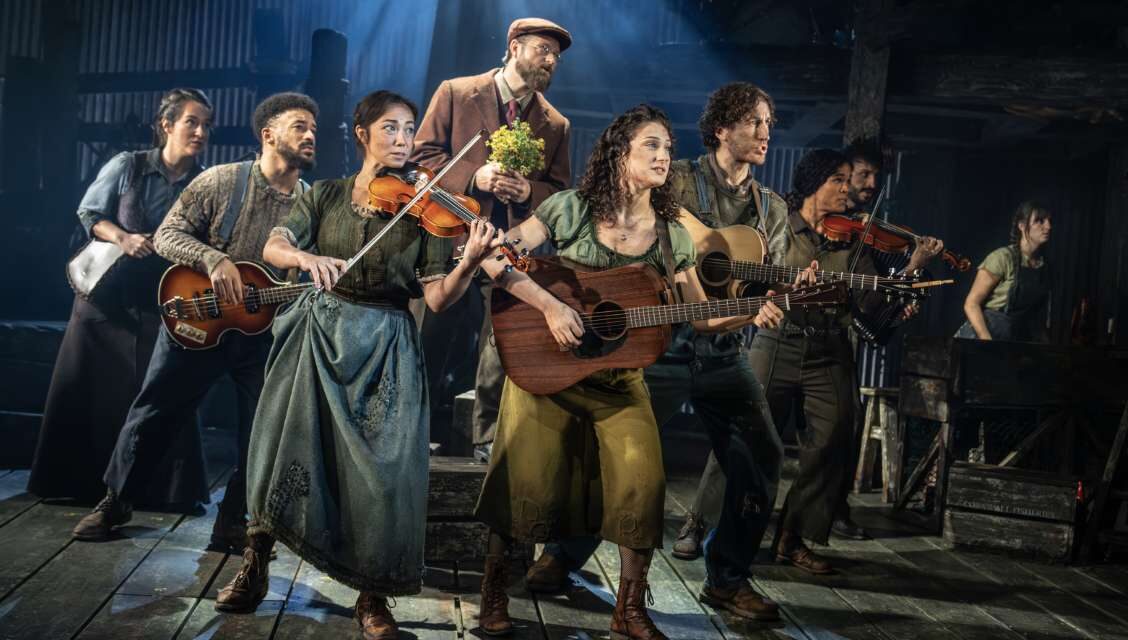
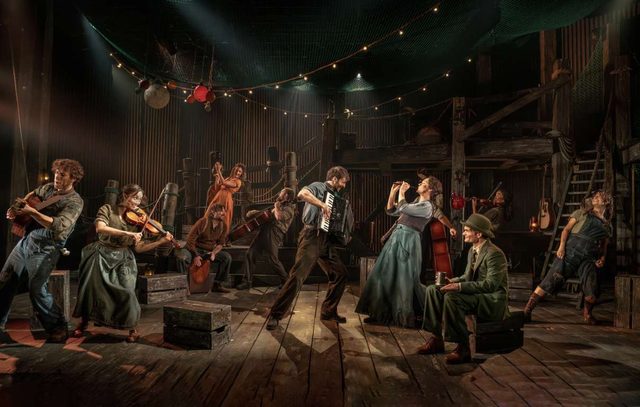
What makes this extraordinary tale soar is the lush melodic score (music by Darren Clark, lyrics by Clark and Jethro Compton). Like the sea, a pervasive symbol, it flows rhythmically and endlessly. A passionate, gifted company of eleven actor/singer/musicians sing the story. They are present throughout, moving with the music (choreography by Chi-San Howard), each of them playing an instrument (violin, mandolin, guitar, cello, tambourine, cornet, etc). A piano stands upstage on the floor of Jethro Compton’s set; a drum set is placed on the balcony. It’s a thrilling sight, as remarkable as the story they are singing.
Each actor/musician plays their fully defined part with passion and purpose. The intense Andrew Durant has the challenge of playing eight decades of Benjamin’s life in reverse, and he is mesmerizing to watch. Kelsee Kimmel plays the well-grounded, truth-telling Elowen with clarity and humor. Morgan Morse plays the charming Jack Trenlee, a twelve-year-old lad whom Benjamin befriends during his seafaring years: we follow Jack into his late twenties, as Benjamin ages in reverse. (Morse also shines as an accordionist).
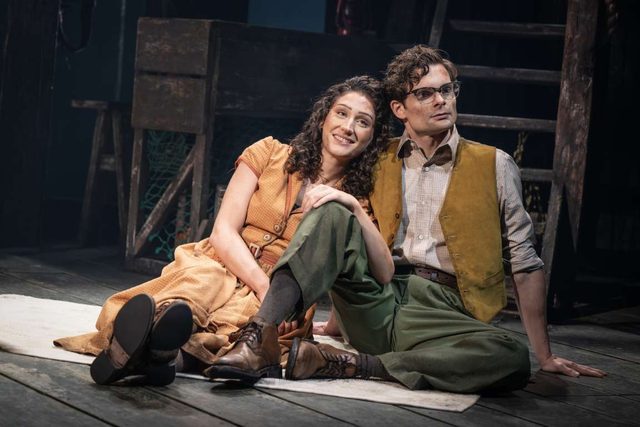
Jethro Compton infuses his script with the elements of nature, especially with the image of the moon and the sea in love. There are other rich symbols – like the letter in a bottle that Benjamin writes to Elowen and casts into the sea during his fisherman’s years. She never receives it, but Benjamin finds it twenty-two years later the other side of the Atlantic in Portsmouth, New Hampshire– a discovery that sends him home again to the dying Elowen.
Fate and nature factor strongly in this story that is, essentially, about time. “Time and tide wait for no man” is a leitmotif repeated constantly. “It’s just a matter of time,”: is another. The play is asking us to look at life and time in a new way. As the dying Elowen sings: “We have time…There’s still time…A life cannot be measured by its years…”
Above all, it’s the final chorus of this folk opera that makes it feel timeless and universal, as if it were a classic written long ago. You’ll be swept away on its transcendent wave of music and meaning:
“So here’s a toast to makin’ the most/Of what we do today….…it never mattered how/The journey starts or ends/Whether short or long/It’s not the time we have/but how that time is used… Whether we be among/The old or young/It’s what we do today.”
The Curious Case of Benjamin Button is running at The Public through December 20, 2026. Tickets and information: https://publictheater.org/productions/season/2627/the-curious-case-of-benjamin-button
Photos: Joan Marcus