Review by Ron Fassler . . .
There are times when you see a new play and, once the plot gets underway, find yourself wondering whether the playwright can balance the many issues and themes introduced. Will the play sink under the weight of its ambitions?
That was the feeling I had at David Zax’s Aftermath, which opened tonight at the Mezzanine Theatre at A.R.T./New York Theatres. Sadly, by the time it reaches its conclusion, the quartet of actors are spent and so is the audience—and not in a good way. In a program statement, director Colton Pometta says he has spent three years with the play. That’s surprising, since there are many holes in the plot that should have been plugged by now, and whatever tension it could supply is hampered by a 100-minute, intermissionless running time that feels too long. The play’s focus on how a mother, father, and son face a family tragedy together is a worthy one, but its execution falls short.
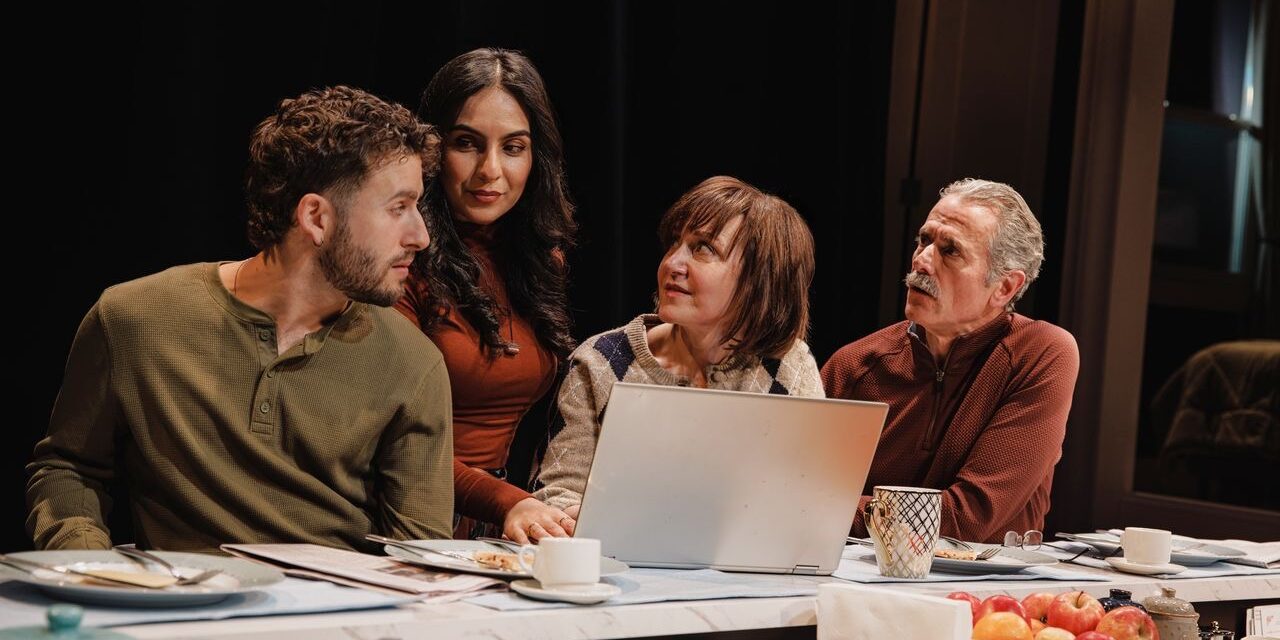
It’s 2011 in an upscale Washington, D.C. neighborhood. The Goldman home is a beauty (nicely detailed on Chen-Wei Liao’s minimal set), and Allan (Steven Skybell) and Linda (Jill Stern) appear to be a loving couple with a twenty-eight-year-old son, Josh (Danny Kornfeld). Though they call him Joshie, he calls himself Mac after his middle name, Macallan. A journalist, he’s home from what we soon find out has been a Taliban kidnapping in Kabul (strong stuff). With the aid of an offstage psychiatrist, Linda is the bad cop to Allan’s good cop, dogmatically enforcing a series of steps that must be followed so that Josh may find his way back to decent mental health. But once they intuit that Josh intends to return to Kabul and fulfill his original mission, horns lock and the fighting begins. The appearance of Mina (Awesta Zarif), a fellow journalist he met in Afghanistan, ends up more a device than a full-blown character, as her presence is required in order that certain secrets be revealed.
Without giving too much of the plot away, I can say the story asks what we are prepared to do for our children under the worst circumstances. Whose lives are worth saving more than others? Are all lives equal? What happens to a wealthy family that finds itself questioning what the piling of dollars after years of hard labor has amounted to? All important questions, but ones that require subtlety and nuance or else they become lectures.
Zaks is in rough territory from the start of the play with its first scene containing so much exposition that it almost borders on parody. Things settle a bit from there but become bogged down in the negative energy that Josh displays throughout. Of course, he’s a deeply traumatized character but in Danny Kornfeld’s performance, what we get mostly is petulance. A seeming lack of maturity mars Kornfeld’s work and keeps the audience from taking his side, which is strange, since he should be sympathetic after the torture he endured during his capture. As his mother, Jill Stern seems uncomfortable in her own skin. Another actor would have turned this into a choice, but it feels much more like an actor out of their depth (the program lists Stern as one of the main producers of Aftermath). Awesta Zarif is saddled with the most difficult character to pull off as Mina remains something of an enigma, or worse, a plot device. However, her poise and strong stage voice greatly help convince us she’s a real person.
Which leaves Steven Skybell as the father to basically hold the entire weight of this enterprise on his shoulders, leaving us with the feeling the play is really his. Fortunately, he is an actor of expert skill and delivers his usual best. He does what neither of the actors playing his wife and son can do which is comfortably live in the space, fill it vocally, and mine the subtext. A trained classical actor with Shaw, Chekhov and loads of Shakespeare under his belt, his Tevye, in the Yiddish Fiddler on the Roof, remains my favorite performance by anyone I’ve seen in this most holy of musicals. In fact, in early 2027 he will be reprising his Tevye, which he first started performing in 2018, at the Ahmanson Theatre in Los Angeles.
Colton Pometta’s staging is fluid, but the pace is slow, and the script could easily lose ten minutes, a cut the director should have encouraged the playwright to make. In addition to the commendable set that Chen-Wei Liao designs for the small stage, there are fine costumes by Räyya Gracy and appropriate lighting by Lucrecia Briceño.
The best plays (and the best-acted ones) are those that make you feel as if you’re witnessing something happening in real life, not on a stage. When those moments occur, you forget you’re in a theater and instead experience genuine behavior between people. To get there, the writing needs to sound authentic, and the director must stage it unobtrusively and guide the entire cast. Aftermath is not one of those plays.
Aftermath is at the Mezzanine Theatre at A.R.T./New York Theatres, 502 W 53rd street, NYC now through November 8th. For ticket information, please click here.
Photos by Marc J. Franklin.
Headline photo: Danny Kornfeld, Awesta Zarif, Jill Stern, and Steven Skybell in Aftermath.