Casual notes on show-biz books, memoirs and studies, dust gatherers and hot off the presses.
Book Review by Samuel L. Leiter . . . .
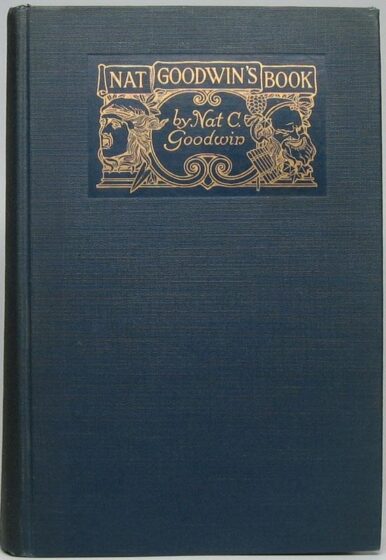
Nat C. Goodwin, Nat Goodwin’s Book. Boston: Richard C. Badger, The Gorham press, 1914.
Nat C. Goodwin (1857–1919), a name few other than theater buffs and historians remember, was one of Broadway’s best-known comic actors of the late 19th and early 20th centuries. One reason he’s remembered is that, physically ordinary as he was, he married five women of celebrated beauty, none more renowned than actress Maxine Elliott, who had a Broadway theater named for her (a “Leiter Looks at Books review of her biography preceded this one).
Goodwin was a regular visitor to Broadway, playing mainly in comedies, but, like most such actors, he hankered after recognition in serious work, his most successful venture being Clyde Fitch’s Nathan Hale, about the American patriot, his least successful being The Merchant of Venice, in both of which he costarred with Elliott. Other works closely associated with his success were A Gilded Fool, In Mizzoura, An American Citizen, and When We Were Twenty-One, all long forgotten but once great hits. His discussion of the ongoing struggle of a star actor to find suitable new projects is of great interest, as is his reflection of the interactions between managers (producers) and actors.
Beginning with the late 1870s and 1880s, he recreates the world of old Broadway, when Union Square was the theatrical center, soon to be replaced by Herald and then Times Square. He himself was a classic Broadway bon vivant, given not only to women, but to wine, and gambling. A member in good standing at the actor clubs, and an extremely wealthy man, he owned a handsome estate in England. He toured the USA frequently and was known from coast to coast.
Something of an outspoken eccentric, he provides an unusual, loosely chronological account of his life, much of it taken up with pithy portraits of the many stars with whom he worked (often sounding like banquet encomiums), but with room to spare for surprisingly vitriolic sniping at several famous names whose identities are left blank but will be clear to readers familiar with the period.
The chapters on Stuart Robson, John McCullough, Henry Irving, Joseph Jefferson, Charles Wyndham, Sol Smith Russell, and Richard Mansfield demonstrate the extraordinary theatrical circles in which he moved. These sketches are valuable both for their firsthand observations and for the prejudices they reveal. Goodwin was not shy about offering judgments on his colleagues. His diatribe against Richard Mansfield, who had died several years earlier at the peak of a brilliant career establishing him as America’s leading actor, will come as a shock to those familiar with Mansfield’s reputation.
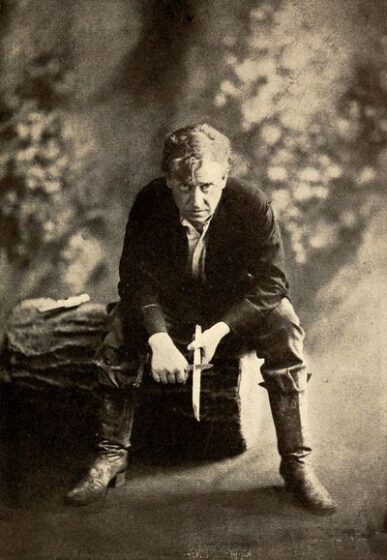
Goodwin talks extensively about his marriages, which were regular fodder for the press. His marital commentaries include extravagant incidents, disputes over money, accusations of infidelity, and complaints about newspaper sensationalism. While he alludes to Elliott’s flaws, he also allows for her popularity, acknowledging that as her fame ascended, it threatened to eclipse his and reduce him to a supporting actor rather than a costar.
Of particular interest is a chapter called “Why Do Beautiful Women Marry Nat Goodwin?,” in which he attempts to answer the question frequently put to him. His treatment is entertaining, if self-exculpatory. He often represents himself as an innocent or comparatively blameless participant in domestic disasters. Feminists will not be pleased.
He offers reflections on theatrical criticism, classical acting, the changing theatre, and his dissatisfaction with aspects of modern stage management, i.e. direction. When he talks about the critics he can be exceptionally cutting because of the harm they can do to an artist’s career; while he mentions no names it’s clear that he harbored especially angry feelings about William Winter, the conservative but widely respected dean of American critics.
The fulsome flattery of the senile, undersized critic who pens his truckling screeds at so much a column (but never again in the paper from which he was dropped) and has been doing so to my certain knowledge for over thirty years, is but the vapouring of his infinitesimal soul.
A contemporary reviewer in The Bookman said such unrestrained expostulations “quite takes away the breath.”
Goodwin reveals himself a strong supporter of the Theatrical Syndicate, the monopolistic enterprise for which most of his contemporaries had little but contempt, and provides interesting information on its early formation not widely shared elsewhere, including Goodwin’s own attempt to form a rival organization that collapsed when its leading participants abandoned him to sign up with the Syndicate. The benefits he derived from his association with it seem his primary motivation in praising its practices as benevolent.
Compiled from his memory alone, without even the use of notes, Goodwin’s book cannot be considered free of possible errors. But, even seen as an attempt to rehabilitate his public reputation, Nat Goodwin’s Book provides valuable revelations for those fascinated by turn-of-the-century American theatre, actors, touring, management, stardom, and famous productions, told candidly, if not without bias.
Warning: I read this book in an inexpensive modern reprint that arrived sans illustrations or index; the text was compressed to save pages. Skip it. Readers wanting the full experience can find original copies on eBay; a Project Gutenberg version can be found online free of charge, with the many illustrations intact.
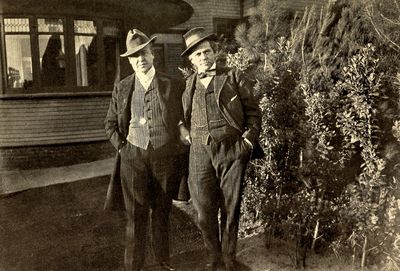
Headline photo: David Warfield, left, and Nat C. Goodwin.