By Alix Cohen’
In the classical theatrical tradition, the clown is a figure who exposes human folly, mocks authority, and reveals the absurdities of society through humor, satire, and foolishness. They are not all, as many believe, clumsy, red-nosed buffoons. In Medieval times, a jester might be the king’s advisor.
Charlie Chaplin proudly called himself a clown: “I remain just one thing, and one thing only—and that is a clown. It places me on a far higher plane than any politician” as does the marvelous Bill Irwin: “I love the word clown. I’m proud of it.”
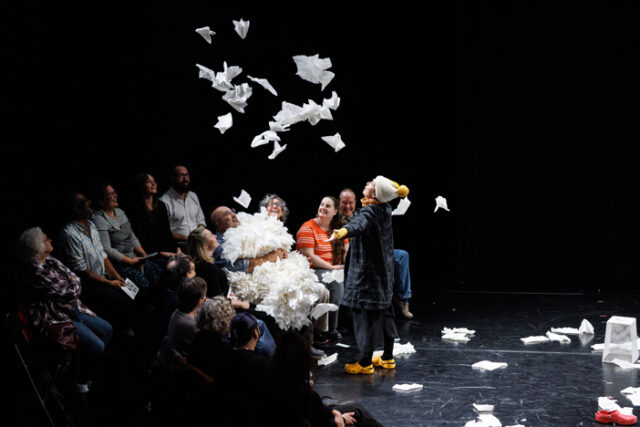
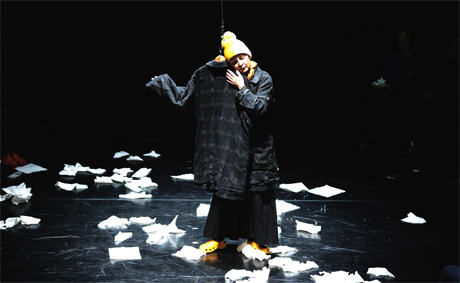
Wearing a black coat, wool pom-pom hat, and yellow Crocs, the mourner has her back to us, silently keening. She throws used tissue after used tissue over her shoulder. Blackout. We hear heart-rending sobbing/wailing. Lights up.
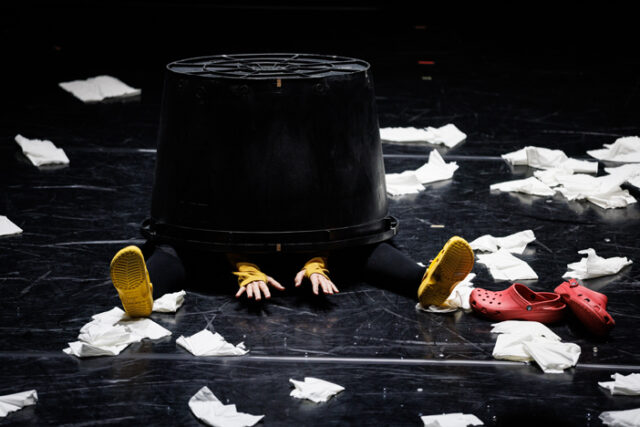
There’s now a HUGE pile of tissues, perhaps 6’ x 6’. She kneels and burrows under, coming out with a pair of red Crocs – belonging to the deceased. Each is held up to her ear. From one, she (and we) hears the sea, from the other, gulls. An audience member is offered a listen.
Asleep in the pile, his shoes on her chest, she kicks and tosses as if having bad dreams. Lights go on and off. We hear a heartbeat. Delicate piano ostinato accompanies waking.
The artist takes off and puts on her coat again and again and again, buttoning one button, placing hands in her pockets each time, unable to get past the familiar action. (Doing things on autopilot allows the brain to rest from the heavy emotional processing of loss.)
A small hand held pipe emits tiny bubbles that seem to literally float, fixed in the air. Tears? She pulls the heap of tissue (part of it woven into a blanket) over a woman in the front row, covering her. The stranger has a fit of giggles. Four legs walk out under the pile.
Play serves as a healthy distraction from grief. It allows the mind to rest, recharge, and step away from intense sadness without feeling guilty. It releases dopamine counteracting stress hormones and physically soothes the brain’s fear centers. (Analysis is an afterthought.)
GREEF is hypnotic. There’s not a rustle or cough during silent stage time. Music is wonderful. An audience member is often subtly drawn in. The artist is aware of and reacts to those expressions she can see in the front row.
A giant, black, plastic tub is rolled on its side in a perfect circle at the feet of attendees. She overturns it, adds a chair, and stands on top. Ta-da! Then, inverts and climbs inside the tub. A plastic, water-filled bag suspended from the ceiling rains shimmering streams. It’s a shower bath. (There’s a goldfish! What happens to the goldfish?!) A volunteer dries the artist.
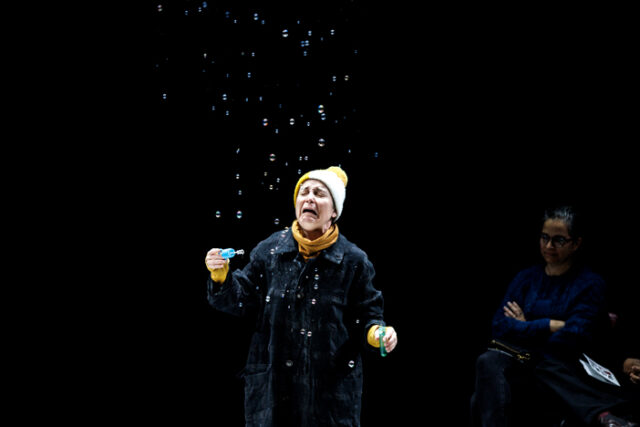
A clear bag filled with helium becomes an ethereal plaything. Untied at the bottom, it nonetheless hovers, wafts and bobs. At one point the bag forms a vase on her hand- narrow base, wide, open top. Lovely and ephemeral.
Twice the character constructs her lost love. She lays her head in a cluster of tissues “wearing” his hat and Crocs. She hangs a matching coat on the suspended hook, then dancing with the graceful torso.
Black and white Pierrot make-up is applied. There are recorded songs. She mimes Johnny Ray singing “Cry”: “If your heartaches seem to hang around too long/And your blues keep getting bluer with each song…” The performer pulls a blue paint sample chip from either pocket, one, needless to say, bluer than the other.
Christina Gelsone and her husband, Seth Bloom, performed together professionally for about 19 years, from 2005 until 2024. Seth died on August 2, 2024. We hear a short excerpt from an interview with them both.
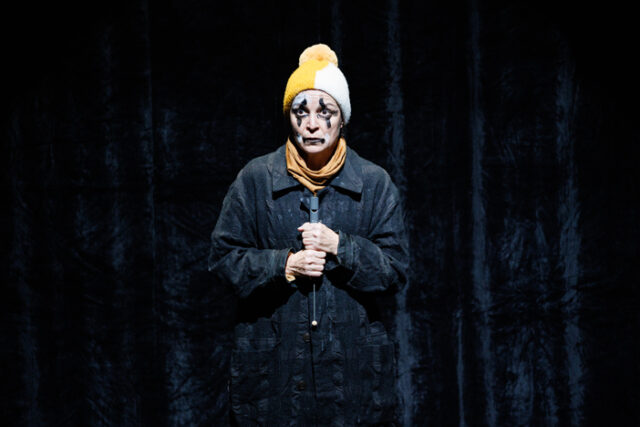
At the end, the character seems to absorb the memory of her love rather than battle against loss.
The piece is enchanting, moving.
There’s no credit for the music which was beautiful and apt.
Emily Dickinson’s “Hope is the thing with feathers”— a poem that compares hope to a bird that continues singing through hardship – might just as well begin, Grief is a thing…
Photos by Maria Baranova
GREEF –US Premiere
Created, written and performed by Christina Gelsone
Directed and Co-Created by Matthew Ferraro
Technical Director- Todd Alan Little
The Baryshnikov Arts Center 450 West 37th Street
https://baryshnikovarts.org/