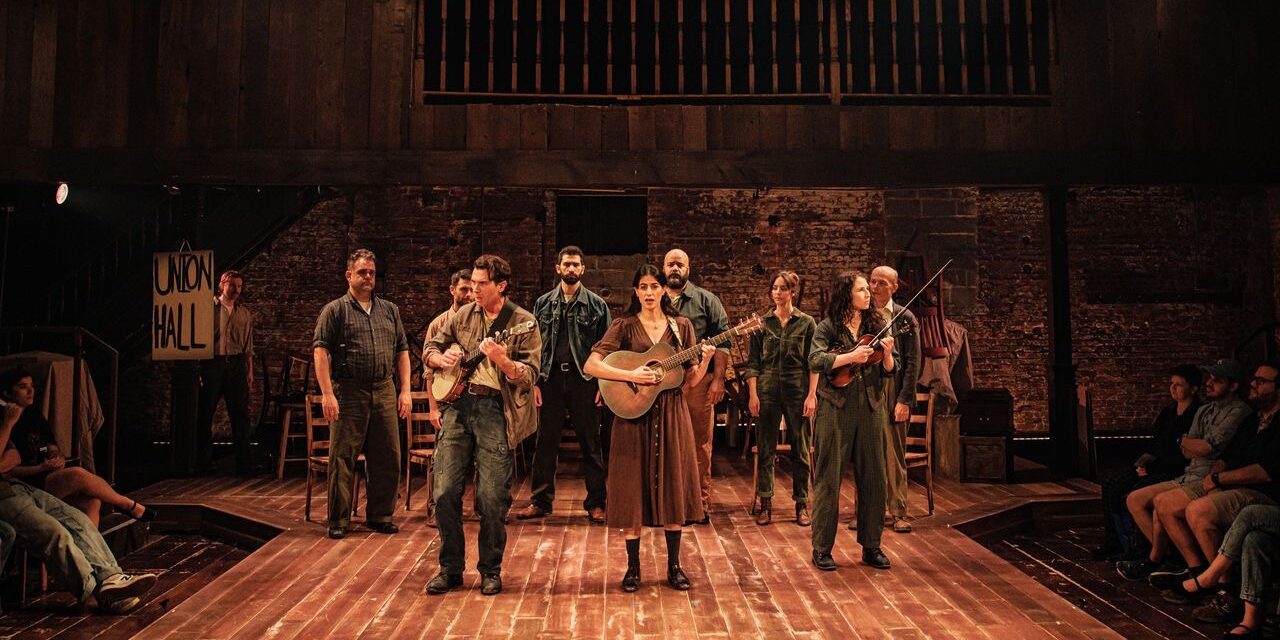
Clifford Odets’ Waiting for Lefty receives a major revival at Classic Stage Company.
Review by Ron Fassler . . .
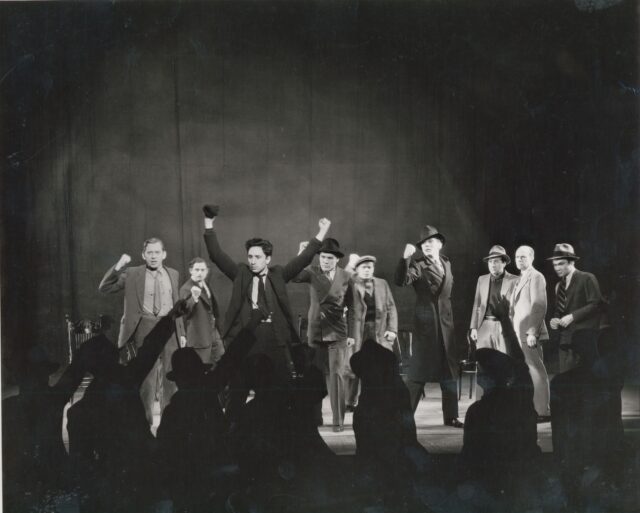
On January 6, 1935, at the old Civic Repertory Theatre on West 14th Street, a series of entertainments was presented as a benefit for New Theatre, a left-wing monthly theatre magazine. Among them was Waiting for Lefty, a one-act play performed by members of the Group Theatre, a collective of politically minded idealists whose membership now reads like a who’s who of American theatre. The company also included Clifford Odets, at the time an unknown actor turned playwright, who had been stirred by newspaper accounts of how mistreated, non-unionized taxicab drivers, out of their depth in the Great Depression, risked everything to go on strike for better wages. In a whirlwind of passion, Odets reportedly churned out Lefty in three days.
The benefit that night drew only one Broadway reviewer: Henry Senber, the second-string drama critic for the Morning Telegraph. This is what he wrote about Lefty in his review:
“One left the theatre Sunday evening with two convictions. The first was that one had witnessed an event of historical importance in what is academically referred to as the drama of the contemporary American scene. The other was that a dramatist to be reckoned with had been discovered.” He concluded, “It has not been announced just where and when Waiting for Leftywill be presented again, but you can rest assured that it will be … soon. A play like this does not die.”
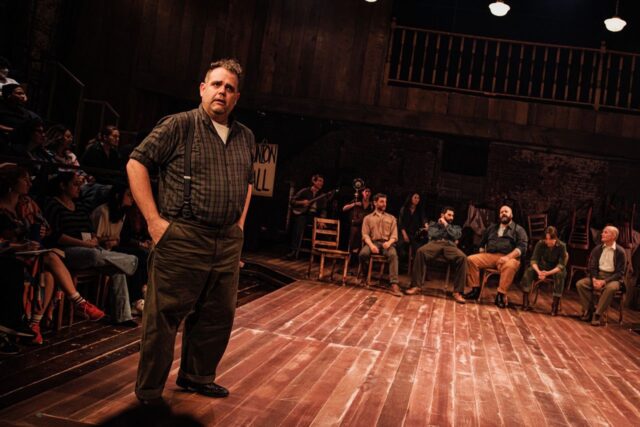
Barsoumian, Austin Durant, Tala Ashe, and Henry Stram in Waiting for Lefty. Photo by Marc J. Franklin.
An electrified audience gave the cast twenty-eight curtain calls. One of the Group’s founders, Harold Clurman, also wrote about it in his memoir The Fervent Years, describing the audience response as “the birth cry of the thirties.” Now, ninety-one years later, Classic Stage Company on 13th Street is making it possible to see Waiting for Lefty and experience in a similar way to what people felt on the verge of the second World War of the 20th century. It’s doubtful few at the preview performance I attended were unaware that a pivotal national election is just around the corner.
Actor Steven Pasquale, in his theatrical directing debut, does a superb job, focusing relentlessly on the message. He has assembled an exceptional ten-person ensemble without a weak link, and the delicate machinery of his well-paced staging comes off without a hitch. In book scenes, it’s no small task to pull off a line like, “Turn your gimlet eye elsewhere, Doctor. Jigging around like a cricket on a hot grill won’t help.” But Pasquale has made sure to cast actors with the ability to handle such over-the-top dialogue for which Odets is famous. Choreographer Susan Misner’s exquisite, interpretive movement is perhaps the show’s secret weapon. Misner has devised a fluidity of expression that is both startling and affecting. To stretch the show beyond its forty minutes or so, original and period music has been dexterously woven through the piece. Casting actors with musical theatre backgrounds, as well as some who are trained musicians, lends a keen level of professionalism throughout. Adam Kantor’s haunting rendition of “If I Had You,” written in 1928 by Ted Shapiro, Jimmy Campbell, and Reg Connelly, stayed with me long into the weekend, and E.Y. “Yip” Harburg and Jay Gorney’s “Brother, Can You Spare a Dime?” proved an inevitable yet equally poignant choice as a group number led by Austin Durant. Original music for the production is credited to Yeller Tooth, whom the program identifies as Sahar Milani and Cameron Scoggins. Both expertly act, sing, and play instruments in the show, alongside fellow musician-actor Doireann Mac Mahon.
Tala Ashe, Raffi Barsoumian, Austin Durant, Greg Hildreth, Adam Kantor, Henry Stram, and Zach McNally as the elusive Lefty, round out this first-rate company. The highest compliment to be paid is that they shine in a way that would make the Group Theatre proud.
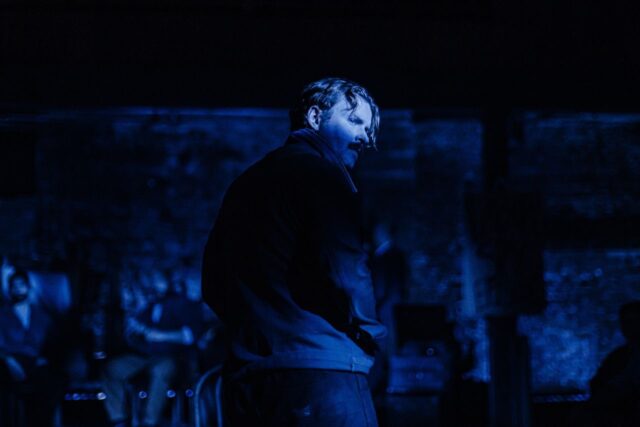
Scott Adam Davies rightly uses the whole CSC stage and its audience, with a profound assist from Mextly Couzin’s lighting design. There’s a warmth in the shafts of light she has created amid an unsettling coldness, and the two strike a perfect balance. Costumes by Márion Talán de la Rosa are properly distressed and help fashion an atmosphere of poverty and thrift. There is also a highly atmospheric sound design by Palmer Hefferan that makes us believe crowd scenes are far more full than what our eyes might see.
Toward the end of the play, a cabbie comes out of the audience, fairly bursting with a stinging diatribe. The character is identified as Agate Keller and was played in the original production by Elia Kazan, who was then still an actor. Later to become the director of such Broadway plays as Death of a Salesman and A Streetcar Named Desire, as well as films like On the Waterfront and East of Eden, Kazan wrote about Lefty in his 1988 memoir, A Life.
“We rehearsed Lefty without the supervision of an overlord; the performance was less directed than played . . . The production moved without the burden of analysis; it was energetic, light-hearted, bold, and sassy. And felt! The emotions were those in our hearts; anger at what existed, demand for a change, and confidence that the change—you know which—would come.”
As timely now as it was then, Waiting for Lefty can be scratched off my bucket list of shows I’ve waited a lifetime to see, thanks to Classic Stage Company with its most excellent production. But if next season it announces Life with Father, which remains Broadway’s longest-running play since closing after its nearly eight-year run in 1947, I could die a happy critic.
At Classic Stage Company, 136 E 13th Street, NYC now through November 26th. For further information, visit Waiting for Lefty.
Headline photo: Zach McNally, Greg Hildreth, Adam Kantor, Cameron Scoggins, Raffi Barsoumian, Sahar Milani, Austin Durant, Tala Ashe, Doireann Mac Mahon, and Henry Stram (by Marc J. Franklin).