Review by Stuart Miller
C-Span is not known for its dynamic dialogue. Even the most compelling and insightful hour of discussion and debate will feature circular talk and boring repetition of technical issues.
On the one hand, I understand the impulse behind Kramer/Fauci (now at St. Ann’s Warehouse) along with Daniel Fish’s decision to stage a verbatim re-enactment of a 1993 conversation between AIDS activist and writer Larry Kramer (Thomas Jay Ryan) and a leading AIDS researcher and government health official by the name of Anthony Fauci (Will Brill). We recently endured a public health crisis of even more epic proportions and again Fauci was front and center. (Nearly twice as many Americans have died from Covid since 2020 as from AIDS since 1982) And public health is in even more dire straits under Donald Trump redux, with Robert Kennedy Jr. toiling to wreck it all.
A play with Kramer and Fauci as fully developed characters, with this public showdown as a set piece, could have been riveting. This production may prove of interest to younger audience members (who were out in reasonably large numbers) who didn’t live through the AIDS crisis but it doesn’t hold up as a drama. Parts of the conversation are illuminating about the push and pull between an activist seeking a sense of urgency and a scientist who is inclined to proceed more slowly, especially since he’s part of a government bureaucracy. And Kramer’s fury at Fauci mixed with his admiration for him adds another layer of tension.
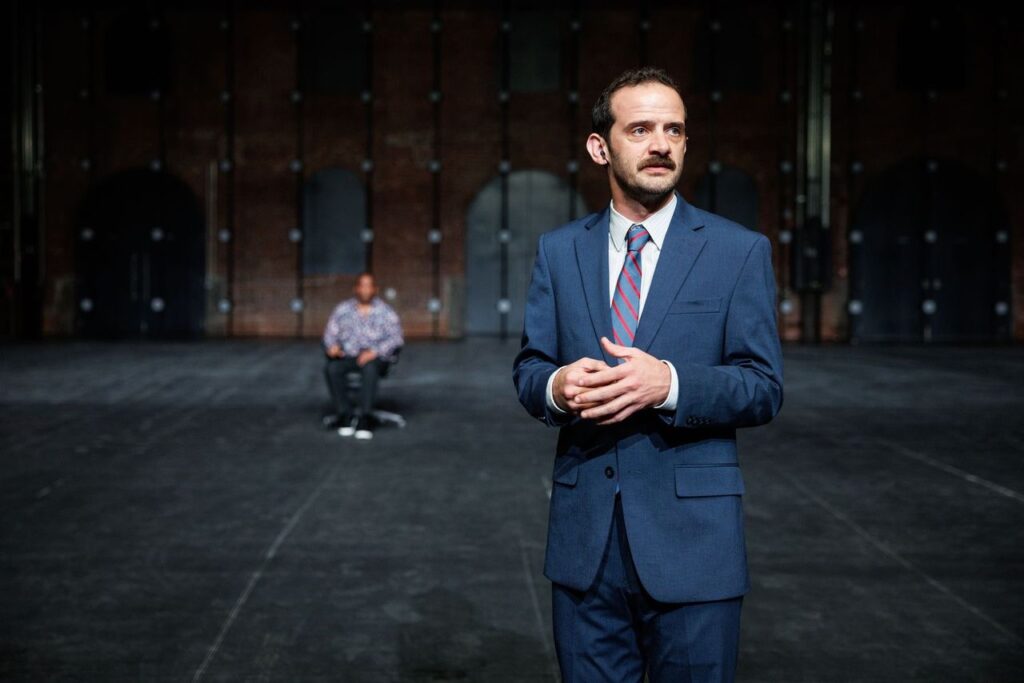
But this production fails to fully hold your attention, even for an hour in part because they are talking points not fleshed-out characters and in part because Kramer and Fauci repeat the same points and then are forced (as are we) to listen to boring clips played by the moderator (Greig Sargeant) and frustrating questions and comments from callers (Jennifer Seastone). The best twenty minutes of it would have been plenty. The performers are all fine and Ryan’s emotional ups and downs grab you, but they all stumble over lines occasionally and I can’t tell if that’s on purpose because the real people had those hiccups or because they were really botching a few lines.
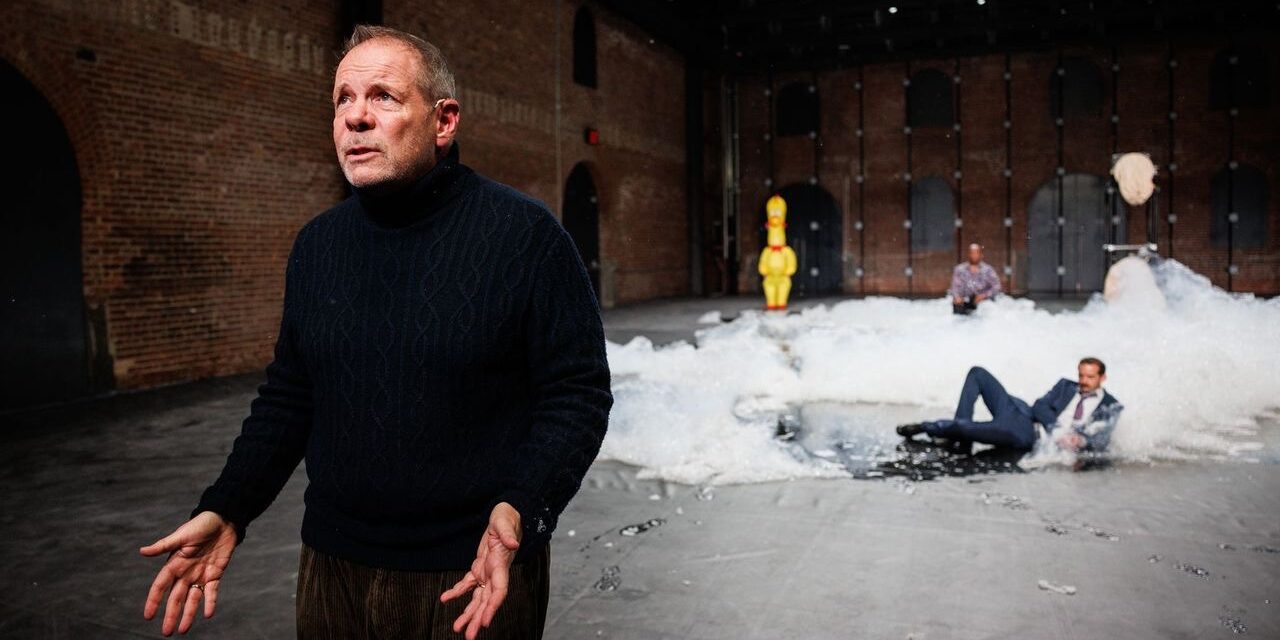
Then there’s the staging. The play is set on a vast open expanse. It starts with Fauci close to the audience, the seated moderator in the middle and Kramer, calling in from New York far, far away in the back corner. That makes some sense, but it doesn’t last as Kramer begins angrily pacing the stage. It’s a little distracting but nothing compared to the fact that Seastone is on rollerblades, skating around to different locations to ask her questions. It’s a silly gimmick, though not as ridiculous as the moment when she dresses in an inflatable chicken suit to ask a question. I have no memory of what she asked because I wasn’t paying attention; I was trying to puzzle out Fish’s intent.

And then there’s the piece de resistance. In the middle of the play everyone leaves the stage except Kramer, who sits silently in a chair as a fan blows soap bubbles, filling the stage with them. It’s actually entertaining to watch but even if it works as a metaphor for the seemingly endless parade of AIDS death, it becomes yet another distraction as the the rest of the show is performed amidst the bubbles with Kramer and Fauci even laying in them and with Kramer later trying to mop them up. If the entire play had been absurdist then this (and the chicken suit) might have worked, but in the middle of a relatively dry, fact-driven debate, it just felt out of place.
Perhaps the most significant problem with this play, however, is that we get the conversation but no context. Was Kramer right about President Bill Clinton dragging his feet and providing mere lip service, or was Fauci right that Clinton’s commitment was sincere, backed by dollars and more, and that Kramer needed to give the new president a chance? Kramer praises some by name (like the drug company Merck) and slams others, including then-Secretary of Health and Human Services Donna Shalala; he does it with such passion that we’re inclined to be on his side, but we have no way of knowing whether his complaints are valid or driven by his experience with the Republican administrations that preceded Clinton.
Fauci does call him out on one lie about AIDS statistics, but that, of course, only highlights how little we know about the accuracy of what the two men are proclaiming. Within a few years of this conversation there would be breakthroughs in creating the drug cocktail that transformed AIDS from a death sentence to a treatable disease. How much of that is because of activists like Kramer, government scientists like Fauci or political leadership from Clinton? The play shines a light on a moment in time, but by leaving us frozen there, it leaves more questions than answers in a way that is unsatisfying even for documentary theatre.
Kramer/Fauci is playing at St. Ann’s Warehouse, 45 Water Street, Brooklyn, now through Oct. 24th. For ticket information, please click here.
Photos by Maria Baranova.
Headline photo: Thomas Ryan (foreground) with Will Brill and Greig Sargeant.