Review by Ron Fassler . . .
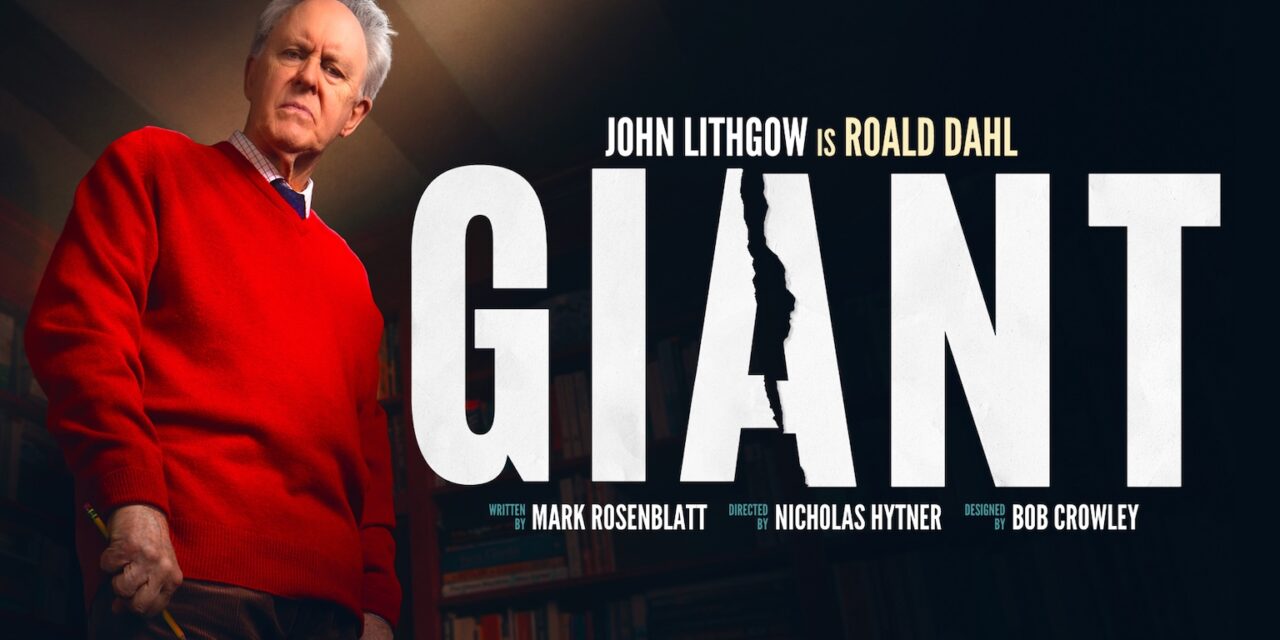
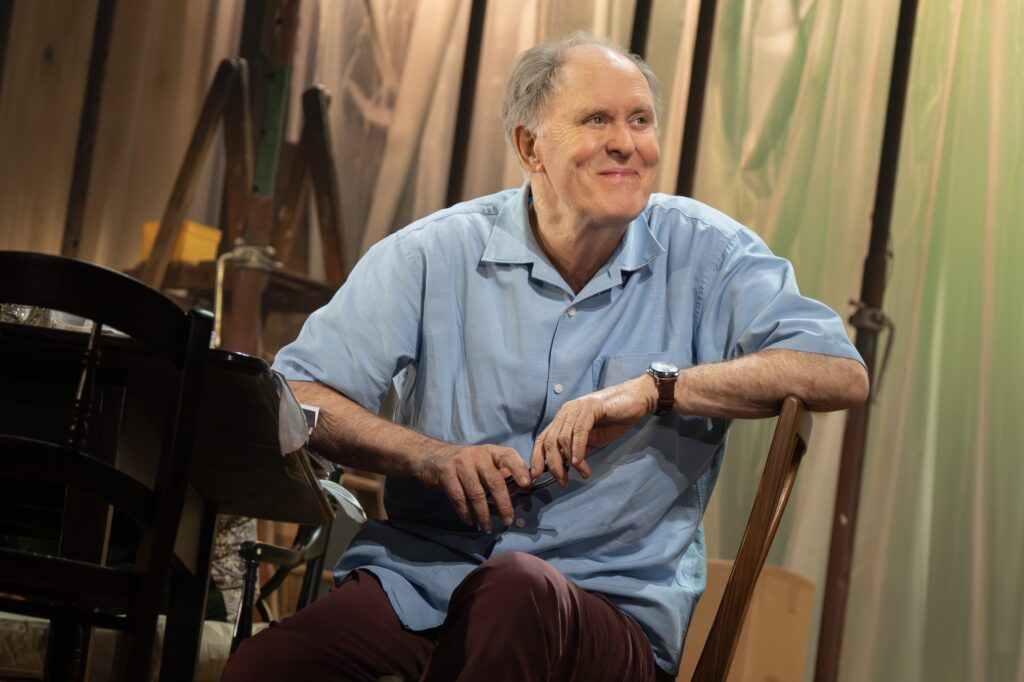
In 1976, a thirty-year-old John Lithgow was cast by director Mike Nichols in the ensemble of the London import Comedians, by Trevor Griffiths. While entering the stage door of the Music Box on West 45th Street, the actor surely could not have imagined that it would be 50 years before he would return to the theatre—this time with his name above the title—in Giant, the London import by Mark Rosenblatt, which opened on Monday. No question Lithgow had a couple of gigs in plays and musicals that came in between: 17 on Broadway alone. Not to mention an overwhelming abundance of film and television shows—he has 6 Emmys, after all. Now, at the ripe old age of 80, he is giving the performance of his career as Roald Dahl, the famed children’s book author who, in an extraordinary series of writings in the last years of his life, revealed a repugnant anti-Semitism to the world. Rosenblatt’s play is a vehicle that the actor has been involved with from the ground floor up and it’s not hyperbole to say there would be no show without him. Written specifically to showcase all the skills in his vast repertoire, and under the uncompromising directorial hand of Nicholas Hytner, Giant arrives as the theatrical event of the season.
Rosenblatt wrote the play prior to October 7, 2023, when the Hamas-led attack in Israel killed 1,200 Israelis. Since then, with over 100,000 injuries and 75,000 deaths in the region, setting Giant not long after the 1982 siege of Beirut coincides with the same humanitarian crisis playing itself out right now. The inciting incident, based entirely on truth, is when in 1983 Dahl wrote a book review in the British magazine Literary Review of photojournalistic Tony Clifton’s God Cried, a harrowing report of the siege. In it, Dahl claimed how Jews have gone “from being much-pitied victims to barbarous murderers,” calling out “American Jewish bankers” and “Jewish financial institutions,” and instigating that Jews “follow the example of the Germans and become anti-Israeli.” This from the man who wrote the beloved Charlie and the Chocolate Factory.
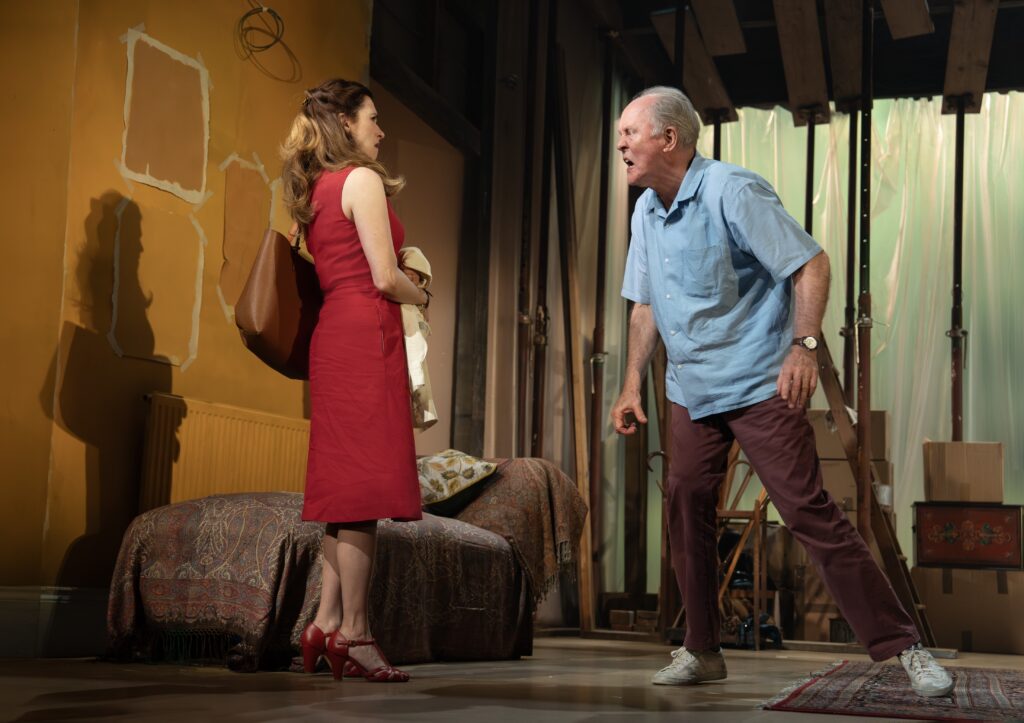
Here, arguing over the age-old conflicts in the region, words prove as explosive as bombs. By turning such scurrilous talk into a well-made play, Rosenblatt has chosen correctly in keeping things tight by its action set entirely at the author’s Buckinghamshire estate shortly after his statements have been published, with consequences so dire that a death threat received was credible enough to warrant a police constable outside Dahl’s home. First off, Dahl must deal with his British publisher Tom Maschler (Eliot Levey), rightly concerned that with the upcoming publication of Dahl’s children’s novel, The Witches, that he must apologize or face jeopardizing sales. Dahl’s fiancé, Felicity Crosland (Rachael Stirling), urges Dahl to do what Maschler says and be done with it. But when told that a representative from the sales division of Dahl’s all-important American publisher, Jessica Stone (Aya Cash) is soon to arrive, Dahl is fit to be tied. After demanding to know how old she is, and hearing she’s quite young, Dahl decries, “They always send me children? … Just because I write about them doesn’t mean I have to be managed by them.”
When she arrives, not only is Stone not a child, but a Jew (“Was that Stein once?”, Dahl inquires). She also has a fifteen-year-old son who she would like for Dahl to inscribe one of his books before she leaves. Their exchanges over young Archie provide Dahl the opportunity to slither snakelike from across the room, almost hissing in anticipation of finding the right moment to sink his venom. This is only one of many “chats” that get under your skin throughout the play, very much set in real time, bifurcated only by an intermission. Just before that moment comes, Stone gets a bit of her own back with Dahl:
“You understand the power of language more than anyone. How it can twist things out of shape. And how it can make things whole again. And this kind of language, when the world comes for us again, when people like you won’t protect us anymore—when it sends me and my son somewhere . . . so, yes, yes you do. Owe me an apology.”
With this speech, it’s obvious Dahl and Stone’s cat-and-mouse game doesn’t play at all one-sided even though the power dynamic of the pair is anything but. However, having specialized in playing intimidating types for decades, the role comes naturally to Lithgow. The chilling psychopathic murderers he played in Brian DePalma’s Blow Out and Dexter’s Trinity Killer are the stuff of nightmares. But remember, he won three consecutive Emmys as the goofy alien in Third Rock from the Sun, and all but started his film career with two Oscar nominated turns as sweet men; the transexual former football player Roberta Muldoon in The World According to Garp, and the desperate man in a loveless marriage with whom Debra Winger has an affair in Terms of Endearment. There’s nothing on earth better than watching so experienced and skilled an actor put everything he’s ever learned into one performance, which he does with delicious glee as Dahl.
With the support of three actors from the West End production last year, which I was fortunate to see ten months ago, Lithgow is in excellent company. Eliot Levey (like Lithgow) won an Olivier award as Maschle, and he is once again in fine form. An actor with a mellifluous voice—the clarinet to Lithgow’s oboe—the music they play is addictive. So too is that of Rachael Stirling’s “Liccy” (short for Felicia), spot on with a whiskey-soaked voice, smoking her cigarettes with something close to majesty. Learning that she is the daughter of Dame Diana Rigg only increases my respect and admiration for her performance.
And in the pivotal part of Jessica Stone (created entirely in the playwright’s imagination), Aya Cash is a revelation. In a stroke of good fortune, this American actress was chosen to replace the British Romola Garai, who created the part in its original Royal Court Theatre production and was unable to move to the West End with the play due to work commitments. Making her Broadway debut, Cash is a worthy opponent, giving as good as she gets. Not to be underestimated, perhaps the fiery red dress in which she’s been costumed should have provided an early clue that she would be no pushover.
Also in the cast are two newcomers to the production, Stella Everett (Julliard class of ’23), who delivers a nicely understated and slyly comedic performance as Hallie, the Dahl’s New Zealander’s housekeeper and cook. On the flip side, in terms of experience, David Manis is sincerely wonderful as the handyman and “all-around ancient retainer,” of the Dahl estate. Giant accounts for this veteran’s 15th Broadway show (he also serves as Lithgow’s understudy). Bravo.
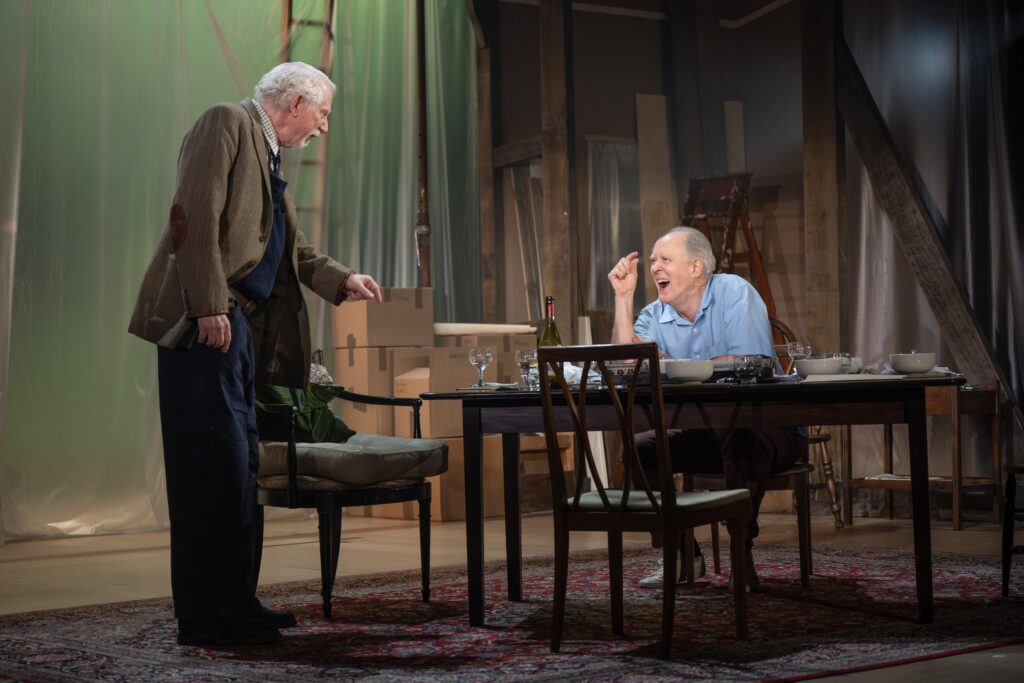
Hytner’s work as director is as meticulous as a jeweler’s. With his longtime and close collaborator, Bob Crowley, all the action is beautifully rendered in the house’s interior designed by the brilliant Crowley (winner of seven Tony Awards, if you didn’t know). In the published script, Rosenblatt describes the house as “having a major makeover and this room is the last remaining sanctuary from dust and works.” Thus, we see exposed plumbing and naked beams with plastic hanging over the back wall, all the better since the play amounts to something of an onstage x-ray of its inhabitants. Renaissance man that he is, Crowley is also responsible for the play’s nicely rendered costumes and lighting.
Seeing Lithgow here is Shakespearean in depth and performance. When he played King Lear in Central Park a dozen years ago this actor could not have been aware that it would prove a damn fine warmup for his Roald Dahl. Miss Giant at your own peril.
At the Music Box Theatre, 239 W. 45th St., New York; https://gianttheplay.com
Photos by Joan Marcus.