By Stuart Miller…
The show finds laughter, absurdity and songs in nuclear bombs and socioeconomic divides.
In “The Americans,” Mikhail Gorbachev’s visit to the U.S. in December of 1987 for a summit with Ronald Reagan spurred intense life-and-death espionage with the future of Cold War relations on the line.
In “Cold War Choir Practice,” that same visit inspires not one, but two efforts at secret-stealing, involving arms dealers, a cult, a Soviet spy who can communicate through a child’s toy and, ultimately, a ticking bomb. The intensity and suspense, however, are dialed way down, in favor of lunacy and laughs, both of which are in abundance in Ro Reddick’s totally bonkers show. (It originated at Clubbed Thumb, in a production with Page 73, last summer.)
The show is built around a children’s choir in Syracuse getting ready to perform at a televised event singing “peace” songs– “I give my drink to a Soviet child, I let her sip from my straw, and then we talk of our differences and we discover they are small”– that are often pro-US propaganda (Soviet children don’t have milkshakes in their poor, repressed world) even as the scenes actually satirize Reagan’s simplistic view of the world along with his voodoo economics. (Reddick’s website accurately describes her tunes as “the theme songs to your late capitalist nightmares.”)
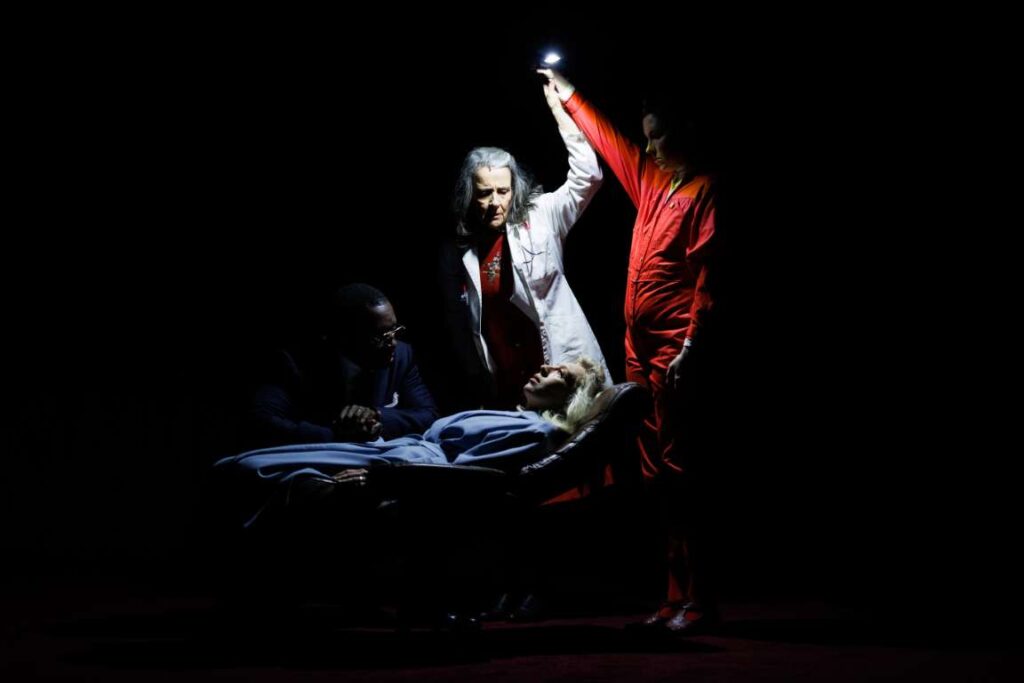
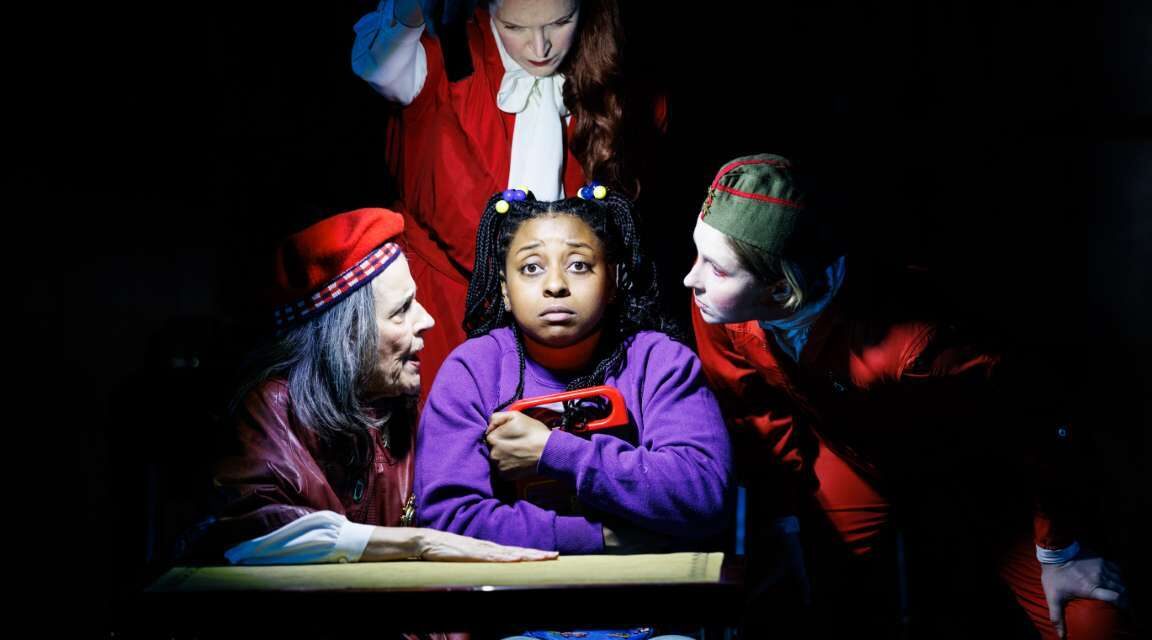
The choir, whose leader (Ellen Winter) confidently declares “the voice of a child can stop a nuclear attack,” also doubles as the play’s loony Greek chorus constantly commenting on or echoing the play’s actions in gorgeous harmonies. The singers also take on other rolls: Grace McLean, magnificently melodramatic and seductive, is the stand-out as the frontwoman for the cult Wellspring (based on the real-life Lifespring group) that proves to be a front for arms dealers seeking to ensure that peace remains elusive.
But underneath all that singing is a plot, or two, or three. The story ultimately revolves around the 10-year-old Meek (Alana Raquel Bowers who captures tweendom energy without playing too cute); her Christmas wish list includes a nuclear radiation detector for the fallout shelter she’s assembling.
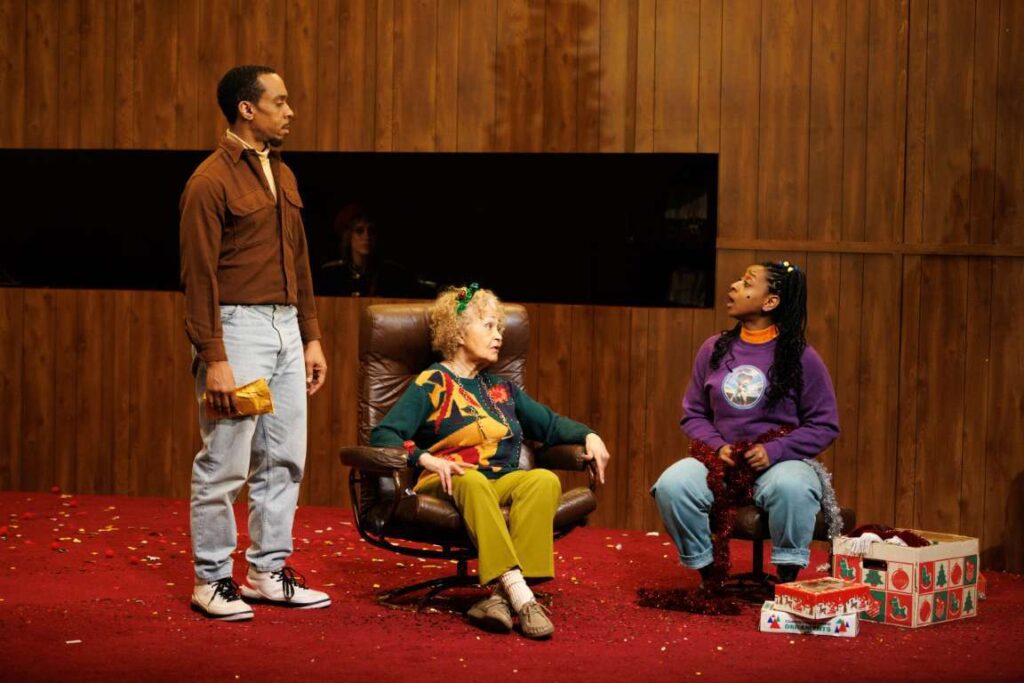
Her father, Smooch, acerbically points out that Black neighborhoods like theirs aren’t important or valuable enough to bomb. Smooch, a former Black Panther lives with Meek and his mother, Puddin (Lizan Mitchell, who brings the cadences and savvy of Norman Lear character) above the struggling roller disco palace that Smooch hopes to revive as a center of the Black community.
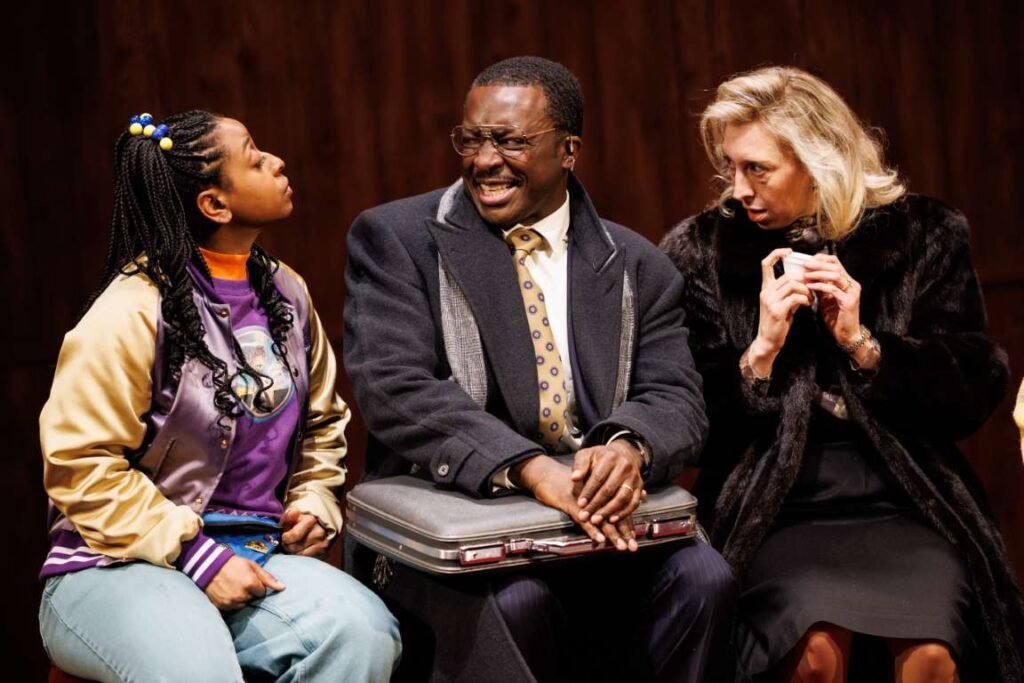
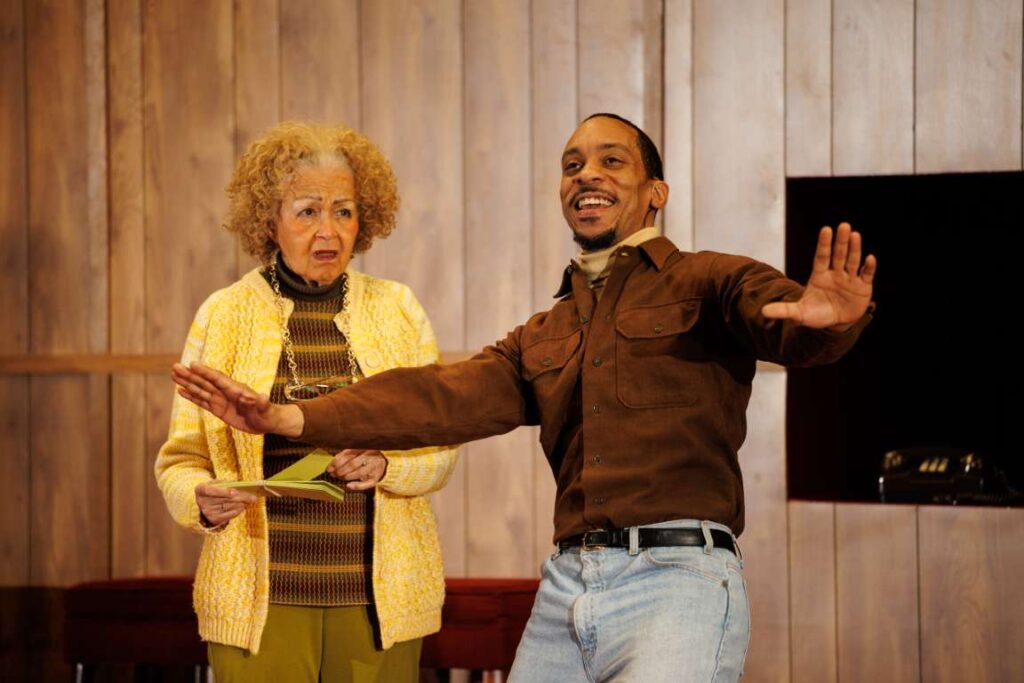
As Smooch, Will Cobbs is perhaps the highlight in this fantastic cast, delicately balancing his love of family and community and his dream of building a better future with long-simmering and justifiable anger at society: in one outburst, he tells the white children in the choir, “And I think you need a song or two about a little Black child, ’cause we at war now too, okay. We got the FBI bombin’ folks — we got the pigs out in the our neighborhood” before giving them coupons for free fries if they’ll come to his Roll-A-Rama.
His life is in direct contrast to that of Clay (Andy Lucien), his older brother who has become a big shot in national security under Reagan, clutching secret information in his briefcase; an Uncle Tom, he’s also given an interview unfairly calling his family “hooked on welfare.” He brings his white wife, Virgie (Crystal Finn) to the family to stash her while she recovers from her experience in the cult as he heads back to Washington for the big summit; but his arrival sparks a showdown between the brothers about race and responsibility that is the most serious and one of the most memorable scenes in the show.
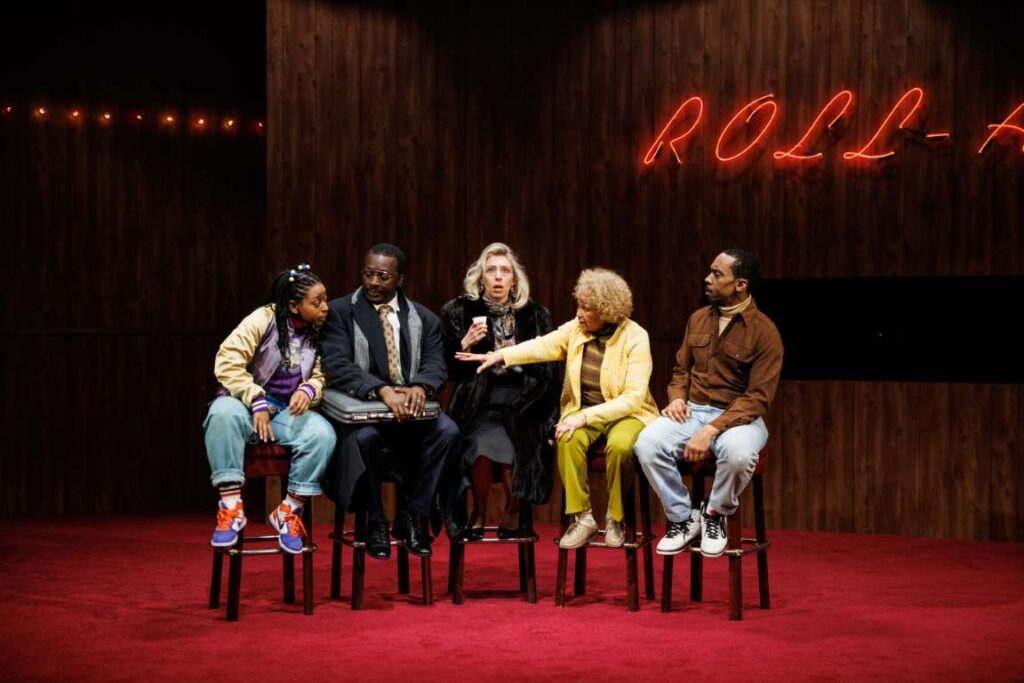
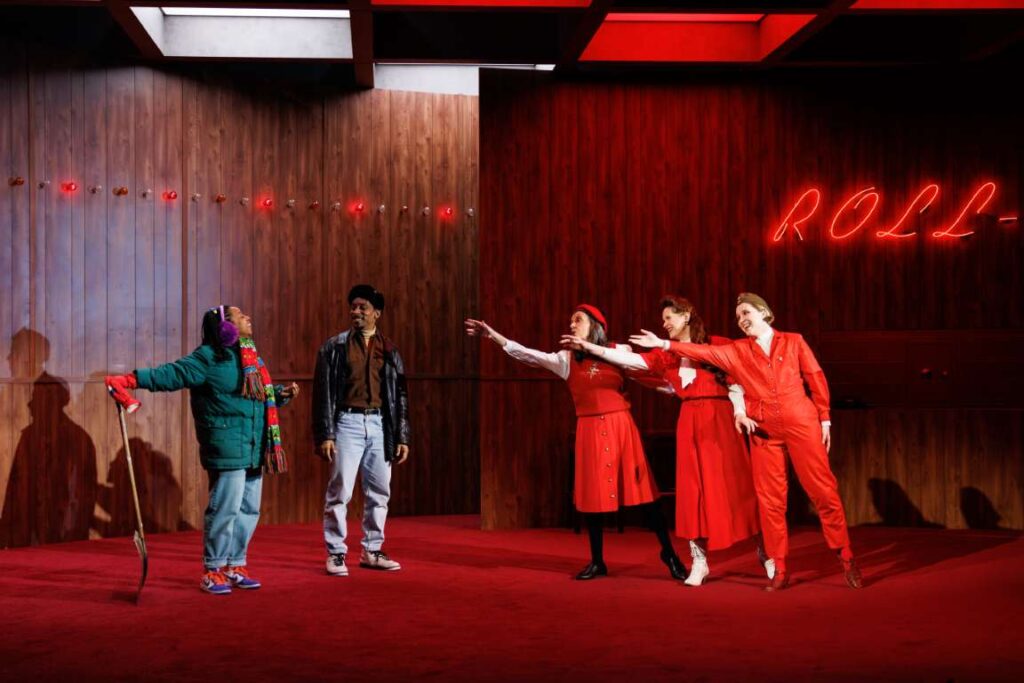
Meanwhile, Virgie is still in the thrall of the cult and Meek is doing the bidding of the Soviet pen pal (Nina Ross) who she obtained through the choir’s peace work but who is actually a spy and who can magically speak to Meek through her new Speak-and-Spell toy. The absurdities and contrivances pile up (including an appearance by Barbara Walters, helping bust the cult’s secret agenda wide open) and the show, directed by Knud Adams, grows wilder and more frantic toward its explosive climax.
As Reddick tears down the wall between drama and surrealism and satire, the play can’t always keep the tonal shifts perfectly in balance; there are also moments you wish Reddick would slow down and develop the characters or explore her ideas about politics, economics, race and society more deeply. But given that America has just launched a poorly planned war of choice over nuclear weapons even as society at home has become more and more divided over class and race, the issues of the 1980s still resonate amid the wild and wacky laughs generated by “Cold War Choir Practice.”
“Cold War Choir Practice” plays at MCC Theatre, 511 W. 52nd Street through April 5th. It runs 95 minutes without intermission.
Photos by Maria Baranova