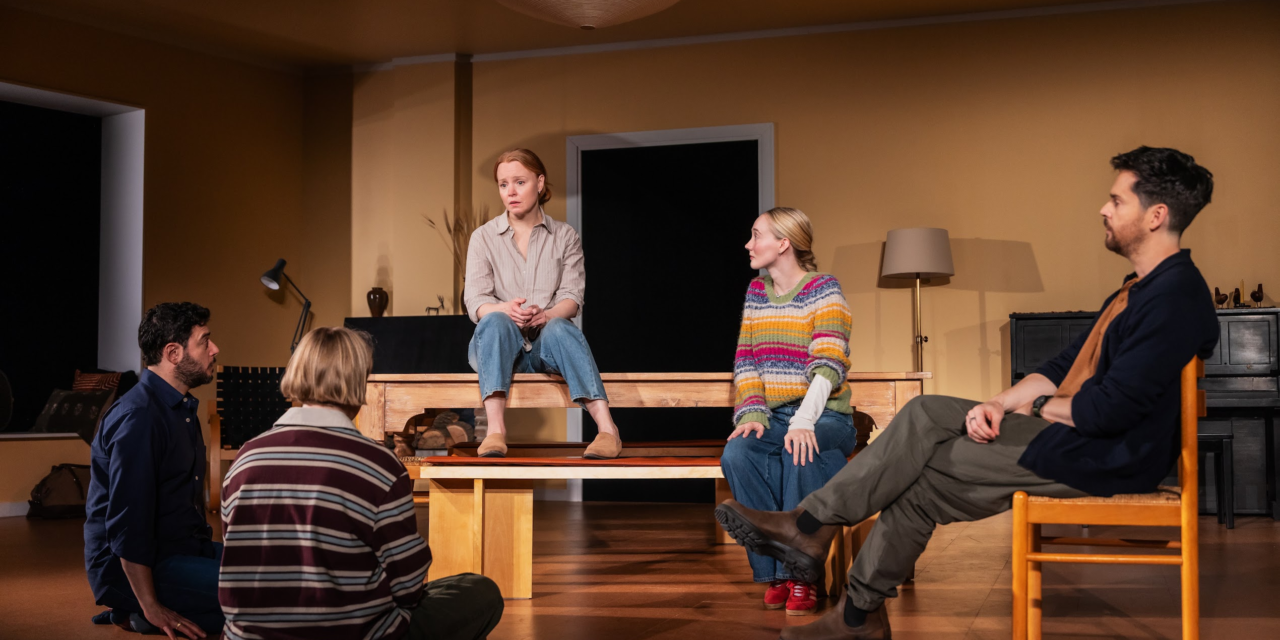
Lauren Ambrose’s riveting lead performance can’t fully elevate a show that doesn’t quite go deep enough.
Review by Stuart Miller . . .
The first time The Unbelievers abruptly shifts time periods in the middle of the scene, with some characters walking off mid-conversation, as the next scene begins in a different year, you’ll be thrown off balance. It’s one of the most emotionally astute parts of Nick Payne’s uneven drama—for Miriam (Lauren Ambrose), whose teenage son, Oscar, has disappeared, time has stopped and she is always trapped cycling between the past and the present.
But this play, about grieving and loss and whether people can move on with their lives, only intermittently captures that potency in its writing. The show is more driven by its themes and ideas than its plot, which alternates between three time frames, which would be fine except that only Miriam is fully developed as a character. There are the days immediately after Oscar’s disappearance, as the family—Miriam’s recently separated husband David (Tom Riley) and her daughters Margaret (Elizabeth Yeoman) and Nancy (Nina Ross) field questions from the police who are seeking to help the search. There’s the one-year anniversary of Oscar’s vanishing when Miriam is becoming more unhinged chasing false hopes (and seducing David for comfort). And there’s the seven-year anniversary when Miriam’s isolation reaches its most extreme, causing the family to fracture.
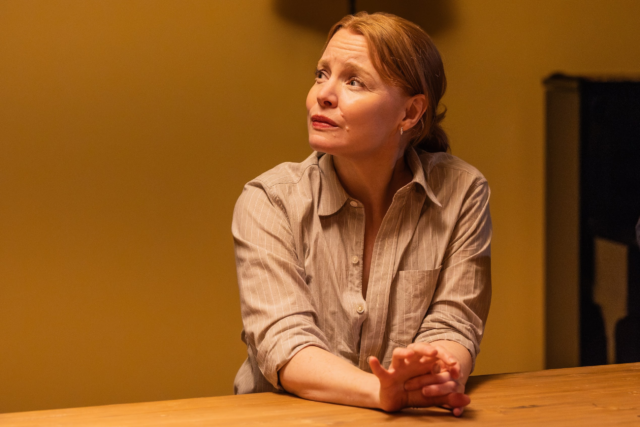
Miriam’s behavior throughout is selfish, which is fascinating to watch– as a parent it’s totally relatable that your every waking moment would be consumed by your missing child, yet she can’t see the way others are suffering and she fails to be fully present as a parent for her two daughters who are still in front of her. Ambrose is excellent in the role; her facial expressions express her sadness and her barely contained fury . . . which occasionally cannot be contained as she unleashes the rage of her loss on strangers and family. Her hands never stop moving as if she’s grasping for something, anything and she fidgets her way through most scenes, as if she’d rather be out there scouring the world for her son.
(Her English accent feels like a bit of a struggle sometimes and given that there’s nothing specific about the setting of the play—we don’t learn much about the community or the family’s work and outside relationships—this could have easily been transferred to an American setting for this production . . . although more of those details would have made the play better.)
But despite Ambrose’s moving performance, the play never achieves the emotional impact that the opening scenes imply are coming. One problem is that the rest of the cast is not up to Ambrose’s level. Yeoman has an expressive face but there’s an artifice to her performance; in one crucial moment I was distracted by the way her body language seemed to strain to demonstrate “this is how you show you’re listening as an actor.” And Ross gives a low energy performance that seems out of keeping with everyone else (to be fair, some of this is the character but she doesn’t take it anywhere interesting). She comes alive most when she performs two songs, the second is lovely and allows for a set change but the first goes on too long without enough reason, derailing the play’s momentum.
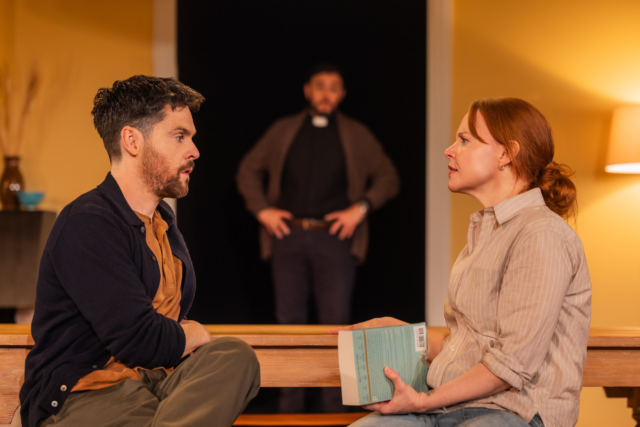
I have no problem with plays that shift tonally between comedy and tragedy (think the best of Martin McDonagh), but Payne and director Knud Adams don’t seem to have command of the proper balance and because the other family members—including Miriam’s first husband Karl, who is Nancy’s father and now a vicar—are sketchily drawn, some scenes just fall flat.
There are memorable moments like when Margaret tells her mother seven years on how she often thinks about the idea that Oscar may have run away, grievously wounding all his loved ones for his own enigmatic reasons. But we learn very little about Oscar so he’s not fully alive to us and we don’t have an inkling of why he vanished, other than to be a plot catalyst.
The Unbelievers is not a bad play. It earns some genuine laughs and raises interesting questions about how to cope with such a tragedy while forcing us to empathize with Miriam, whose behavior can be frustrating and even infuriating. It’s just that it seemed like it could have been a very good or even excellent play before settling into one that’s just fine.
At is Manhattan Theatre Club, 131 W. 55th Street, NYC, through November 29th. For further information please visit The Unbelievers.
Photos by Matthew Murphy.
Headline photo: Hadi Tabbal, Nina Ross, Lauren Ambrose, Elizabeth Yeoman, Tom Riley in The Unbelievers.