By Carol Rocamora…
Kip Williams transforms Genet’s dark tale of obsession and revenge into a visually astonishing theatrical experience that blurs the line between stage and screen.
Be warned. Kip Williams, the daring young Australian director, can take you on a dangerous and thrilling theatrical journey unlike any other you’ve experienced before.
Williams dazzled us last season with his direction of The Picture of Dorian Gray on Broadway, in which one actress (Sarah Snook) played twenty-six roles. The miracle of the production consisted of giant video projections, which made the multiple casting possible. Williams calls his new form “cinetheatre,” giving us a radically new perception of the art form, providing an aesthetic experience unlike any you’ve ever experienced.
And now he’s dazzling us again with his sensational treatment of The Maids, Jean Genet’s lurid one-act play (1947) about two sisters in service of a woman in high French society who plot to kill their abusive employer. Williams has adapted it himself and updated it to the present, featuring Claire (Lydia Wilson) and her younger Solange (Phia Saban) who serve Madame (Yerin Ha), an arrogant celebrity/influencer with a sky-high social media profile.

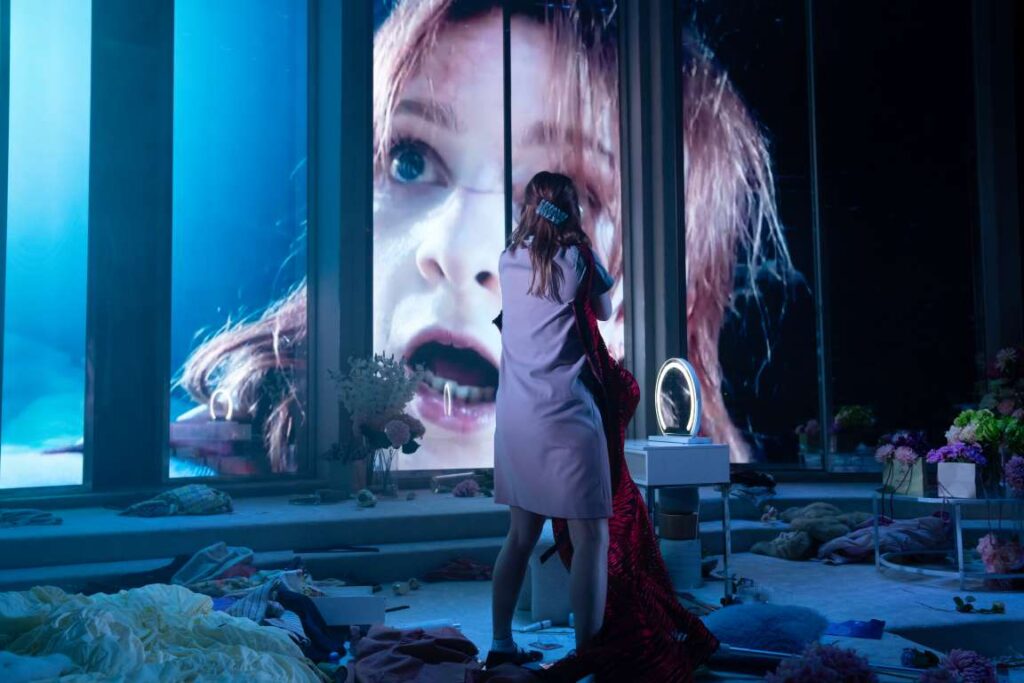
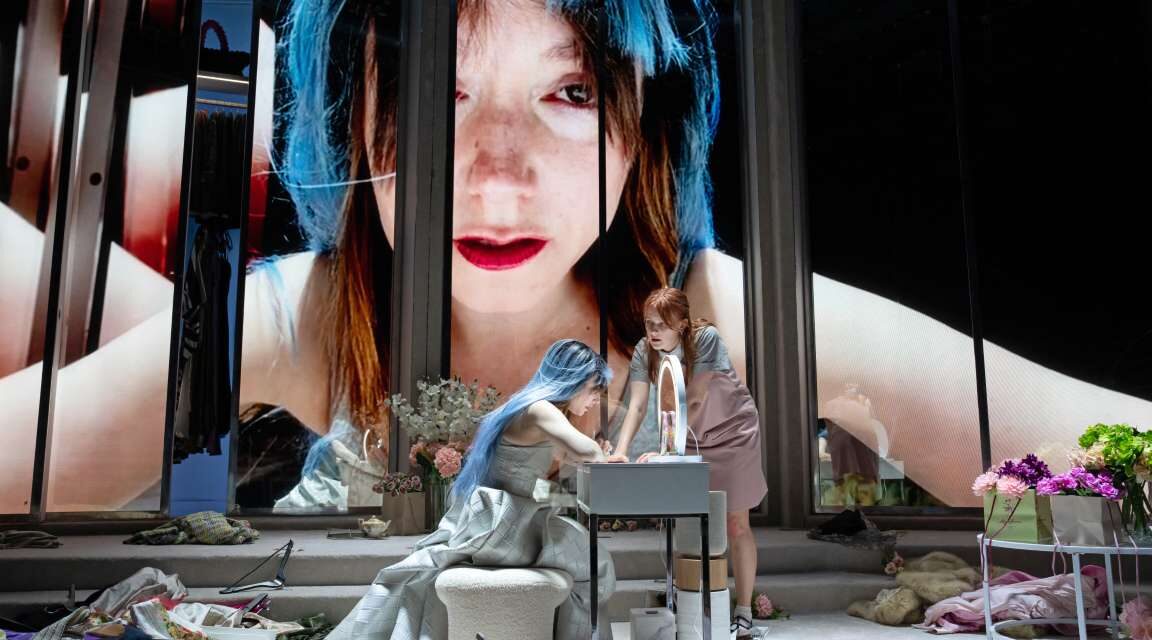
We first meet this pair of tortured sisters in Madame’s ultra-luxurious boudoir (sumptuously designed by Rosanna Vize), carpeted with wall-to-wall lavishness, filled with buckets of bouquets, backed by towering floor-to-ceiling mirrors behind which are closets featuring racks of extravagant designer clothes. It’s evening, Madame is out, and the sisters are performing their nightly ceremony, acting out their obsessive worship/hatred for their mistress in which one plays Madame and one plays a maid. It’s Claire’s turn to play Madame, and she slings abuse at Solange, humiliating her, while Solange submissively attempts to dress her in a drop-dead gorgeous red gown (lavish costuming by Marg Horwell). It’s a grotesque sado-masochistic ritual that they repeat every night, in a rehearsal to accomplish their ultimate revenge: namely, to kill Madame and cure themselves of the psychosis of subjugation, wherein they both despise their mistress, adore her, want to be her, and want to murder her.
What makes their ritual – and the rest of the play – so overpowering is director Williams’s “cinetheatrical” technique. Each sister carries a cell phone, taking videos of herself and each other and projecting them onto the towering mirrors that flank the entire upstage wall of the room. At times, they enhance features of their own faces, enlarging their lips and heightening their cheekbones. The visual effects are gasp-producing, grotesque, and overpowering.
On this particular evening, the sisters have taken a significant step toward their ultimate goal. Hacking into the laptop of Madame’s boyfriend, Claire has written fake emails to implicate him in an embezzlement scheme. As a result, he’s been arrested, and now – with the boyfriend out of the way – it will be easier for the sisters to accomplish their murderous plan.
Enter Madame (Yerin Ha), and the fun really gets going. As played with flamboyant imperiousness, Madame swans around her boudoir, trying on clothes, discarding them, wailing about her boyfriend’s arrest, raging about what it will do to her image and reputation. “You’re lucky, you have nobody in the world!” she tells her maids, gushing with self-pity. She suddenly declares that Claire and Solange are her sisters and her only friends – and invites them to escape with her to the south of France, to hide from the scandal, “play, and have fun.” Thereupon, Madame starts emptying her closet, offering her gowns and furs to Claire and Solange, while videos of this over-the-top spectacle are projected on the upstage mirrors. (One of the most outrageous, surreal projections is when Madame affectionately calls Claire a “Claire-Bear”, and a huge projection appears on one of the mirrors featuring the actress’s face with bear-ears!)
Then comes the news that the boyfriend has been released from prison and will meet Madame at a posh nightclub downtown. In a panic, the sisters decide that the only way out is to offer her poisoned tea before she meets the boyfriend and he reveals the maids’ treachery. Wheen Madame leaves, however, without drinking the tea, the frenzied sisters choose a last resort, featuring the most sensational series of projections of the evening. (No spoiler – yours to discover!)
How Williams executes his “cinetheatre” technique” is a miracle of modern-age stagecraft and technology. Praise goes to his video designer Zakk Hein and his production team for offering us a whole new phenomenon in theatre design. You sit in the audience, focused on the live actors, while their faces are simultaneously enlarged and distorted on screens ten times their height, competing for your attention. You integrate the live actresses and their enlarged, grotesque images in your mind’s eye – and the result is a theatrical experience unlike any other.
Meanwhile, it intrigues me as to why the amazing Kip Williams has chosen The Picture of Dorian Gray and The Maids for his latest accomplishments. A thought: this director appears to be fascinated with the surreal elements in classical literature and how their darkest features can be magnified, in the way that a movie director would want to enhance the grotesque in a horror film – all in order to provide a thrilling, unique, and unforgettable experience in the theatre.
The Maids, by Jean Genet, in a new version written directed by Kip Williams, at St. Ann’s Warehouse, Brooklyn, now through June 14.
Photos: Julia Cervantes