By Alix Cohen
1865. Famous author, playwright and personality, Oscar Wilde, sued the Marquess of Queensbury for criminal libel when the Marquess accused him of sexual relations with his son, Lord Alfred Douglas, “Bosie,” who was, in fact, Wilde’s lover. Advised not to pursue the case, Oscar was determined to use the forum to protest bigoted laws concerning homosexuality. He withdrew the suit (after going to court) when it became clear mounting evidence was against him.
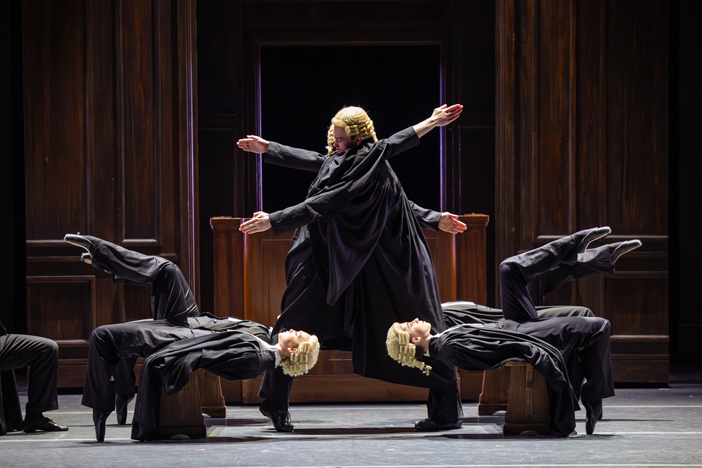
The authorities then arrested him for “gross indecency.” Constance and his two sons didn’t attend the two month trail. We see the family pass through a stately, arched courtroom. (Watching the set come together is mesmerizing; varied use of the arches inspired. Design by Jean-Marc Puissant)
Phpto by Daniel Boud
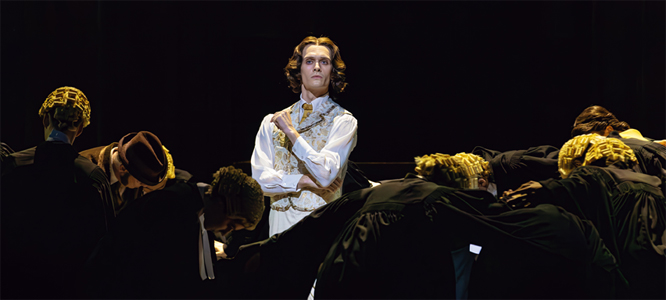
White wigged and black gowned barristers listen, confer, “wield” benches, and surround the accused. Oscar rises from a circle of bent over bodies like the pistil of a flower. Seven counts of indecency made an example of him, sending the offender to hard labor for two years. Wilde was 40.
Alone in his cell – a narrow iron bed and metal door- Oscar (Jarryd Madden) begins to hallucinate the past, including his literary fictions. The dandy Dorian Gray –The Picture of Dorian Grey – enters. He sits back to back with Wilde on the thin mattress. They cradle, tumble, almost wrestle.
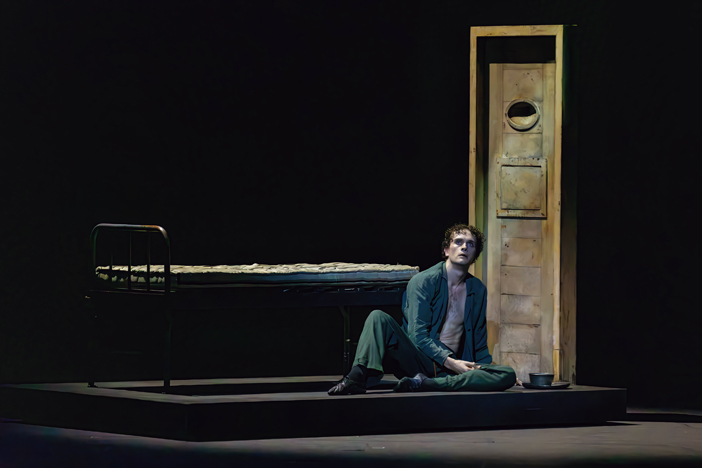
Photo by Curtis Brown
Slipping on a piped suit jacket, the author joins Constance (Benedicte Bemet) and his children for a picnic. A giant tree looms overhead. Their light, playful pas de deux suggests happy time. He reads The Nightingale and the Rose to his boys.
Two scenarios unfold before us.
One is Wilde’s fairytale: The nightingale (Jill Ogai) sacrifices her life to bring a young student the red rose demanded by his love, only to have it summarily rejected. We see an enchanted grove, a giant stylized moon with a face, and an opulent ball. ‘Beautiful.
The other, is society in which Wilde moved as a successful writer. Constance proudly on his arm, he’s a celebrated luminary. Young men gravitate to Oscar. He preens, struts, and mimes writing.
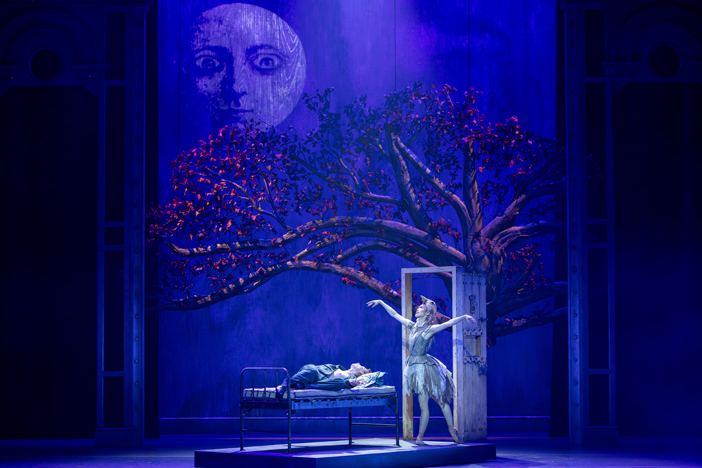
Photo by Daniel Boud
Wearing a green carnation (a symbol of aestheticism, unconventional identity, and—by implication—homosexuality), Robbie Ross (Jett Ramsay) greets the couple, dancing first with Constance, then Oscar. (Ross is thought to have been Wilde’s first male lover.) The three love and trust one another. Dorian Grey comes and goes like a shadow.
At Oscar’s home the lovers avoid being seen by a maid. Constance becomes aware. She cries. Robbie takes his new fiend to clubs where men gather to meet and have sex. Two dressed as women dance a robust, ersatz cancan. The club is sultry, inviting; gleeful.
Birds congregate. Evocative headdresses show beaks and eyes, “torn” chiffon skirts flutter. Three dancers whose kimono-like robes expand by way of rods might be butterflies. There’s hand writing on the apparel. Puissant also designed the ballet’s imaginative, beautifully detailed costumes, all of which share the stage aesthetically.
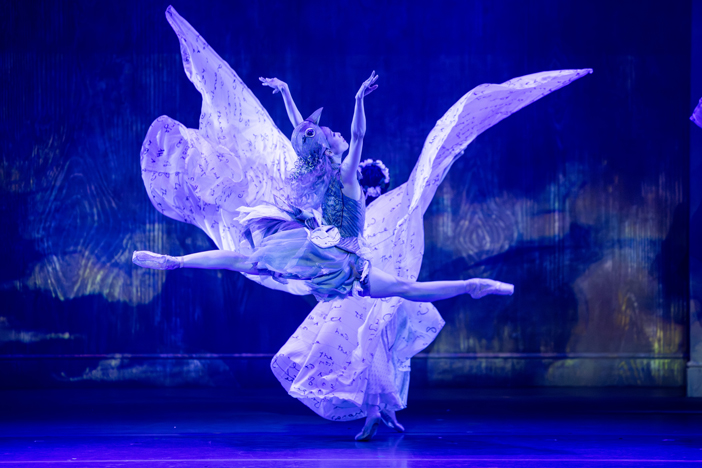
Photo by Christopher Rodgers Wilson
Ogai is a magnificent dancer, delicate, but with strength and control that makes every movement precise without appearing stiff. Sharp avian gestures are wonderful.
The nightingale dies.
Christopher Wheeldon’s choreography showcases partnering as a language of desire and vulnerability. Proximity, glances, embraces and shared weight are telling. There are moments of emotional exposure and responsiveness. Signatures include constant transformation of space; tilting, curving, and stretching beyond conventional alignment so positions connect.
A gorgeous score by Joby Talbot is also integral to choreography. Lyrical passages, rhythmic energy and dissonant textures intensifying conflict almost dictate movement.
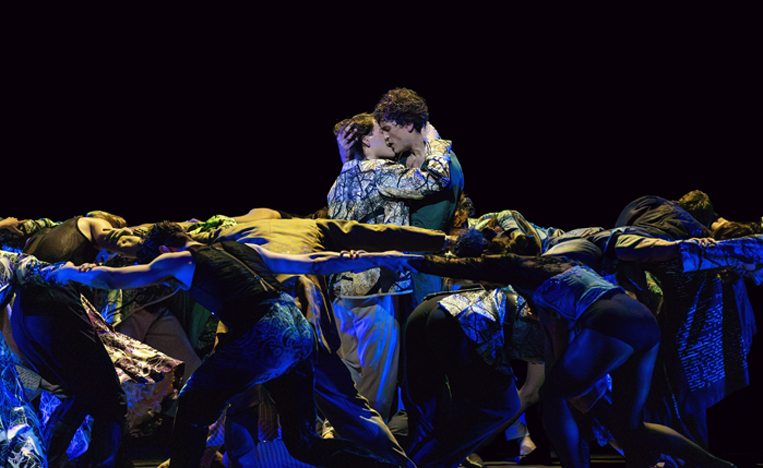
Photo by Curtis Brown
During intermission, projections on the curtain mark off days by fives until the entire expanse is filled. Other excellent projections (David Bergman) include a vast array of moody clouds, tree shadows, and handwriting everywhere. Lighting Design (Jon Goldman) is immensely nuanced and insidiously controls where we look.
Act II finds Oscar a broken, maddened man. This chapter parallels The Picture of Dorian Grey and Oscar’s affair with Bosie. (Adam Elmes) Dorian (Maxim Zenin) cuts an elegant figure. He touches his face gazing at the portrait. Evolution of self confidence is subtly apparent. Long limbed and nimble, Zenin moves like a young animal exulting in youth. Am I imagining that physicality seems more jaded as the story evolves? Elmes’s dancing reads vigorous, uninhibited, entitled.
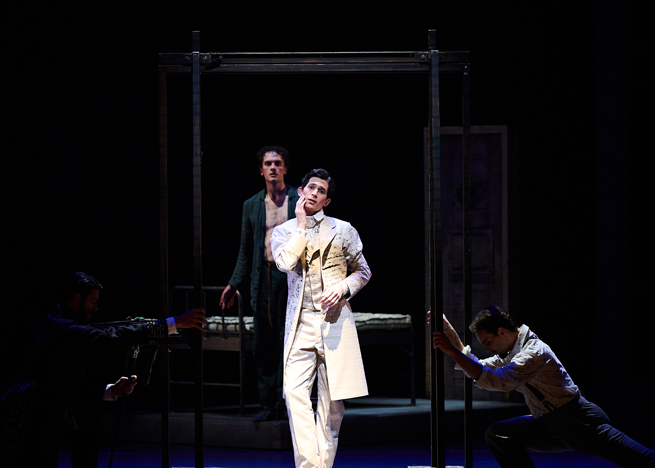
Photo by Christopher Rodgers Wilson
Scenes from the tale are shared with artist Basil Hallward (Cameron Holmes), fascinated by his subject’s beauty, and by Lord Henry Wotton (Luke Marchant), who convinced Dorian to pursue beauty and pleasure above all else.
At a party, Oscar is magnetically drawn to Bosie, nonetheless with a push/pull at the start. When passion erupts, the two dancers enfold one another vertically and horizontally. There’s nothing prurient here. Connection is graceful and loving. Like the orgies (one in each act), artful depiction retains definition of action and intent. The stage seems fogged with heat.
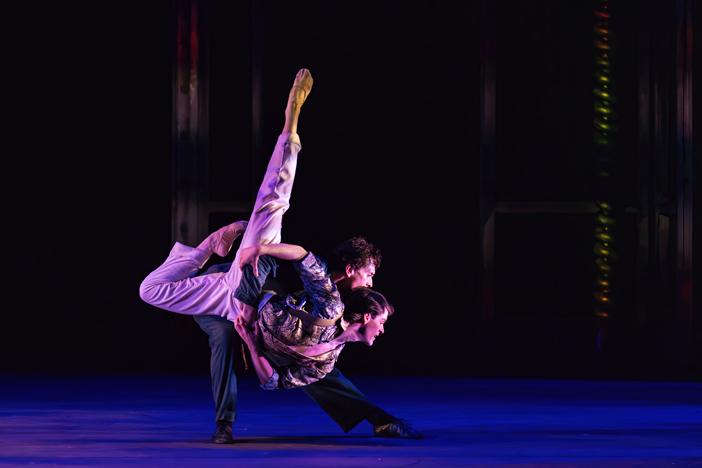
Photo by Curtis Brown
When a cloth is removed from the large picture frame, we see an increasingly misshapen Oscar- a fitting conceit to indicate the young man’s portrait demonically morphing as he himself stays unblemished and young.
A collage of memories precedes another court scene. There’s actual shouting. Benches become barriers. Gowns whip. In his cell, Oscar collapses. We hear him whimper. (Perfect use of unexpected sound.)
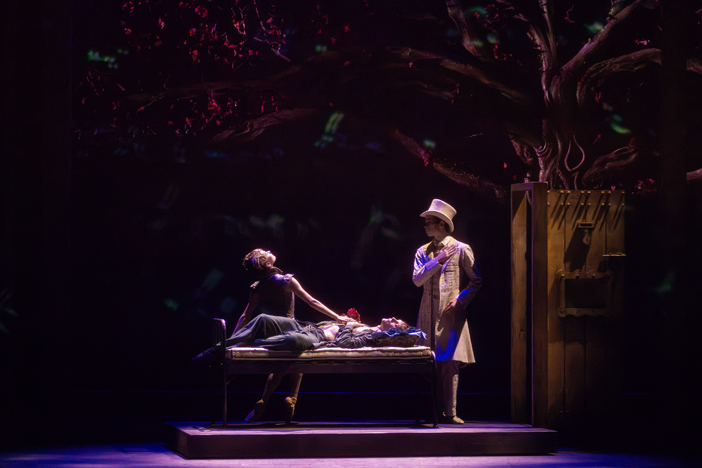
Photo by Curtis Brown
Narrator Sean O’Shea, who eloquently bookends the piece, tells us the day after Oscar was released, he sailed for Paris. There he lived a struggling, dissipate life; scandalized, alienated from his family, with only Robbie his only visiting friend. Oscar Wilde died there at 47. Bosie published the poem “The Dead Poet.” Its ending conveys the stark pain of loss after a dream of reunion.
Oscar‘s finale is quiet, poetic and rife with pathos. The production is captivating, moving, visually arresting. It respectfully and unflinchingly tells its story.
American David Hallenberg, former principal dancer ABT. Made his debut dancing at City Center when he was 18. Twenty years later, he brings the groundbreaking Oscar– all too briefly- to the self same stage.
Openuing Photo- Curtis Brown
The Australian Ballet
Artistic Director-David Hallenberg
Music Director/Chief Conductor- Jonathan Lo
Christopher Wheeldon’s Oscar
Choreography- Christopher Wheeldon
Synopsis – Christopher Wheeldon and Joby Talbot
Based on an original idea by Alexander Wise and Christopher Wheeldon
Composer- Joby Talbot