By Alix Cohen
Johnny Mathis (1935- ), known for his smooth voice and romantic ballads, helped define the easy-listening and adult contemporary genres with a career spanning more than six decades.
Henry Mancini (1924-1994) left a lasting legacy as one of the most influential film and television composers of the 20th century, redefining screen music by blending jazz, pop, and orchestral styles, creating instantly recognizable themes.
Michael Feinstein knew both.
Opening this evening with the theme for television’s Peter Gunn (Henry Mancini) unquestionably wakes up an audience anticipating familiar crooning. Feinstein’s tribute mixes serenades with swing in palpable appreciation.
“Le Jazz Hot,” not as Feinstein sings, Les Jazz Hot, (Henri Mancini/ Leslie Bricusse) bounces in with a horn and cymbals. A swing arrangement of “It’s a Wonderful World” (Henry Mancini/Johnny Mercer) follows. Thinking is clearly, if you have a big band, it’d be a shame not to use it.
It was Mathis who suggested he and Mancini work together. Over time, the composer’s wife Ginny grew to feel he became the best interpreter of her husband’s music. Mancini was a flutist when he met Glenn Miller in the army and became a mentee. After discharge, the nascent composer went to Hollywood (and met Ginny) where his popular songs were employed as movie themes.
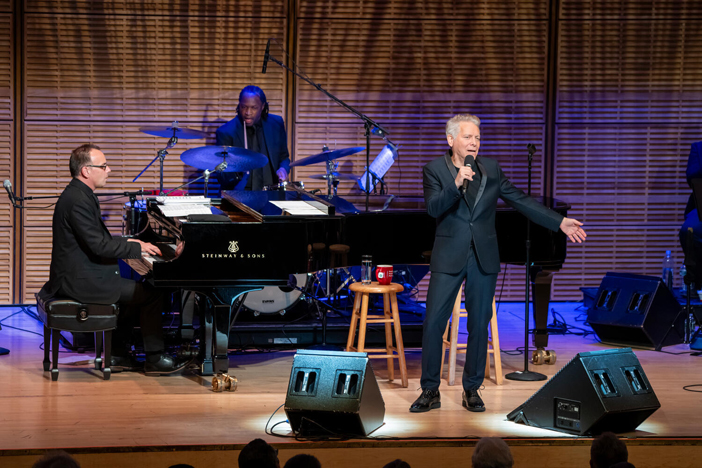
Tedd Firth, Mark McLean, Michael Feinstein
His favorite (also that of Bricusse) was apparently “Two for the Road”, written for the film of the same name. Feinstein sits at the piano offering the treat of his own accompaniment. The song is dulcet, understated, warm.
“Johnny Mathis was (Mathis is still alive) one of my favorite people, kind and optimistic.” His parents, who worked as domestics, saw the boy’s talent and secured a vocal coach at 13. He was only 19 when signed to Columbia Records. While Mathis preferred “pure” renditions, Mancini delighted in reinterpretation of his work.
“Days of Wine and Roses” (Henry Mancini/Johnny Mercer) arrives with a nod to the original Nelson Riddle arrangement, full of brass, sounding very much of its time. Unsually, Feinstein barely moves tonight. A raised arm is notable.
In 1956, Columbia paired Mathis with Mitch Miller who had threatened to fire Rosemary Clooney if she didn’t record “Come On-a My House.” (Ross Bagdasarian/William Saroyan). It was a runaway hit. Miller gave Mathis “It’s Not for Me to Say” and “Chances Are.” (Both by Robert Allen/Al Stillman) The second went to #1 on the charts.
Mathis broke through on The Ed Sullivan Show in 1957. Feinstein’s versions are tender, cottony foxtrots. Impeccable phrasing reminds us of the days when this was an important element of performing. This artist hoists the banner.
“By the time Mancini wrote “Whistling in the Dark” for Darling Lily, Mercer had become disillusioned. Lyrics were darker”: “Often I think my poor, old heart/Has given up for good/And then I see a brave new face/I glimpse some new neighborhood/So walk me back home, my darling/Tell me dreams really come true/Whistling, whistling, here in the dark with you…” A beautiful song done justice.
“In 1958, after Johnny had been with Columbia only two years, they released a Greatest Hits album. For the next ten years it remained top of the charts.”
Usually a ballad, title song of the film Charade (Henry Mancini/Johnny Mercer) seriously swings tonight, knocking the pith out of its meaning.
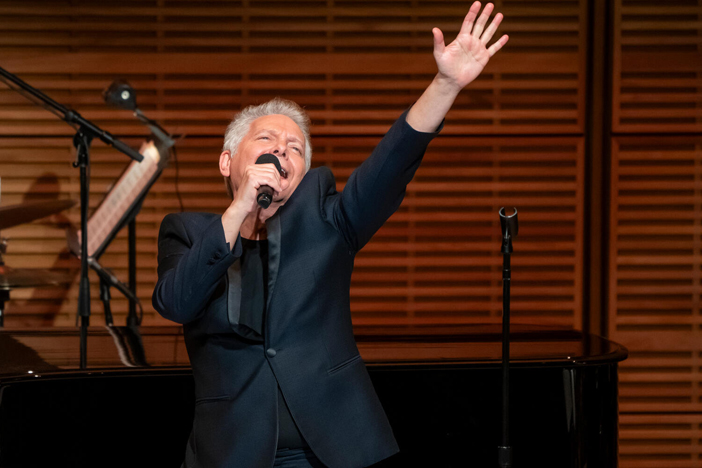
Michael Feinstein
A lovely “The Twelfth of Never” (Jerry Livingston Paul Francis Webster ) floats in on solo piano.“A Certain Smile” (Sammy Fain/Paul Frances Webster) and “Wild is the Wind” (Dimitri Tiomkin/Ned Washington) arrive Latin. It’s easy to picture Feinstein on the stage in a dance band.
Composed by Erroll Garner, Johnny Burke added lyrics to “Misty” creating a classic. Feinstein tells us Mathis was at the end of a long recording session and about to leave when Garner’s manager called in the favor of recording her client’s song. The rest, as they say, is history. Misty” suits Feinstein’s natural proclivities.
“Johnny said his favorite album (songs from Hollywood musicals) was the one made with Mancini.” We hear “When I Fall in Love” (Victor Young/ Edward Heyman from One Minute to Zero) borne on tiptoeing piano, circling brushes and guitar strum, and an inviting “Beware My Foolish Heart” (Victor Young/Ned Washington from the film of the same name)
Feinstein tells us that when Mathis arrived in New York at 19, Bart Howard took the young man under his wing. “Johnny slept on Bart’s couch and cooked for him.” He subsequently recorded dozens of Howard’s songs. “Let Me Love You” emerges Latin dancy.The evening ends, of course, with “Moon River” (Henry Mancini/ Johnny Mercer) in full sway mode.
“It’s wonderful to be able to salute Johnny Mathis while he’s still alive,” Feinstein comments. Mathis is 91 in September.
A glimpse of two greats by a third.
All quotes are Michael Feinstein
Photos by Stephanie Berger
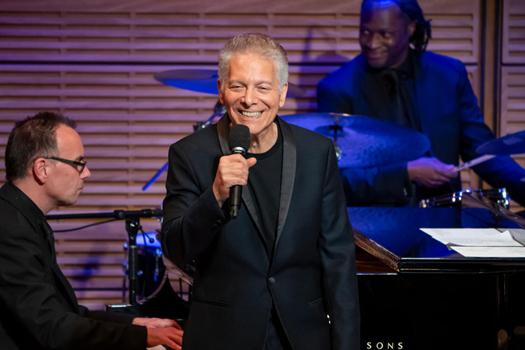
Opening: Tedd Firth, Michael Feinstein, Mark McLean
Standard Time with Michael Feinstein
My Celebration:The Magic Music of Johnny Mathis and Henry Mancini
Michael Feinstein, Artistic Director
Carnegie Hall Big Band
MD- Tedd Firth
June 18, 2026
Carnegie Hall’s Zankel Hall