By Samuel L. Leiter
As I watched the revival of August Wilson’s emotionally explosive but dramatically stiff Joe Turner’s Come and Gone at the Ethel Barrymore Theatre, I was struck by how much more operatic it was than dramatic. Over the course of two and a half hours, a company of hugely talented actors, led by the inimitable Ruben Santiago-Hudson (Seven Guitars), Cedric the Entertainer (American Buffalo), and, in her Broadway debut, Academy Award nominee Taraji P. Henson (The Curious Case of Benjamin Button), lift Wilson’s play to a plane begging for a musical score of equal power.
Under Debbie Allen’s direction, Wilson’s poetically soaring speeches, aria-like monologues, dynamic confrontations, dreamlike evocations, and ritualism make you wonder why no one has made an opera out of it. Its infusions of dance and song, combined with larger-than-life performances (especially the final scene), further emphasize the point. Even David Gallo’s spectacular background montage of Pittsburgh houses and infrastructure (like a bridge that pulls focus from the staging), with a giant staircase to no man’s land, has opera written all over it. Stacey Derosier’s lighting also gets to have a field day with imaginative effects, while Paul Tazewell’s period costumes hew more closely to reality.
As a straight play, however, for all its inclusion of African-American history, folklore, and spirituality, and its themes related to the Great Migration northward of formerly enslaved, displaced peoples struggling to reclaim identity, it meanders from one eruptive situation to another in a series of encounters lacking a consistent arc of suspense or a strong narrative spine. The ritual substructure, interesting as it is now and then, works to subvert the sense of progression.
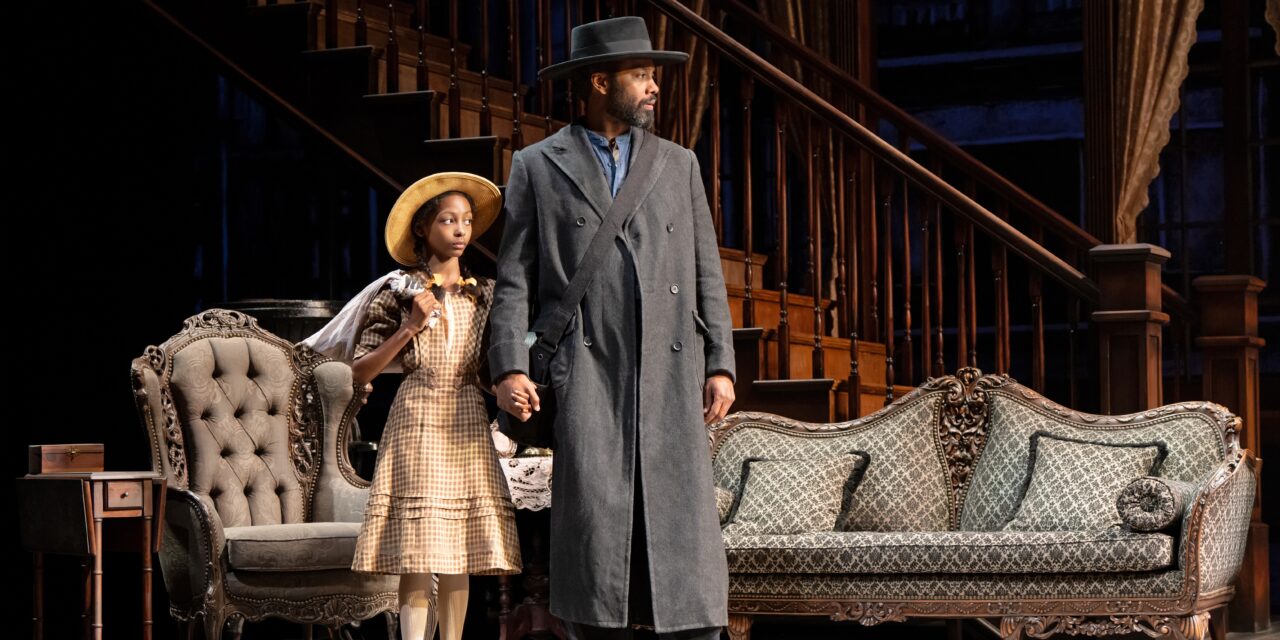
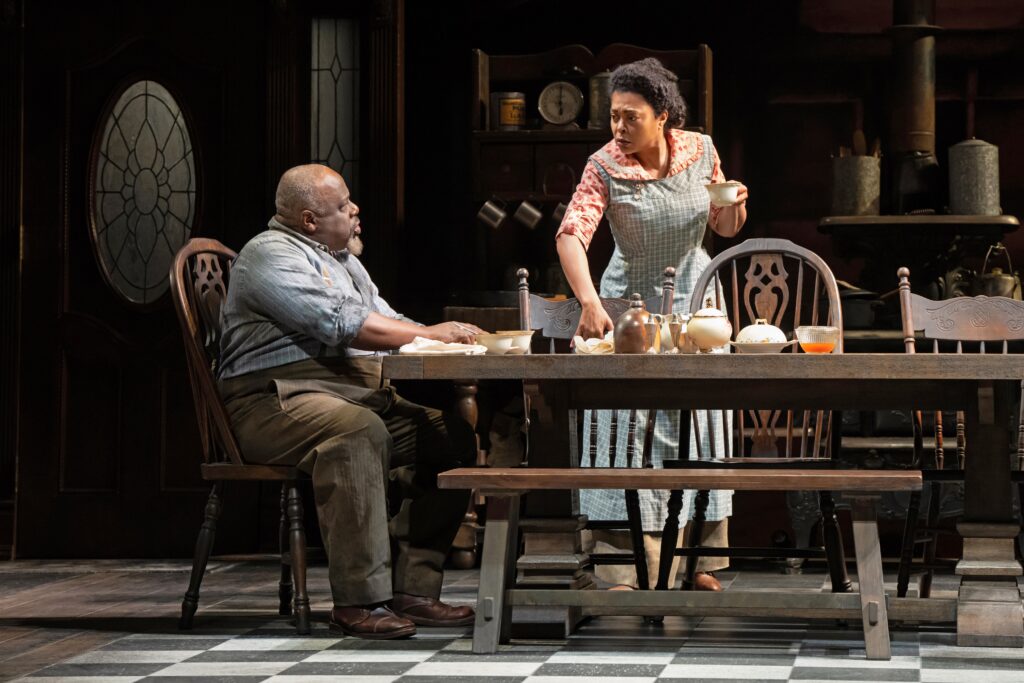
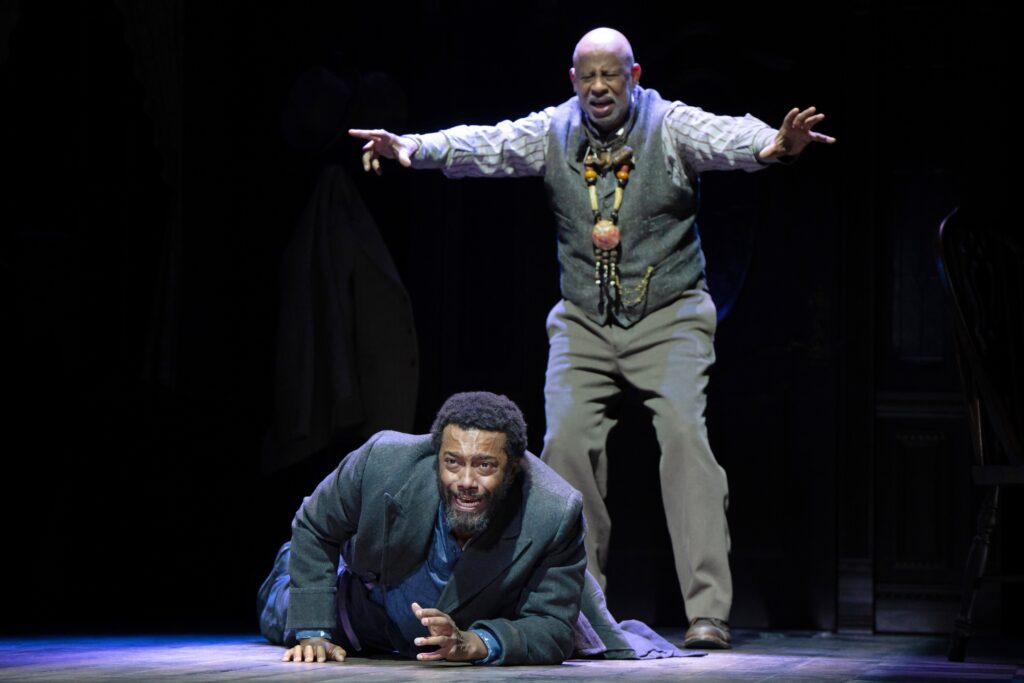
Set in a 1911 Pittsburgh boarding house run by Bertha and Seth Holly (Henson and Cedric), a rare beacon of stability for Black migrants fleeing the Jim Crow South in search of work, family, and belonging, the play gathers a volatile mix of men and women whose paths collide in unexpected ways. At the center is Herald Loomis (Joshua Boone), a mysterious, traumatized former church deacon—almost Hasidic in his long black coat and wide-brimmed hat—who arrives with his 12‑year‑old daughter, Zonia (Savannah Commodore when I went), in search of his wife, Martha (Abigail Onwunali). He was separated from her after being impressed into seven years of forced labor by the notorious Tennessee official Joe Turner (based on the real Joe Tunney). Their story, and those of the other boarders, is threaded together by the African cosmology practiced by the spiritually eloquent Bynum Walker (Santiago-Hudson), a conjure man who “binds” people through ancestral knowledge and helps them recover what he calls “one’s song.”
The second in Wilson’s 10-play Century Cycle, located between Gem of the Ocean (set in 1904) and Ma Rainey’s Black Bottom (set in 1927), Joe Turner’s Come and Gone embodies multiple themes related to the Great Migration, picturing a time when the psychic aftershocks of enslavement were still close enough to feel like living memory rather than history.
It also foregrounds women’s values, with speeches lauding female moral and emotional stability, while similarly creating an undercurrent of male sexual seduction, revealing how gendered power operates within the Black community’s struggle for self-definition, i.e., men attempting to define themselves by the women they control. Even a little boy, Reuben (Jackson Edward Davis when I attended), in a remarkable scene with Zonia, is used to represent how such gendered practices are learned.
The three stars all prove worthy Wilsonians, Ruben Santiago-Hudson most of all because his role requires not only ostentatious oratorical skills but a capacity for breathing spiritual authority into every word and movement. Cedric the Entertainer offers solidity and humor to his boarding house landlord, and Taraji P. Henson crafts a vivid image as his wife. However, she has a tendency to play for laughs, overusing her dishcloth prop, and sometimes verges on a stereotype like Queenie in Show Boat. Joshua Boone handles Loomis, perhaps the most difficult role, with strength and dignity, but I doubt anyone could conquer the character’s over-the-top climactic scene at the end, when Loomis and the play balloon into 19th-century melodramatics.
At its best, Joe Turner’s Come and Gone seems to sing; at others, it falters into stillness. You leave with its cadences in your ear, and the quiet suspicion that its truest expression lies somewhere beyond the spoken word.
At the Barrymore Theatre, 243 W. 47th St., New York; https://joeturnerbway.com
Photos by Julieta Cervantes.
Headline photo: Savannah Commodore and Joshua Boone in Joe Turner’s Come and Gone.