By Carol Rocamora…
History feels alarmingly current in this riveting portrait of political persecution.
Sometimes it takes a play from another time to “hold a mirror up” to our own, as Hamlet told the Players. And that mirror can be a glaring, frightening one.
That is the case with Are You Now or Have You Ever Been, Eric Bentley’s electrifying 1972 docudrama now playing at the City Center with a core and rotating star cast. Its original subtitle: “The Investigation of Show Business by the Un-American Activities Committee 1947-1956. It will send shock waves of recognition through you, as to what is going on in our own times with respect to injustice – the fear of confronting it, and the price that is paid for doing so.
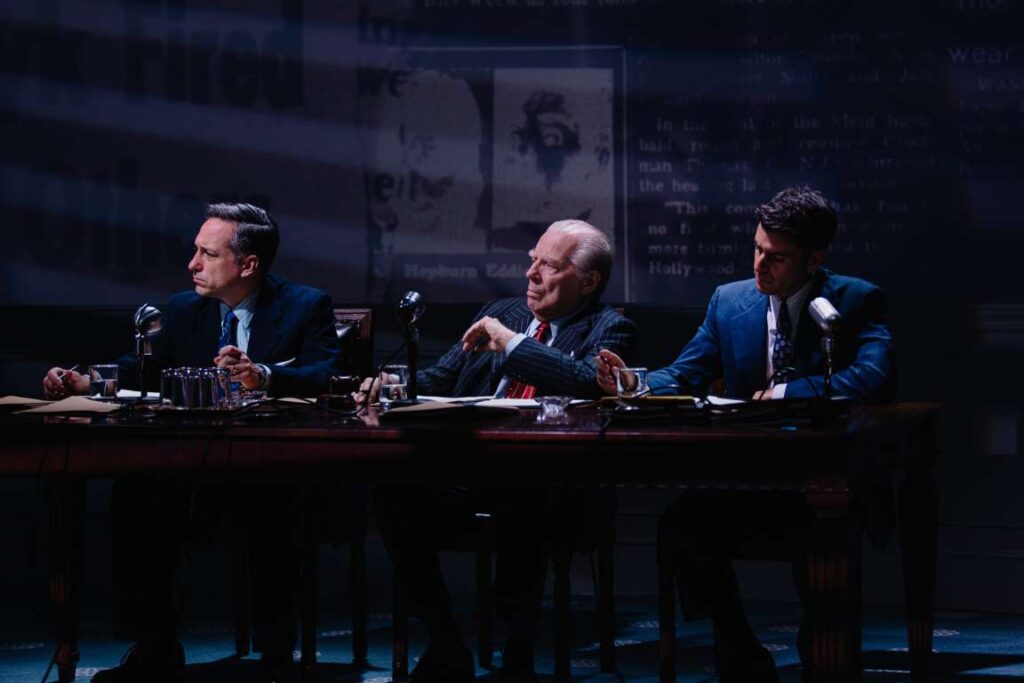
As you know, HUAC, as it was called, was founded in the thirties and became a standing committee of the House of Representatives. Created in response to the so-called “communist scare,” it sought to identify alleged subversive activities among citizens and organizations that – in its view – posted a threat to the government.
Consisting exclusively of original transcripts, Bentley’s powerful play focuses on hearings of members of the Hollywood film industry as well as theatre artists, beginning in 1947 and continuing into the 1950s. Dozens were summoned to testify, in a climate of fear and intimidation. “Are you now or have you ever been a member of the Communist Party?” was the question they were asked (hence the play’s title), followed by pressure to name names of others who might be members. Those questioned faced agonizing choices: protecting their reputations, betraying their colleagues – or refusing to answer and facing the consequences, which included blacklisting and imprisonment. The play invokes the memory of the “Hollywood Ten” – screen writers, directors, and actors who refused to testify, invoked the First Amendment, and landed in jail.
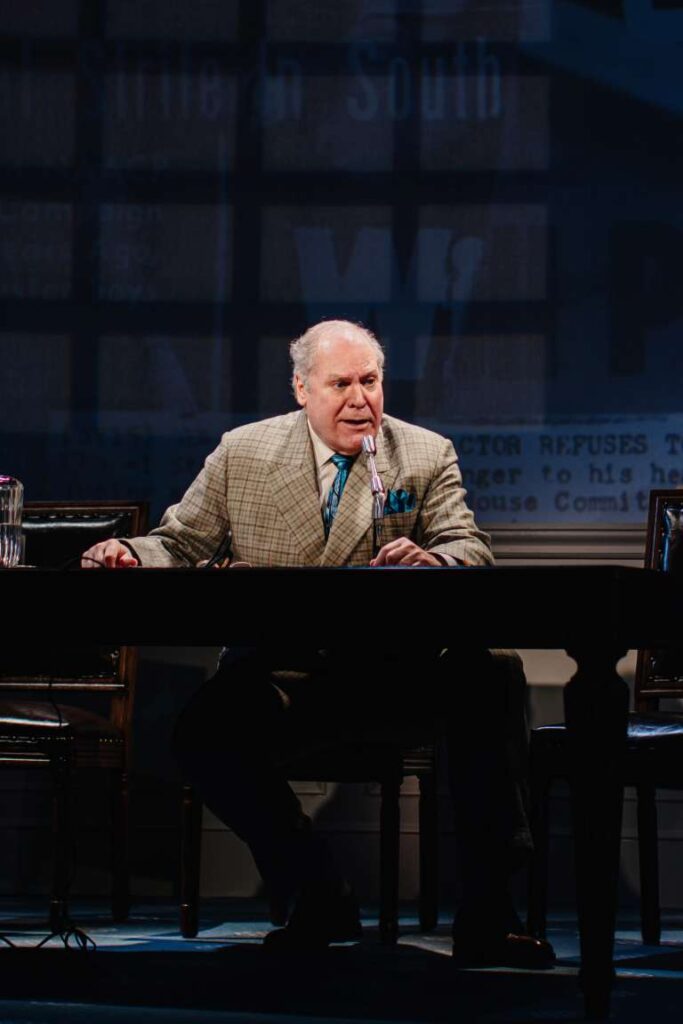
Director Anna Shapiro’s eleven-member cast includes a core trio to play the HUAC committee interrogators (Michael McKean, James Babinsky and Adam Kanter). Three other core cast members (Frederick Weller, Brooks Ashmanskas, and Steven Boyer) play multiple roles as writers, directors, and actors who were interrogated. Then there are five actors who each play a single role; these performers will rotate throughout the fifteen- week run.
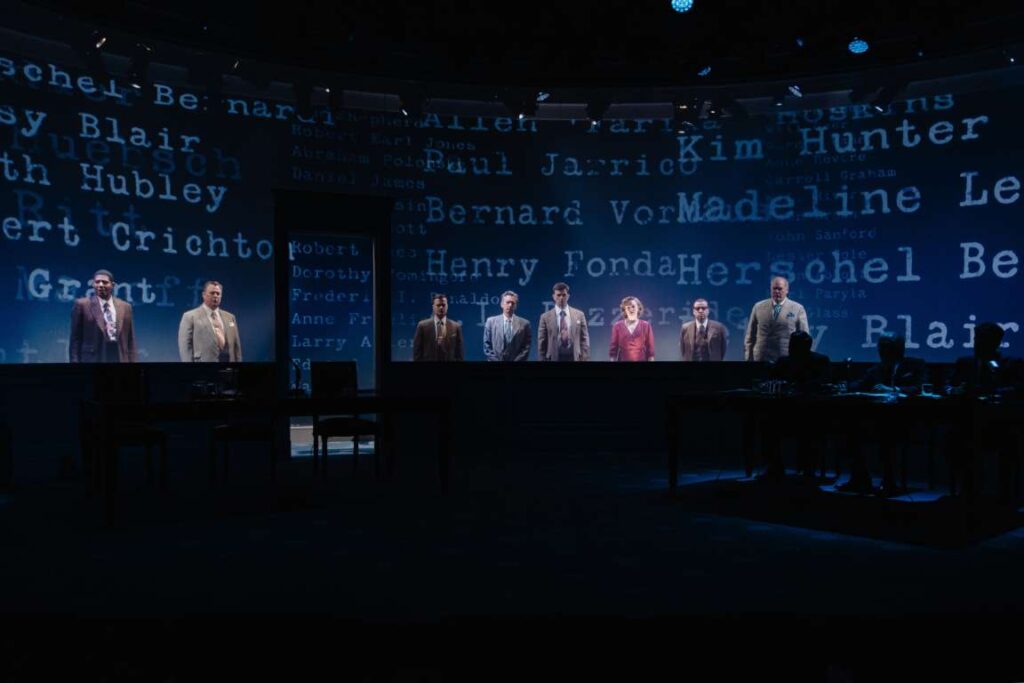
In all, seventeen testimonies are heard. “Everything you are about to see actually happened,” warned the message projected on the upstage wall of Andrew Boyce’s set, which also features huge projections (designed by Brittany Bland) of disturbing news clippings from the various hearings.
The high stakes were defined by one of the first to be interrogated – Ring Lardner Jr., screen writer (played by Steven Boyer.) “Does this committee have the right to ask these questions?” he fired back, in defiance of the aggressive interrogations. (He ultimately became one of the Hollywood Ten). Next came Larry Parks, actor (played by Andrew McCarthy), who admitted to being a member of the Communist Party from 1941-45. During his brutal grilling, the interrogators pressured him to name names of other members and places where they met. Shaken, he relented in a so-called “closed hearing,” naming fellow actors Morris Carnovsky, Lee J. Cobb, and others. Nevertheless, Parks was blacklisted from being hired by any Hollywood studio.
One after another, excerpts from these agonizing interviews continue. After Parks comes actor Sterling Hayden (played by Frederick Weller) who praised the committee and named names. (Twelve years later, Hayden would change his story. “I was a rat,” he exclaimed, in a spasm of self-hatred.) Others named names, too, including Elia Kazan (played by Weller again), celebrated director of Tennessee Williams’s and Arthur Miller’s plays. Jerome E. Robbins, the famous choreographer (played by Stephen Boyer) admitted that he was a Communist party member and named names, too, under duress. Astonishingly, screen writer Martin Berkeley (played by Ashmanskas) named 182 fellow artists whom he said were either Communist Party members or sympathizers, including Dorothy Parker, Dashiell Hammet, and Lillian Helman.
In a dramatic tour de force a response from Lillian Hellman follows. As played by Sally Murphy, Hellman steadfastly refused to name names, declaring, famously: “I cannot cut my conscience to fit this year’s fashion.” Arthur Miller (played by Weller, again) refuses, too.
Bentley manages to offer a moment of comic relief in this painful series of testimonies. Abe Burrows (co-author of Guys and Dolls, played by David Krumholtz) uses his abilities as a humorist and satirist to divert the committee with ambiguous answers and ultimately avoided blacklisting.
Bentley concludes his docudrama with two heroic testimonies. One comes from Lionel Stander, actor, who himself asked to appear before the committee in 1953 so that he could swear under oath that he was not a communist, as falsely accused by fellow actor Martin Lawrence. In a charismatic performance by Jay O. Sanders, the accused Stander is belligerent, flamboyant, and totally uncooperative before the committee, refusing to answer if he had ever been a Communist Party Member (he remained blacklisted until 1965).
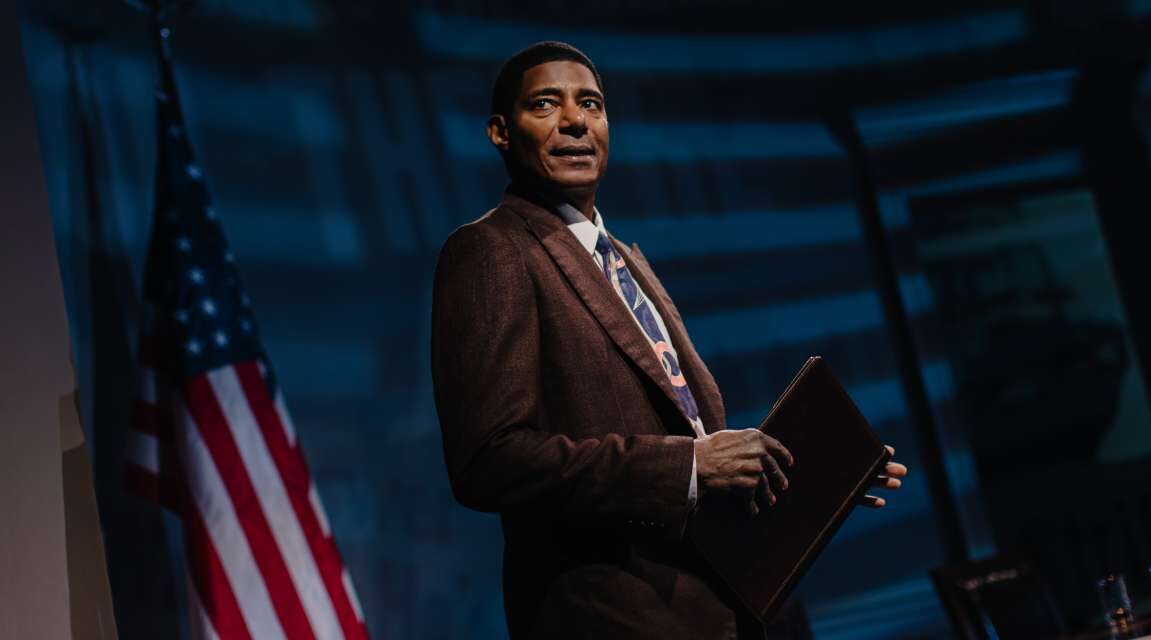
The final scene in Bentley’s docudrama features an eloquent, moving testimony from Paul Robeson, the great singer and civil rights activist. He was called before HUAC in 1956 after he refused to sign an affidavit saying he was not a Communist. During the interrogation (performed with passionate conviction by Billy Eugene Jones), he displayed courage and tenacity in refusing to answer questions and name names, repeatedly invoked First, Fifth, and Ninth Amendment.
Courage and defiance on the one hand; capitulation and shame on the other… There is great power to this alarming revival, which serves as a warning to all of us who love our country and what it has stood for. As director Anna Shaprio puts it, we live in an age “of more threat to our freedoms than I’ve experienced in my lifetime.” This revival urgently reminds us of how important it is to find the courage to confront this threat, fortified by those who have done so before us.
“Are You Now or Have You Ever Been,” an American docudrama by Eric Bentley, now playing at City Center through September 11.
Photos: Mark J. Franklin
Cover photo: Billy Eugene Jones as Paul Robeson