By Walter Murphy…
A tense psychological drama about power, ambition, buried truths, and the lasting wounds of the past.
OBIT is a college campus drama about a jilted admirer stalking her prey and exacting her revenge. Playwright Rebecca Chace’s script touches on many issues, most of which create tension that builds throughout the 90-minute performance, while others detract from the steely focus of the admirer’s attempt to understand what was, for her, a life-altering event. Director Will Steinberger does well to adhere to the few elements that give the admirer enough ammunition to bring her prey down.
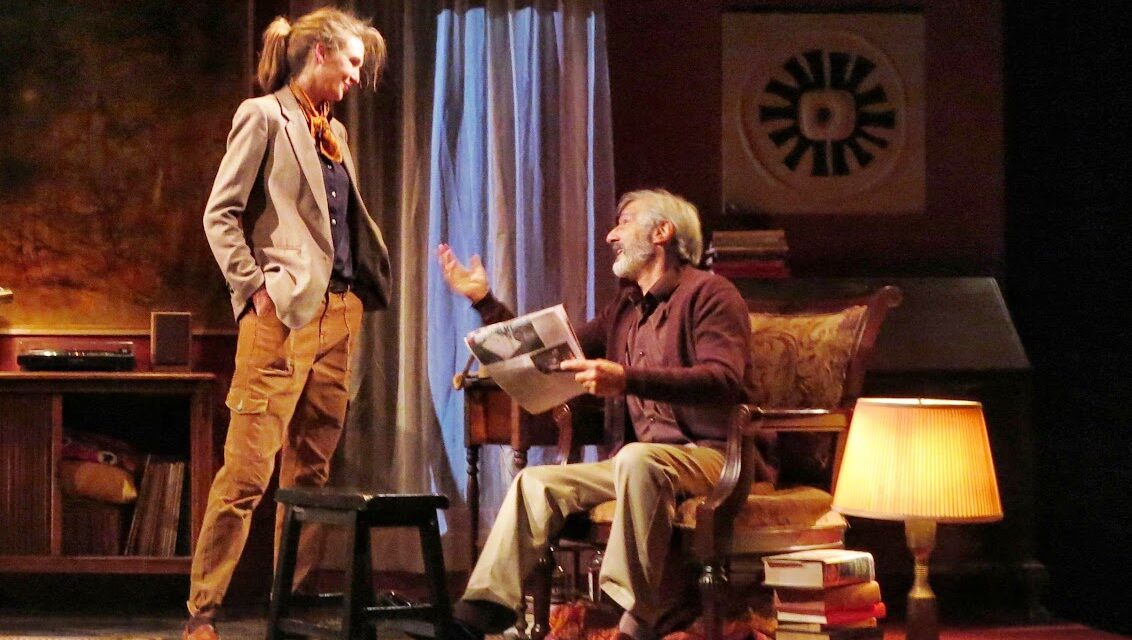
Maya Hawthorne (Carolyn Holding) is an advance obituary writer assigned to interview Philip Stern (Richard Topol), the president of Briarwood College, noted for its theater program, revitalized by the president, but also under a cloud of allegations involving fundraising and misuse of funds.
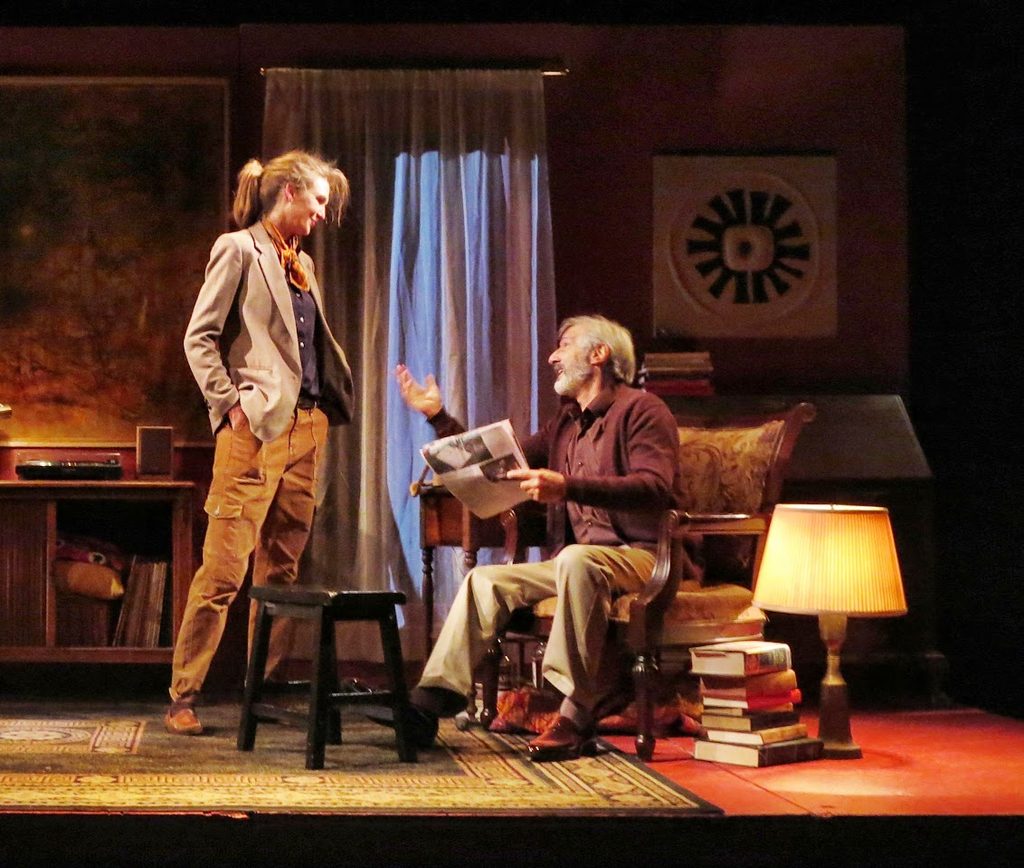
The interview at the president’s residence takes place in the near future, after the college and its reputation have declined. By then, cell phone service no longer works, information in the “cloud” has disappeared following its collapse, and the local power grid features frequent blackouts. Yet The New York Times has survived. Maya works for the paper and her research has armed her with the facts she needs to extract her revenge.
Maya arrives at Philip’s on-campus home in the evening, yes, with wolves howling at the door. After firing off a few warning shots, she explains that The Times now requires reporters to carry firearms. (One of the more questionable points in the script, since this seems contrary to the traditional neutrality of journalism.) She ingratiates herself with the pompous president, who tries to charm and impress her with his accomplishments.
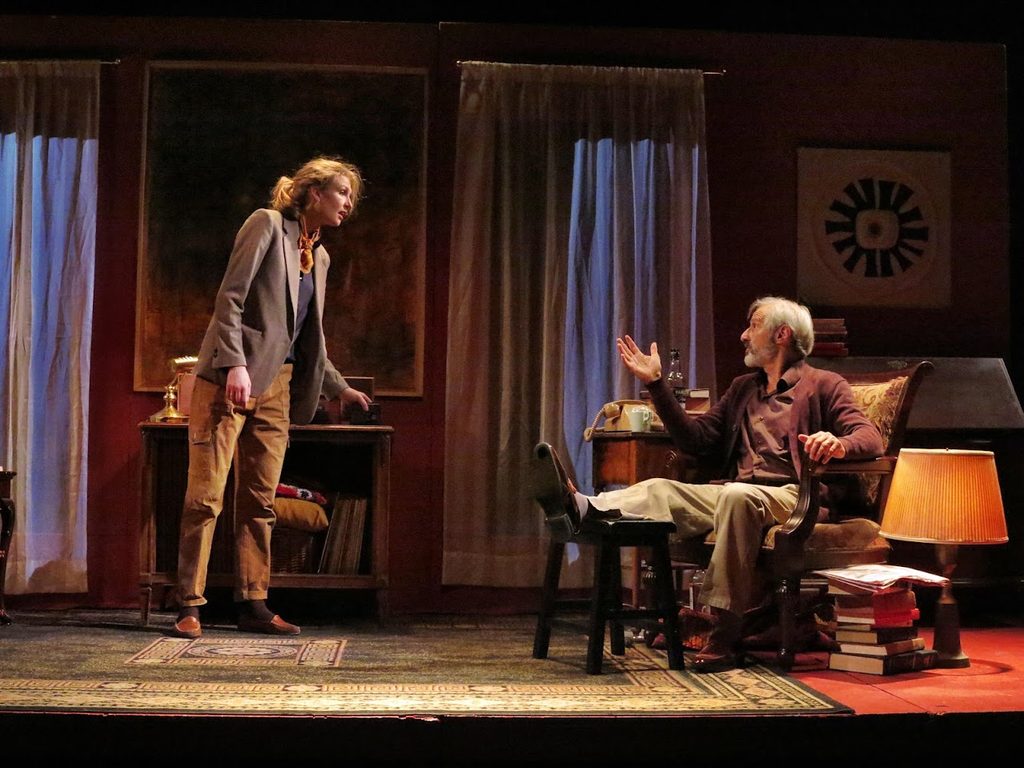
“I put the college on the map. Everyone says that. Put it on the map! I was able to attract the funding and commitment to a liberal arts education that is at the heart of the whole project of Democracy.”
However, for all his BS and bluster, Maya knows that he is not the jolly septuagenarian he hopes to present in his obituary.
“Now, let’s see. You excelled at fundraising and persisted with your little theatre. You started a third-rate nursing school, though that never really took off. You became known as a visionary in education, if not the arts. Three marriages, no children. That’s something.”
During the interview, Steinberger uses subtle touches to establish the characters’ dynamic. Holding’s Maya establishes that she is in control of the situation. Despite her initial fawning comments about the great man, she will shift the power dynamic in her favor. After retrieving two glasses—one a plastic cup and the other a proper coffee cup—she pours whiskey into both. She takes the plastic cup, only to immediately switch them so that Philip has the plastic cup.
The game is on.
The power dynamic is further illustrated when Philip asks Maya to sit on a low stool before him, like a serf before a king. Later, Maya regains her dominance by making Philip sit on the stool while she sits in the club chair.
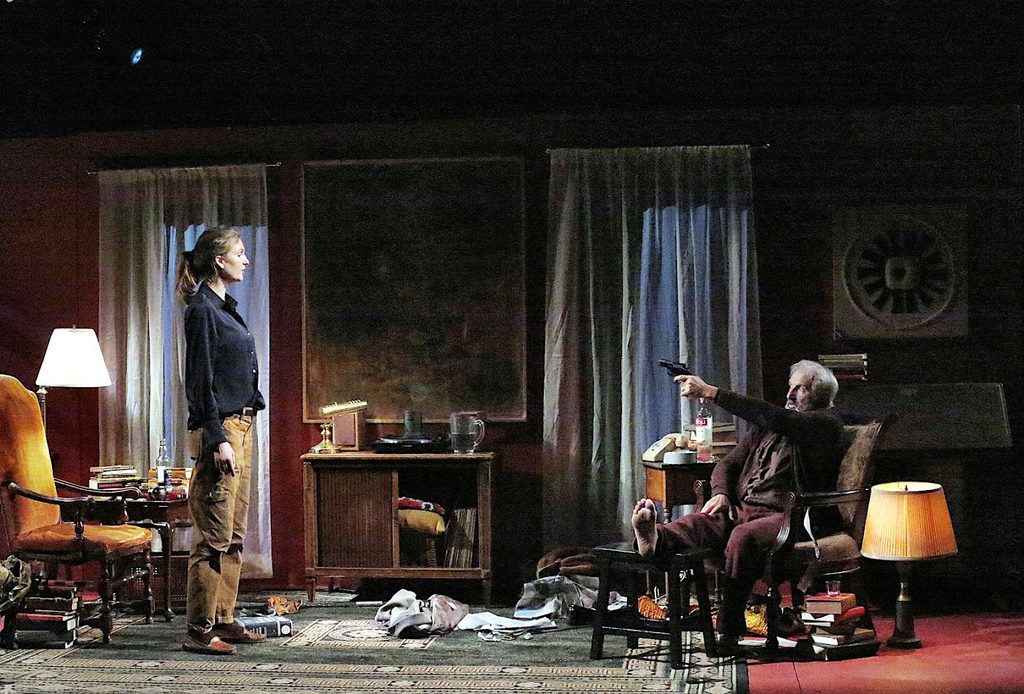
Throughout the performance, Holding’s Maya is a figure of steely reserve as she masterfully exacts her revenge. She is at times playful but also ruthless in getting what she wants—an explanation that Philip protects with lies and denial until Maya physically and emotionally breaks him. In an odd turn, Maya asks Philip to dance. And, of course, she leads.
For all Maya’s terse focus, Topol’s Philip is a storm of opinions and brags. Given the setting in the near future, Chace’s script touches on the current state of education: support dogs on campus, the farm that supported the campus kitchen, the liberal arts as the savior of democracy, foreign-student programs as a lifeline for colleges, donor largesse as possible money laundering, and class distinctions. Philip blithly dismisses them.
After Philip realizes the interview is not going to paint a compelling portrait, he goes into full denial-and-attack mode. When Maya points out, “We both came in the back door. A failed actor and a townie,” Philip snaps, “I am not a failure! I’m getting an obituary in The New York Times!”
Yes, along with Richard Nixon and Bernie Madoff.
The explanation Maya seeks is simple: Why was her mother fired from Briarwood College years ago? It is the reason for her revenge tour de force. In a flashback scene, Holding, as her mother Angela, meets after hours with a younger, flirtatious Philip. The skill of the actors plays out beautifully. Angela takes pity on the plight of the embattled Philip, who, once he gets what he wants, turns threatening and violent. The actors effectively illustrate the cause of Maya’s quest for revenge. Philip caused Maya’s mother’s life to spiral.
Chace’s dystopian choices and the setting slightly in the future afford the designers—Anna Grigo (scenic and costume), Dante Olivia Smith (lighting), and Brian Hickey (sound)—the opportunity to create tension throughout the performance. Frequent blackouts and a storm raging outside, combined with dimmed lighting and headlamps, create an ominous, tense look and feel to the evening.
At one point, as Philip sits on the wee stool with the room in darkness and only the light from Maya’s headlamp. The scene is reminiscent of a film noir interrogation: Philip cowering in darkness, Maya in control, as she has been throughout the night.
Her revenge achieved.
OBIT. Through October 4. Theater for the New City, 155 First Ave. (at E. 10th Street) 90 Minutes. No intermission https://www.obitplay.com/