By Alix Cohen
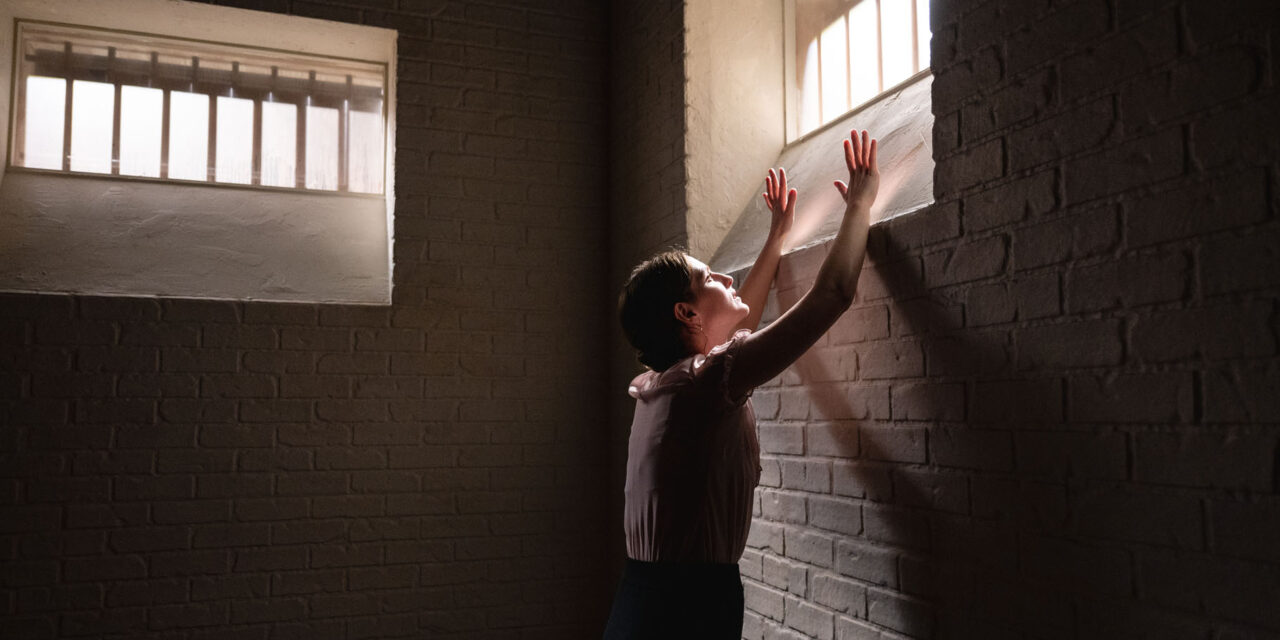
1933 Berlin. Jewish, philosophy graduate student, Hannah Stern né Arendt (Ella Kaille) (and her unseen mother), have been arrested by the Gestapo. Stern is held in a stark, white brick, cellar cell with next to no furniture. For eight days, she’ll sleep curled up on the floor or slumped in a straight-back chair. We hear faint sobbing from elsewhere.
Lauren Helpern’s Set is as unforgiving as circumstances. Lighting by Zachary Connell effectively takes us from day to day. Costume Design by Deborah Caney is spot on.
Karl, (Brett Temple), the young officer assigned to interrogate her, has only just been advanced from a conventional crime unit. Insecurity makes him overzealous with questioning and something of a martinet, but, interestingly, not unkind.
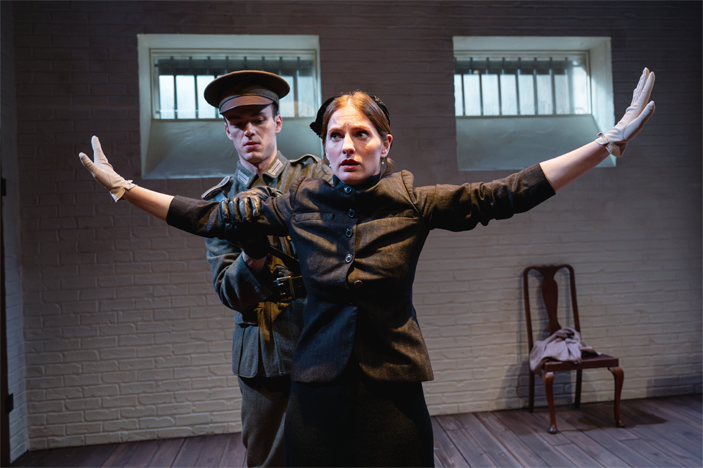
Marshall Law has been declared. Political activism is a crime. Hannah is suspected of gathering evidence of antisemitic propaganda and discriminatory statements to send abroad and sway opinion. She’s taken outside the library, ostensibly “in protective custody for her own sake.”
Why would a doctorate about St. Augustine and love require magazines and newspapers? Karl demands. Wandering the shelves, the detainee responds, serendipitously reading articles as well as pulling books, frees her mind. Nazis search the Stern home. Her husband has left Germany. Karl reads many of the books and journals retrieved looking for evidence.One seems written in code. She says it’s Ancient Greek.
The two discuss St. Augustine, Emanuel Kant, Rahel Varnhagen (who wrote about assimilation, the struggle to be part of society while Jewish), even Goethe. Though not as learned as his prisoner, Karl has inquisitive intellect and surprising education. Discussion of tenants is wisely kept by the playwright to accessible language based on backgrounds.
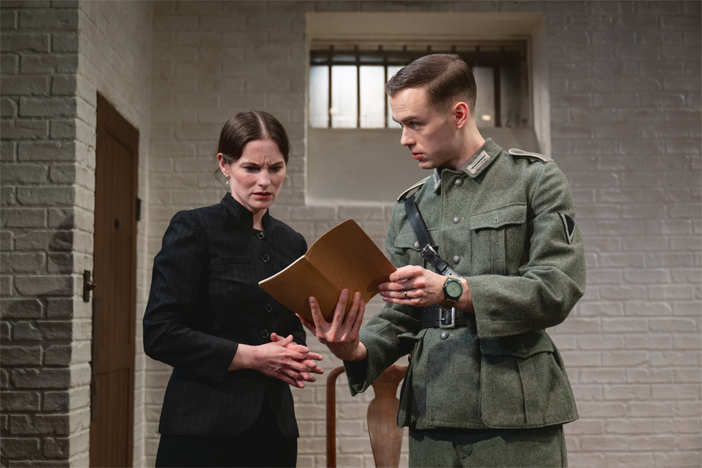
When she’s visited by Erich (Daniel Cantor), a lawyer sent courtesy of Zionists, Hannah stresses she didn’t request representation. He convinces her that his status as a war veteran and government affiliations can only help. “I’ll claim you’re a philosopher only interested in abstract ideas.” Karl counters with implication that association with the cause will hurt her case.
Short scenes offer restrained parry and thrust. Rapport extends to sharing some personal information. Hannah steadfastly maintains her innocence. (She was not innocent.) Whatever Karl thinks, once arrested, charges won’t be dropped. Still, life is not black and white. Even evil can show sparks of humanity.
In 1957, Hannah Arendt would publish The Origins of Totalitarianism, examining how it culminated in the unprecedented political systems of Nazi Germany and Stalinist Russia.
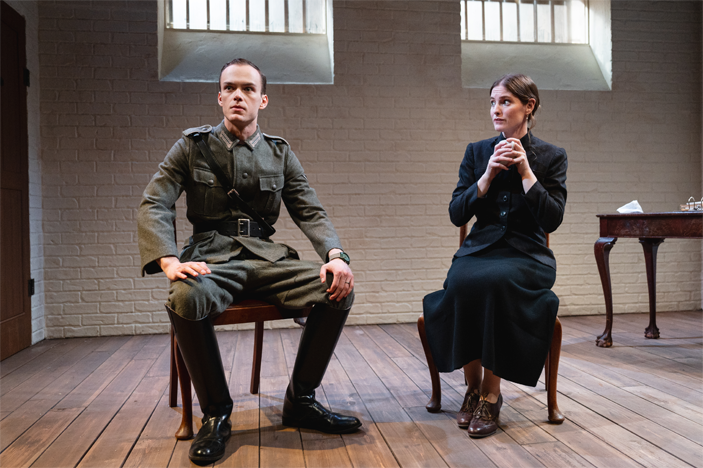
Jenny Lyn Bader’s play is powerful and subtle; direction is not. Ari Laura Kreith minimizes threat/drama by keeping Hannah (Ella Kaille) too wide-eyed and calm even when alone in the cell. Only once do we see her hands shake and that done poorly. As the piece progresses, it seems as if she’ll never get out, yet there’s no sign of increased fear; no stress in her voice, no anxiety in her eyes. Inexplicable over use of arms is distracting. It would be hard to fault the actress herself.
As Karl, Brett Temple comes off better. Awkwardness is credible, his darting, curious mind visible. A bit more menace early on might show pride and commitment the character clearly feels. Also,Temple has a habit of glancing at the audience when he turns his head.
Daniel Cantor’s Eric is low key and believable.
This is a far better piece than its production. It deserves wider recognition.
Photos by Valerie Terranova
Mrs. Stern Wanders the Prussian State Library by Jenny Lyn Bader
Directed by Ari Laura Kreith
59 East 59 Theaters
September 12 – October 25, 2026
https://www.59e59.org/shows/show-detail/mrs-stern-wanders-the-prussian-state-library/?utm_source=mrssterndedicated&utm_medium=email&utm_campaign=mrsstern&dm_i=4ZPT,RROS,2E9I7Z,3DRL8,1,0,0,0