By Stuart Miller…
A strong cast and an intimate setting give new life to monologues Whoopi Goldberg wrote and performed decades ago.
Whoopi Goldberg became a star shape shifting between characters on the Broadway stage in her self-titled show more than forty years ago and performed a celebrated revival twenty years on. Now Goldberg’s stories and characters are back in “The Whoopi Monologues” and it has been noted that the biggest change is giving five talented actresses each a juicy monologue to bring to life.
That change is quite effective, especially because the first monologue is performed by Kara Young, who might be the greatest stage actor working right now. But there’s another change that has drawn less attention: instead of a Broadway stage that keeps a separation between the audience and the spotlighted performer, this production is enhanced by the intimacy of the Mitzi Newhouse Theatre. The actors feel like they’re regaling us, not with a performance but in a conversation (even in Danielle Pinnock’s portrayal of the Jamaican Lady, which is the most performative role); the actors talk to, high five with and respond to audience members, underscoring the connection we feel with these very human characters.
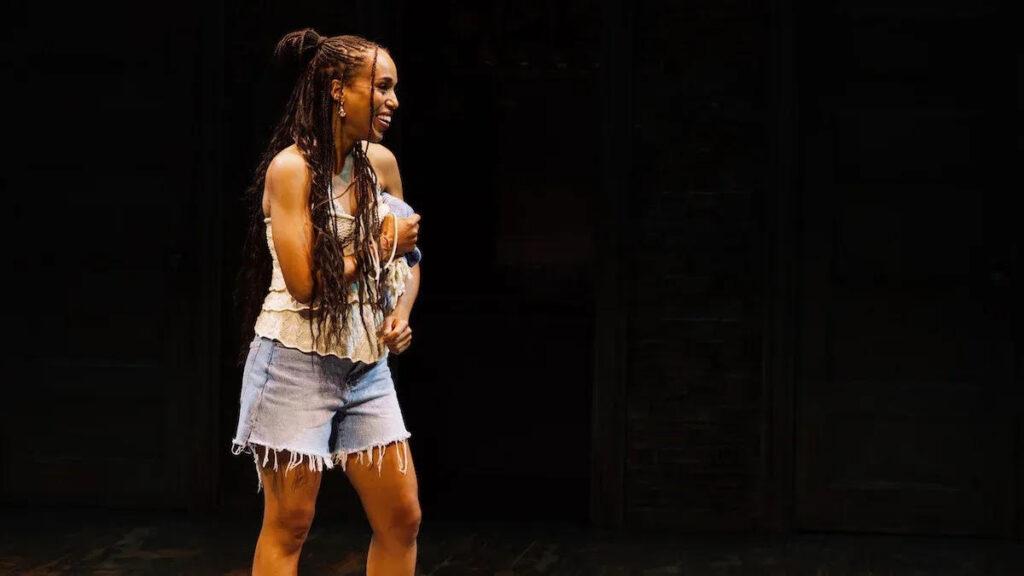
“The Whoopi Monologues.”
One recurring theme is that Black people, especially Black women, were unseen and underrepresented in TV. That was true in the ‘80s but this cast is filled with recognizable faces, headed by Kerry Washington, who also is a producer (and she’ll be replaced after August 2nd by Jurnee Smollett) so bringing these stars up close and personal takes on added importance. Director Whitney White further creates a party atmosphere by finding moments for all the women to be onstage together, supporting each other or dancing the hustle. The environment created is essential because the monologues are uneven in quality and impact and the performances get everyone leaving the theater in a buzzy good mood (which, to be honest, is disconcerting given that three of the first four stories are ultimately dark and heart-wrenching.)
The show opens with Young as Fontaine, whose story is full of surprises– we meet a thief filled with bravado who is revealed to be a junkie but also the possessor of a PhD (which Young “can’t do shit with” so instead stays high to ameliorate the frustrations) and a deep sense of empathy that offsets her frequent rages. From robbing apartments on the Upper East Side to the Anne Frank House in Amsterdam we never know what’s coming next yet it’s all fully grounded and believable. Young is a chameleon within just this one role, holding herself pridefully or flinging herself to the floor in her impression of a green bean that’s the funniest moment of the night. At the end her wounded vulnerability will break your heart.
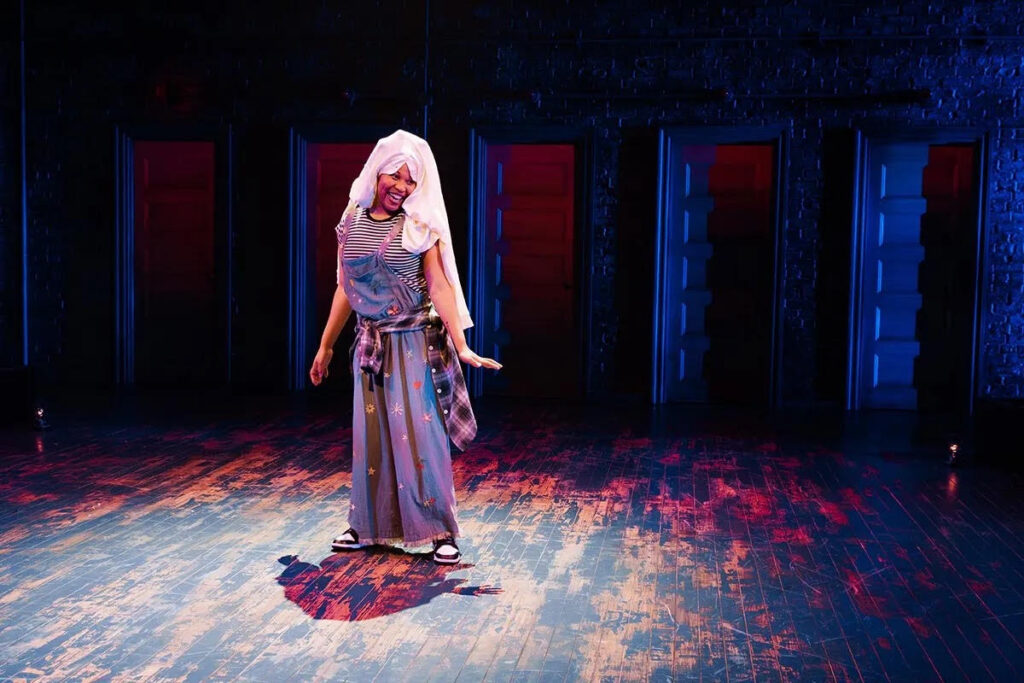
She’s followed by Dominique Fishback as “the Blonde Girl,” a little Black girl who wears a shirt on her head pretending she has “long, luxurious” blonde hair. The girl, perhaps the most famous of Goldberg’s characters (and reminiscent of Toni Morrison’s “The Bluest Eye”), desperately wants blue eyes and even dunks herself in Clorox bleach in her efforts to re-make herself as white. Fishback, who first became known in David Simon TV projects (“Show Me a Hero” and “The Deuce”) actually started with her own solo show “Subverted,” and she easily transforms herself here, finding a little girl’s energy and misguided dreams without veering into caricature.
Unfortunately, the Jamaican Lady who tells the story of moving to America to cook, clean and provide “nookie” for an aging white man she calls the “old raisin,” largely feels like a caricature. Pinnock earns continuous laughs for her over-the-top performance and a wonderfully joyous lingerie reveal, but the role and the story are the least grounded of the night and feel out of place here. (Pinnock also earns a big cheer for throwing in a “Knicks in Five” line but while I’m excited by any reminder of this spring’s amazing championship run, it took me further out of the world created by Goldberg.)
Washington is fine but unremarkable as a Surfer Girl who has gotten pregnant and is turned away by everyone she goes to for help, from the church to her own family. Her obliviousness is poignant but the story doesn’t feel that it’s offering much that is new… until a twist at the end that deepens the character’s anguish and makes us re-think everything we just heard.
The last monologue was added by Goldberg in her 2004 revival and Kecia Lewis brings both warmth and an edge to Lurleen, for whom menopause has her looking back at her life as a woman, from her first period to the hot flashes that are driving her mad. (There are pills for erectile dysfunction, she notes, that are more effective and safer than anything for women enduring what she is.) The story meanders a little and takes too abrupt a turn toward suicidal thoughts and then back to hope and an appreciation of life but Lewis keeps you engaged even when the script falters.
Even though the show is inconsistent, it’s still a worthy revival– at her best, Goldberg has created nuanced characters whose struggles are quite moving and Lewis, Fishback and especially Young reel you into the worlds they are creating on a largely bare stage.
“The Whoopi Monologues” at the Mitzi Newhouse Theater at Lincoln Center runs 1 hour and 40 minutes without intermission.
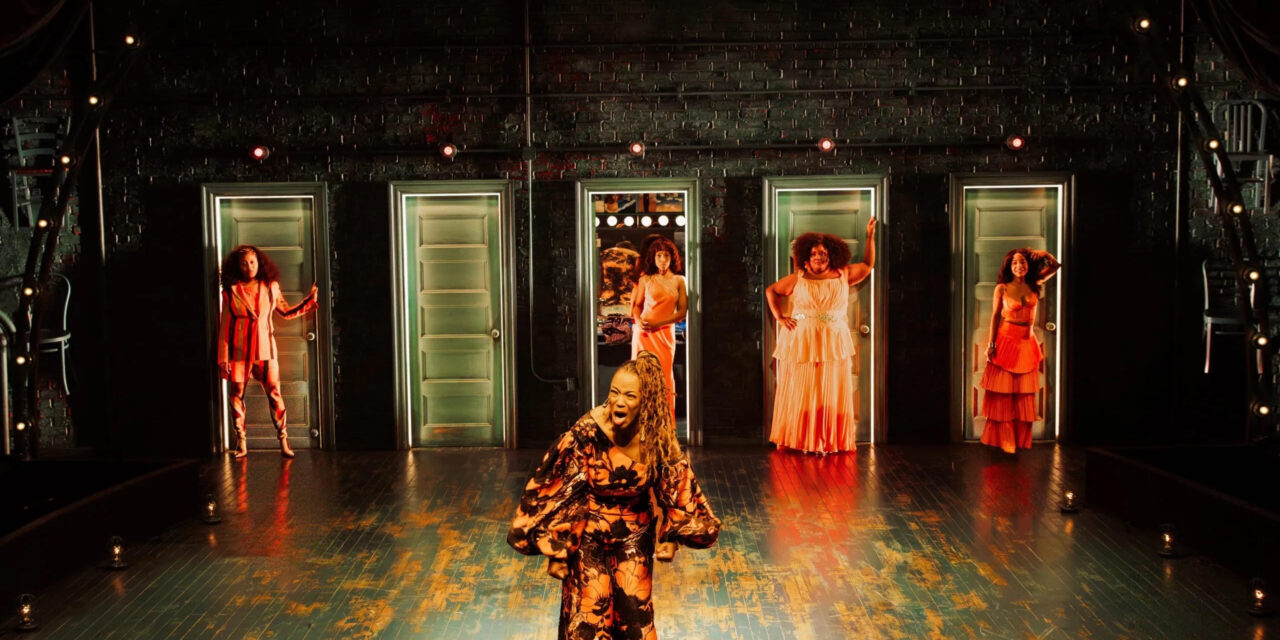
Cover photo: The company of “The Whoopi Monologues.”
Photos: Angela Marie Orellana