By Alix Cohen
In the last five years the U.S. has seen a record rise in censorship laws and enforcement mechanisms—particularly targeting education. The number of bills, the proportion enacted, and the share of students and faculty affected have all climbed dramatically. State and federal actions now constitute a coordinated network of restrictions that many observers describe as the most significant curtailment of academic and expressive freedom in modern U.S. history. Not just words but entire histories have been banned.
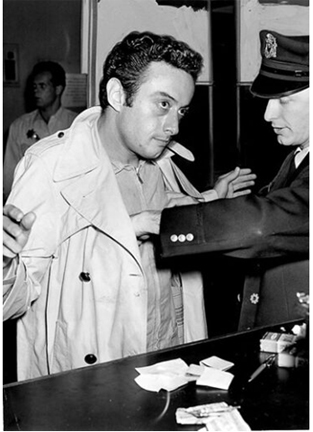
Lenny Bruce 1964 (Public Domain)
Lenny Bruce (1925-1966) used profanity and explicit language deliberately to challenge censorship laws, expose social hypocrisy, and push the boundaries of free speech in comedy. Convicted and sentenced, the artist was exonerated by Governor George Pataki thirty-seven years later. This is the story of his blatantly wrongful trial.
March 1964, undercover detective Herbert Ruhe was in the audience at Café Au Go Go in Greenwich Village where Lenny Bruce was appearing. The venue was known to host celebrated talent. Strict state licensing for movies, aggressive crackdowns on adult literature, and libel laws were in effect. Ruhe later admitted the city was looking to make an example.
Bruce would’ve disdained “undercover.” He had a habit of goading obvious police. There to ascertain probable obscenity charges, Ruhe not only took down terms he considered repugnant but added his own editorial comments.
April 3, the comedian was detained by plainclothes officers before his 10 p.m. show. Also held were club owners Howard and
Elly Solomon. The charge was “obscene, indecent, immoral, and impure play, exhibition and entertainment” a possible three year sentence.
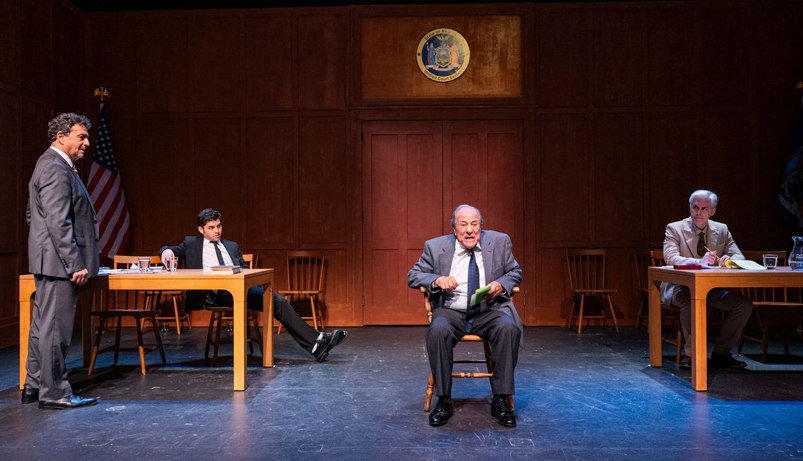
Stephen Schnetzer (Martin Garbus), Johnny Anthony (Lenny Bruce), Dan Grimaldi (Herbert Ruhe), Ian Lithgow (Richard Kuh)
Poet Allen Ginsberg immediately formed the Emergency Committee Against Harassment of Lenny Bruce joined by hundreds of prominent writers, actors, educators, and critics. The accused hired first amendment attorney Ephraim London who telephoned young associate (and Bruce fan) Martin Garbus, apparently the night before the comic’s arraignment. Garbus would be second chair. He was thrilled.
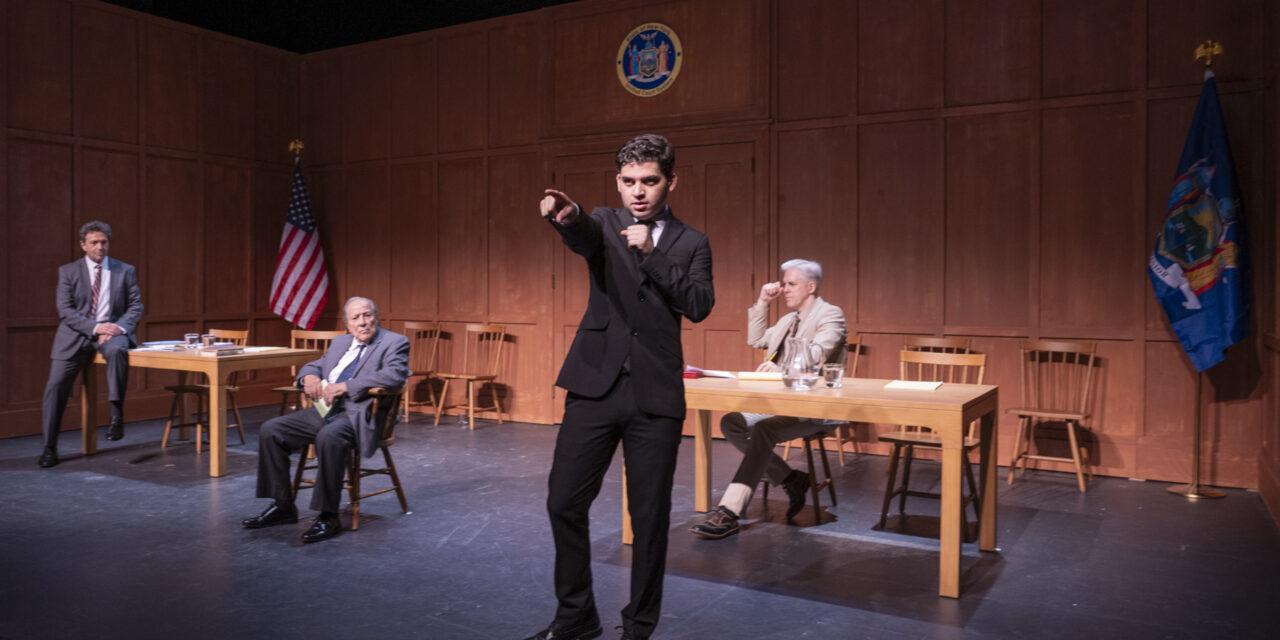
“I wonder how many of you have pissed in the sink?” asks Garbus (Stephen Schnetzer) in his additional role as narrator (and judge.) In court, Bruce (Johnny Anthony) attempts to deliver the “bit” from which this is quoted. Throughout proceedings, the comic stresses that context and appropriate delivery are necessary to understand intention, but is prevented from performing his act in court. (Susan Charlotte’s play gives him the opportunity.) “How do you police creativity?” he exclaims, exasperated.
Anthony’s restless movement and Long Island accent are effective. Unfortunately, he looks nothing like the wirey, drug-fueled protagonist. Softness extends to acting which seems annoyed rather than brooding and desperate, an unwell man fighting for his professional life.
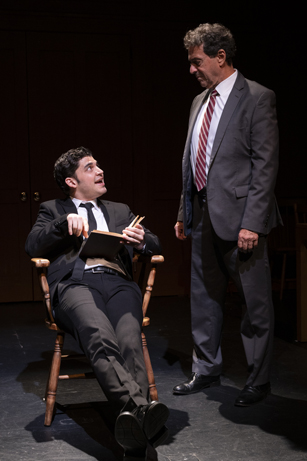
Johnny Anthony (Lenny Bruce) &
Stephen Schnetzer (Martin Garbus)
On the stand, key witness Inspector Ruhe (Dan Grimaldi, irritatingly vivid) presents excerpts from Bruce’s act – monotone, without frame of reference, and evidently changing some language. “Putz,” Bruce mutters from the sideline. “I assume that’s a liberal, leftist term,” the detective snaps.
Prosecutor Richard Kuh (Ian Lithgow- a bit vague, but the part is also written that way) encourages Ruhe to describe masturbatory gestures ostensibly made by Bruce onstage and is later “caught” by the defendant stroking his own pen in kind. Bruce denies the actions backed up by several people present at the time.
The playwright chooses three pivotal witnesses to exemplify the case.
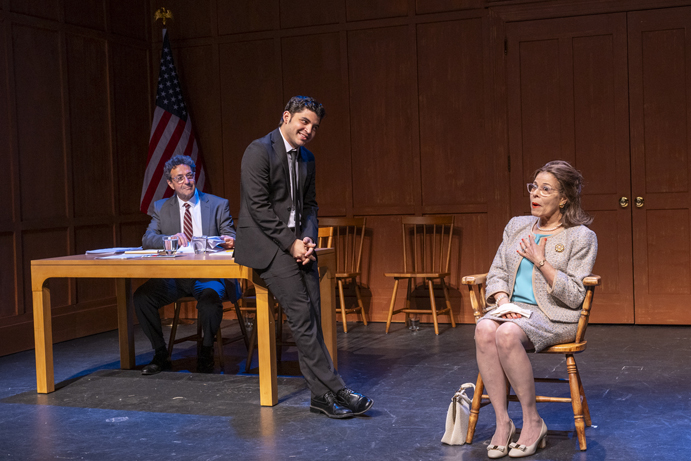
Stephen Schnetzer (Martin Garbus), Johnny Anthony (Lenny Bruce), Roberta Wallach (Dorothy Kilgallen)
Columnist, radio, and TV personality Dorothy Kilgallen (Roberta Wallach), referred to as “a spokesperson for the most prudish elements in the entertainment world” in fact, unflappably defends Bruce. “He’s trying to stimulate his audience and make them think.” Wallach is aptly ladylike and precise. Wasn’t Kilgallen a brunette?
Cartoonist/playwright Jules Feiffer (Timothy Doyle) says Bruce “gets to the core of what the American experience is today…He’s brilliant… and desperately needed.” The character is smart, soft spoken, modest. Doyle has chosen to make him fluttery. Though based on my research, not accurate, it works.
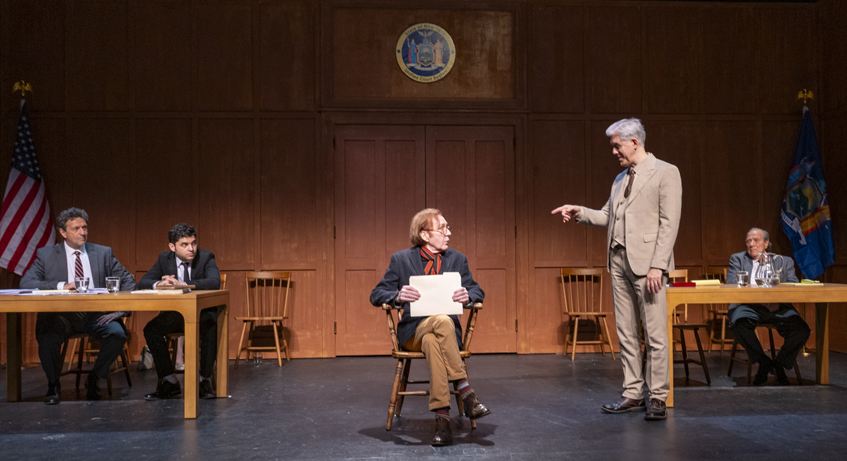
Stephen Schnetzer (Martin Garbus), Johnny Anthony (Lenny Bruce), Timothy Doyle (Jules Feiffer)
The third witness is Presbyterian Minister Forrest Johnson (Jonathan Spivey) who attended the performance in question. “I think he was talking about the cheapening of religion,” he says referring to a section of the monologue. The character doesn’t understand what all the fuss is about. Spivey is thoughtful and credible.
Bruce was treated for pleurisy and exited the hospital even more debilitated. We should see him broken when singing to himself, muttering about the loss of his wife, yet faculties in court remained clear.
Kuh asked for imprisonment. Bruce was sentenced to four months in the workhouse. Free on bond, he never got there, dying of an overdose August 1966.
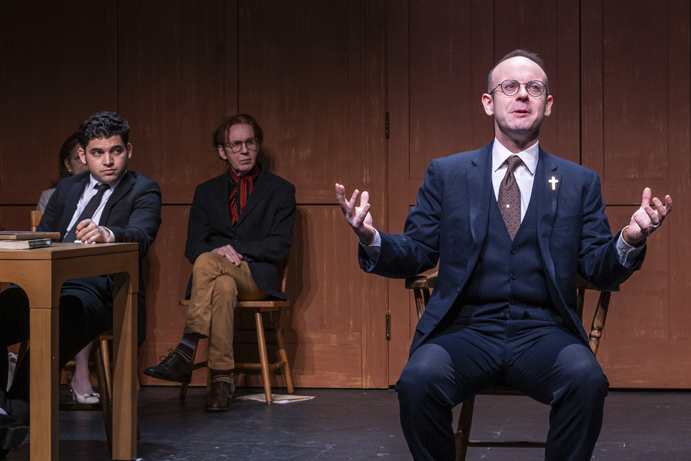
Johnny Anthony (Lenny Bruce), Timothy Doyle (Jules Feiffer), Jonathan Spivey (Forrest Johnson)
Director Anthony Marsellis uses the stage well. Actors are focused. The piece is well paced.
It’s a helluva story reflecting the impotence of those battling censorship today. Expressions that plausibly cut short the life of a major satirist are now commonly used in almost all the arts.
Except for Bruce’s meandering monologue at the end of the play, the piece moves along. Real testimony and the artist’s interjections are effectively edited.
Tonight’s greatest drawback is the performance of Stephen Schnetzer who is consistently insecure about his lines, gutting the emotion and commitment of the character. An off night?
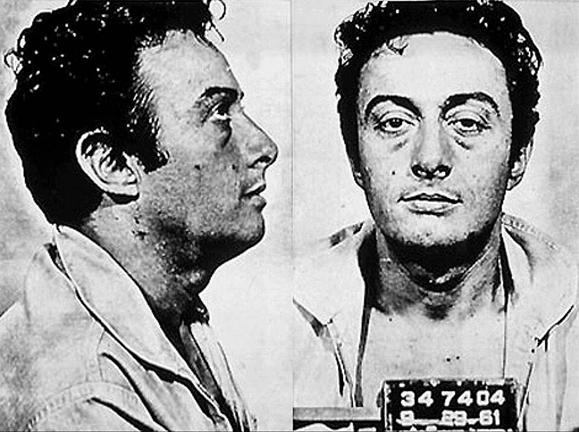
Lenny Bruce mug shot (Public Domain)
Production Photos by Russ Rowland
Attorney Martin Garbus has argued cases involving first amendment, constitutional, criminal, copyright and intellectual property law. Among his impressive list of past clients are Daniel Ellsberg, Don Imus, Nelson Mandela, Vaclav Havel, Cesar Chavez, Allen Ginsberg, and Lenny Bruce. Garbus’s book Ready for the Defense (Farrar Straus & Giroux, 1971), his memoir Traitors and Heroes-A Lawyer’s Memoir, and conversations with the attorney provided source material.
This is Susan Charlotte’s fourth theatrical adaptation of his cases under the umbrella title “All The Court’s a Stage” after Shakespeare.
Cause Célèbre Productions presents
The People Versus Lenny Bruce by Susan Charlotte
Based on The People Against Lenny Bruce in Ready For The Defense by Martin Garbus
Directed by Antony Marsellis
Theatre Row 410 West 42nd Street