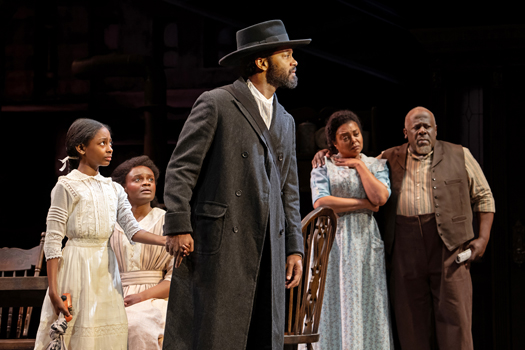
On the stairs of a 1911 Pittsburgh boarding house, a young tenant plays the song “Joe Turner’s Blues:” They tell me Joe Turner’s come and gone/They tell me Joe Turner’s come and gone(Oh, Lordy) /Got my man and gone…
W. C. Handy described it as a “true folk song of the Negro.”
Turner was known for rounding up Black men on minor or false charges, forcing them into chain gangs and labor camps during the late 19th and early 20th centuries. His actions became a symbol of racial oppression and the continuation of slavery-like conditions after the Civil War.
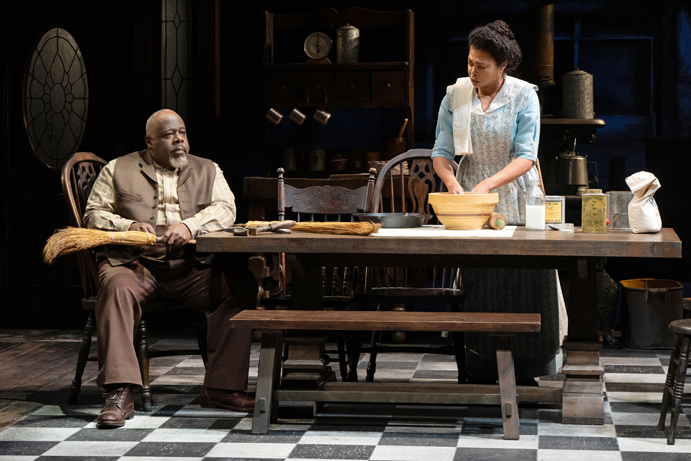
Cedric the Entertainer (Seth Holly), Taraji P. Henson (Bertha Holly) ,
Playwright August Wilson makes the axis of this work Herald Loomis (Joshua Boone), a man haunted after being kidnapped by Turner and forced into seven years labor. Finally released, but broken, with young daughter, Zonia (Savannah Commodore) in tow, he searches for lost wife Martha (Abigail Onwunali), hoping to reclaim his life.
Joshua Boone presents a self-contained man on the verge of erupting. When the character does so, and the manner in which it occurs, is palpably unnerving.Boone is as good a physical actor as he is persuasively emotional. Act II finds him in a well deserved spotlight.
Owner of the establishment Seth Holly (Cedric the Entertainer) was born into a free family. Keeping this in mind helps perspective. He finds Herald spooky from the get-go. “Somethin’ ain’t right with that fella…he looks like he owes the devil a day’s work.” Seth’s wife, Bertha (Taraji P. Henson) tells him to back down, have sympathy for the man, and take the $2 weekly rent.
The proprietor works a night shift at a factory. He also makes pots and pans- as taught him by his daddy- which are sold to White peddler, Rutherford Selig (Bradley Stryker.) The playwright indicates obtuse bigotry beneath the salesman’s affability. Selig has a reputation for finding people which is, in fact, mostly luck. Herald pays him to find Martha. Bertha runs the house and her frequently bombastic husband. Both Taraji P. Henson and Cedric the Entertainer are eminently naturalistic and credible.
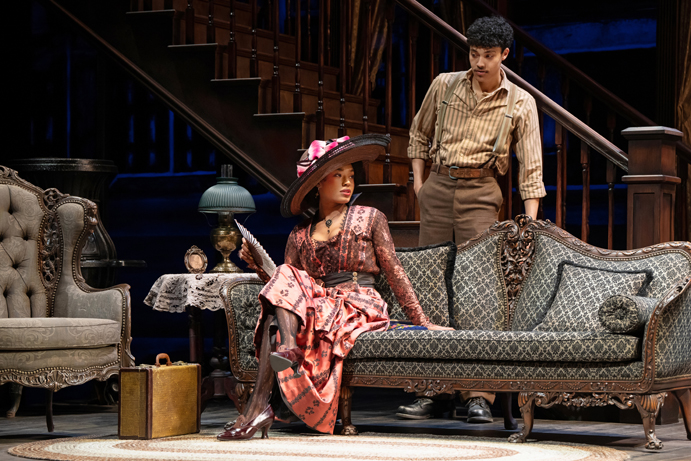
Maya Boyd (Molly Cunningham) & Tripp Taylor ( Jeremy Furlow)
Representing Black spiritual traditions, Bynum Walker (August Wilson denizen, Ruben Santiago-Hudson) seems like a permanent part of the household. Raised in slavery, he’s a rootworker and conjure man, a kind of shaman that helps people find connection, purpose, and identity with a “Binding Song.” From this, he garners a little income.Hudson is marvelous. Not a gesture or tone is out of place in his character creation. Whether curmudgeonly or in the spirit, he captivates.
Also in residence are itinerant construction worker, guitarist, and opportunist Jeremy Furlow (Tripp Taylor.) Then, successively, bereft Mattie Campbell (Nimene Sierra Wureh), abandoned by a n’er-do-well boyfriend who she attempts to hire Bynam to find, and Molly Cunningham (Maya Boyd) an attractive woman on her own who secures what she needs from admirers.
Nimene Sierra Wureh embodies Campbell as just innocent enough for us to believe a growth of maturity and adjusting to circumstance. As Molly, Maya Boyd is charming and believably strategic.
The story reflects pain, prejudice, resilience, culture, and the ongoing struggle to define oneself in America. A roster of backgrounds and fates offers a glimpse pf the era’s Black population. Only one scene, featuring Zonia and neighboring boy, Ruben, (a too self conscious Jackson Edward Davis) seems totally extraneous.
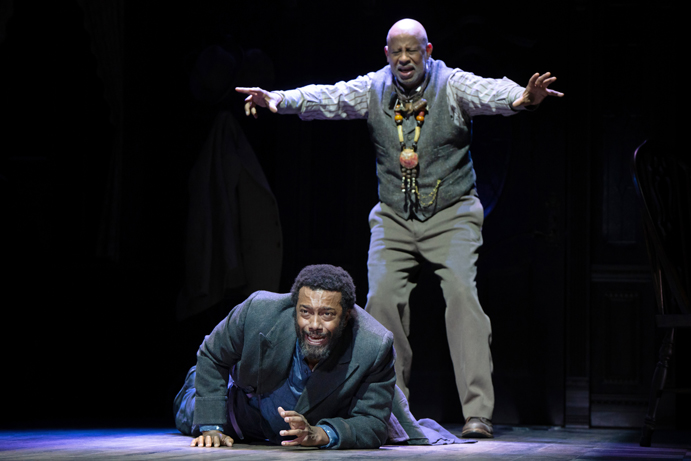
Joshua Boone (Herald Loomis) & Ruben Santiago Hudson (Bynam)
Directed by Debbie Allen, the piece uses its staging area with variation and realism. Characters are distinctive, actors focused. Segments of Herald “slain by the spirit”/talking in tongues/having a fit, are particularly well manifest. Also uniquely appealing is an ebullient, after dinner Juba dance. (a West African–rooted spiritual dance tradition where participants move in a counterclockwise circle, clapping, stomping, and singing.)
The set is all brown, as if a sepia photograph of the period. Floating windows indicate a second story. (David Gallo)
Costumes by Paul Tazewell are flattering, well tailored, and bespoke to character. ‘Love Bynum’s tribal necklace.
Sound Design (Justin Ellington) is excellent.
Original Music/Music Supervisor Steve Bargonetti offers evocative, apt, and understated tune.
Vocal/Dialect Coach Dawn-Elin Fraser has everyone on the same page- not a given.
Joe Turner is part of August Wilson’s Pittsburgh Cycle, also called the Century Cycle. The series includes ten plays, each set in a different decade of the 20th century, exploring African American life, history, struggle, culture, and resilience.
Photos by Julieta Cervantes
Opening: (Savannah Commodore (Zonia), Nimene Sierra Wureh (Mattie Campbell), Joshua Boone (Herald Loomis),
Taraji P. Henson(Bertha Holly) , Cedric the Entertainer (Seth Holly)
Joe Turner’s Come and Gone by August Wilson
Directed by Debbie Allen
Ethel Barrymore Theatre 243 West 47th Street