By Ron Fassler . . .
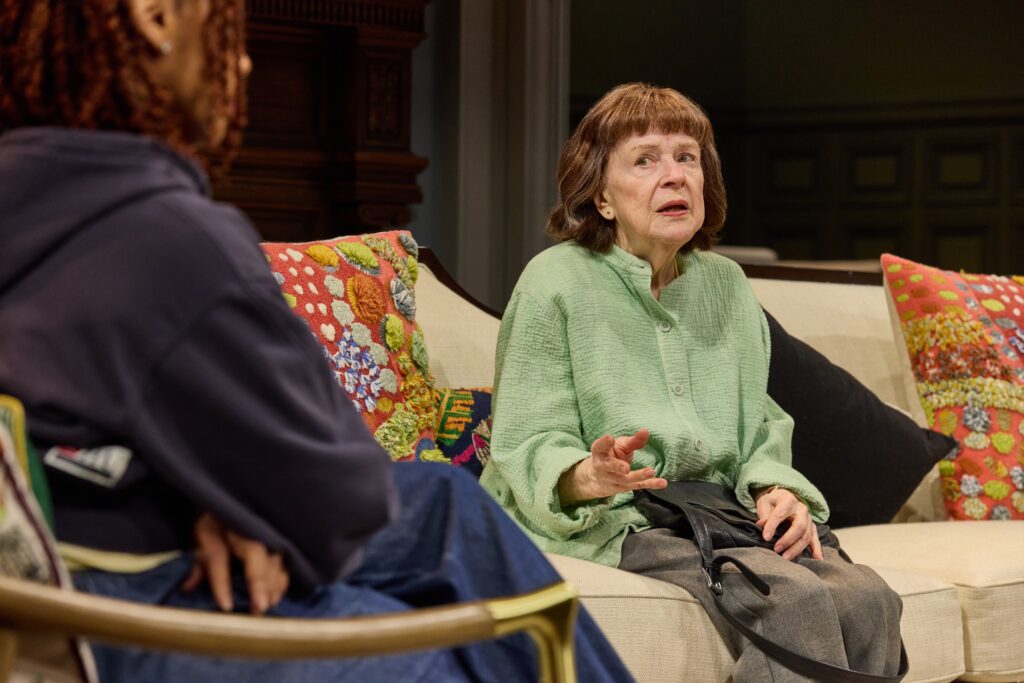
Over time, the relationship between playwrights and their muses have produced some extraordinary results. Such pairings go back as far as the Greeks and Sophocles, who it is said to have looked to actors Tlepolemus and Cleidemides for inspiration with his plays. And Richard Burbage, the first to portray Richard III, Romeo, Henry V, Hamlet, Macbeth, Othello, and King Lear, certainly influenced how Shakespeare wrote those roles. Modern playwrights such as Arthur Miller, Tennessee Williams, Edward Albee, and Terence McNally all had their muses. In fact, Albee and McNally shared one in Marian Seldes. And it has been our great, good fortune over the last thirty years that Pulitzer and Tony Award-winning playwright David Lindsay-Abaire has written specifically for the marvelous Marylouise Burke, with whom he has teamed on a half-dozen remarkable plays and performances.
In a recent interview with journalist Raven Snook, when Burke was asked about being Lindsay-Abaire’s muse, she modestly replied, “Well, I can’t say that he considers me his muse. He’s certainly central in my life.”
“Can I say that she is my muse?, “Lindsay-Abaire quickly responded. “Because she is. Her voice started to get in my head, so much so that whenever I would hit a bump in a play, I would think, okay, let’s bring in Marylouise. Does that solve the problem? And automatically, the dam would break. Then I just started writing with her in mind, and she made and continues to make all of my plays so much better.”
And it has been our great, good fortune over the last thirty years that Lindsay-Abaire has written specifically for the marvelous Marylouise Burke, with whom he has teamed on a half-dozen remarkable plays and performances. And now with their 7th, The Balusters, another delectable part for Burke. First among equals in this ten-person, rip-roaring comedy, Burke—at age eighty-five—makes it impossible to imagine anyone else doing what she does on the stage of the Samuel J. Friedman Theatre. And while radiating in the glow of Burke’s work, it did cross my mind that since the fall, we’ve also gotten to experience the ninety-one-year-old Ann Reid’s remarkable Broadway debut in Oedipus, and the indefatigable June Squibb turning ninety-seven (!) during her limited run in Marjorie Prime. Truly, this has been a Broadway season for the ages—or should I say aged?
If its plotting seems familiar, that’s because The Balusters takes a hammer to a neighborhood association meeting in much the way Tracy Letts did with a plunging darkness in The Minutes (2020), and what Jonathan Spector hilariously achieved with last season’s Eureka Day, another MTC production. It all takes place on a single set—Derek McLane’s perfectly appointed plush living room in a Victorian home built circa 1900. The house has been recently purchased by Kyra Marshall (Ankia Noni Rose), who has moved to Vernon Point with her offstage husband and teenage daughter. African American, Kyra is feeling much happier living in this fictional city, rather than her previous residence in the non-fictional Baltimore. And though Vernon Point is decidedly upscale, the playwright describes in his stage directions that “if you walk a few blocks, just beyond the boundaries of the historic district, you’ll find apartment buildings, discount stores, and housing projects.” Kyra, quickly recruited as the newest member on the board of the city’s Historical Society, winds up playing hostess to a series of meetings in which the audience are flies on the wall to the goings-on. It’s a riotous journey from “decorum to disaster,” as the play’s advertising cleverly states. With increasing intensity, issues concerning the landmarked status of their treasured homes come close to matters of life and death, raising the stakes dramatically for the comedy that ensues. Whoever thought discussions over a stop sign could generate so many sparks of lightning-fresh humor? And as would be expected from a playwright of his caliber, Lindsay-Abaire gets in some keen-eyed commentary on where we are at this quarter mark of the 21st century. Much of the humor will hit close to every American home.
The aforementioned Burke plays Penny Buell, the eldest of the group and the one responsible for taking the minutes, mostly in absent-minded fashion. The long-serving President is Elliot Emerson (Richard Thomas), to the manor born and who holds onto his gavel like a security blanket. The Vice-President, Melissa Han (Jeena Yi), is an Asian American who has a feisty manner and is not to be toyed with. Nor is the Treasurer, Ruth Ackerman (Margaret Colin), a caustic, well-to-do matron. Willow Gibbons (Kayli Carter), thirtysomething, has inherited a family mansion where she lives by herself, while home builder Isaac Rosario (Ricardo Chavira), a Latino and who doesn’t come from money, can afford to live among these elites having married a successful local doctor. Rounding out the board are Alan Kirby (Michael Esper), who has a difficult time being listened to, and Brooks Duncan (Carl Clemons-Hopkins), African American and gay and, due to that status, mentions more than once his feelings about being on the outs with these folks. Lastly is Luz Baccay (Maria-Christina Oliveras), a Filipino housekeeper who seemingly knows where all the neighborhood bodies are buried.
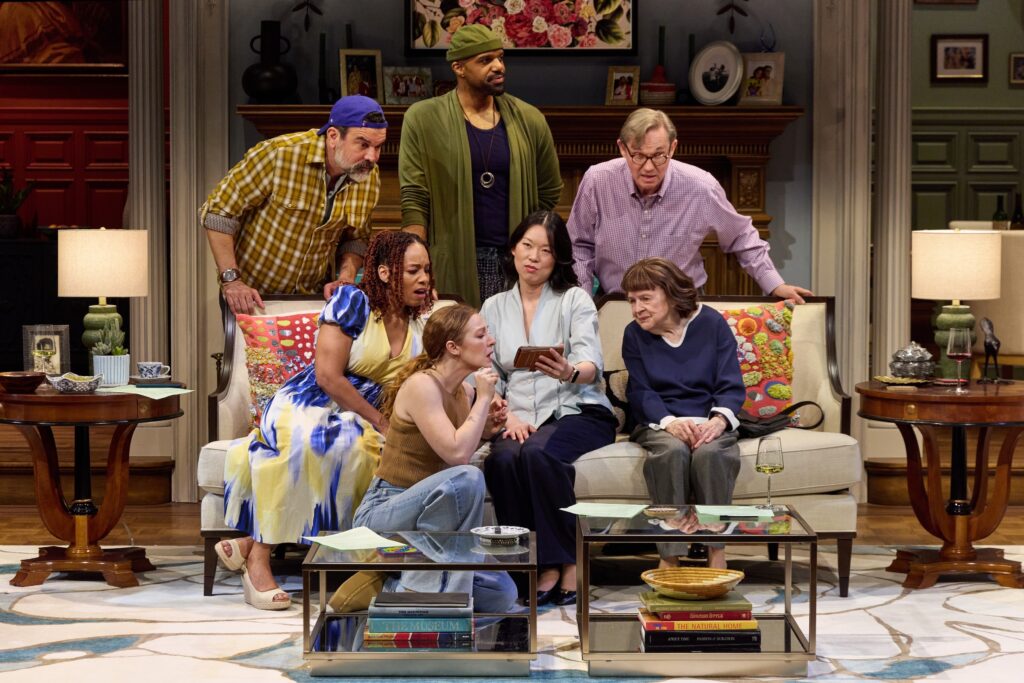
Under Kenny Leon’s fine direction, this flawless band of actors perform wonders with the material. Already having sung the virtues of Burke’s Penny, I additionally admired Richard Thomas’s performance to no end. Celebrating 68 years as an actor on Broadway (he made his debut at the age of seven in Dore Shary’s hit 1958 drama Sunrise at Campobello), Thomas is at his career-best here. Anika Noni Rose infuses the leading role of Kyra with intelligence and a mothering instinct not to be messed with. Margaret Colin lands every zinger with her usual panache, and there are deft and complicated turns from Maria- Christina Oliveras and Jeena Yi that are outstanding. There is also fine work from Kayli Carter, Ricardo Chavira, Carl Clemons-Hopkins, and Michael Esper. It’s seriously one of the funniest and most talented casts on Broadway. Kudos as well to Emilio Sosa’s spot-on costumes, excellent lighting design by Allen Lee Hughes, and Thomas Schall’s crafty fight direction. My only criticism is the sound design from Dan Moses Schreier is ear-splittingly pumped into the theatre before it started and felt jarringly out of place as interstitial music between scenes.
The more I think on it, I grow fonder that Lindsay-Abaire titled his play The Balusters. Yes, balusters are an important plot point (someone’s installed improper and anachronistic ones while updating an historic home), but because it’s an unfamiliar word with a funny sound to it. Seeing the title The Balusters on a poster might be cause for someone to mistake it for story of a family. After all, we’re all basically stuck with neighbors as family, right? Impossible to get rid of and sometimes forced to live with, such a conceit makes the play easily relatable and truly funny.
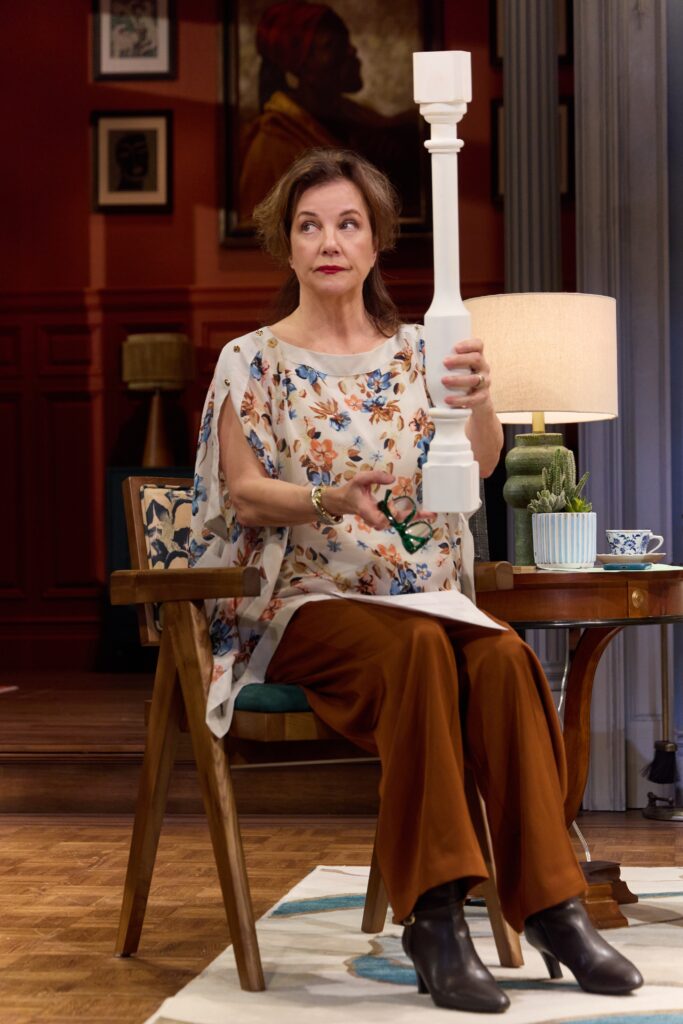
With so many outrageous lines done to a fare thee well from this sensational acting ensemble, The Ballusters provides more gut-busting laughter than any show this season. And at the preview I attended, Marylouise Burke was greeted with an ovation at her curtain call that was so euphoric it seemed to take her aback. Let’s hope in two weeks’ time she’s equally stunned by the news of a first time Tony Award nomination for Featured Actress in a Play. Personally, no other nomination would make me happier.
At the Samuel J. Friedman Theatre, 261 W. 47th St., New York; https://www.manhattantheatreclub.com/shows/2025-26-season/the-balusters/
Photos by Jeremy Daniel.
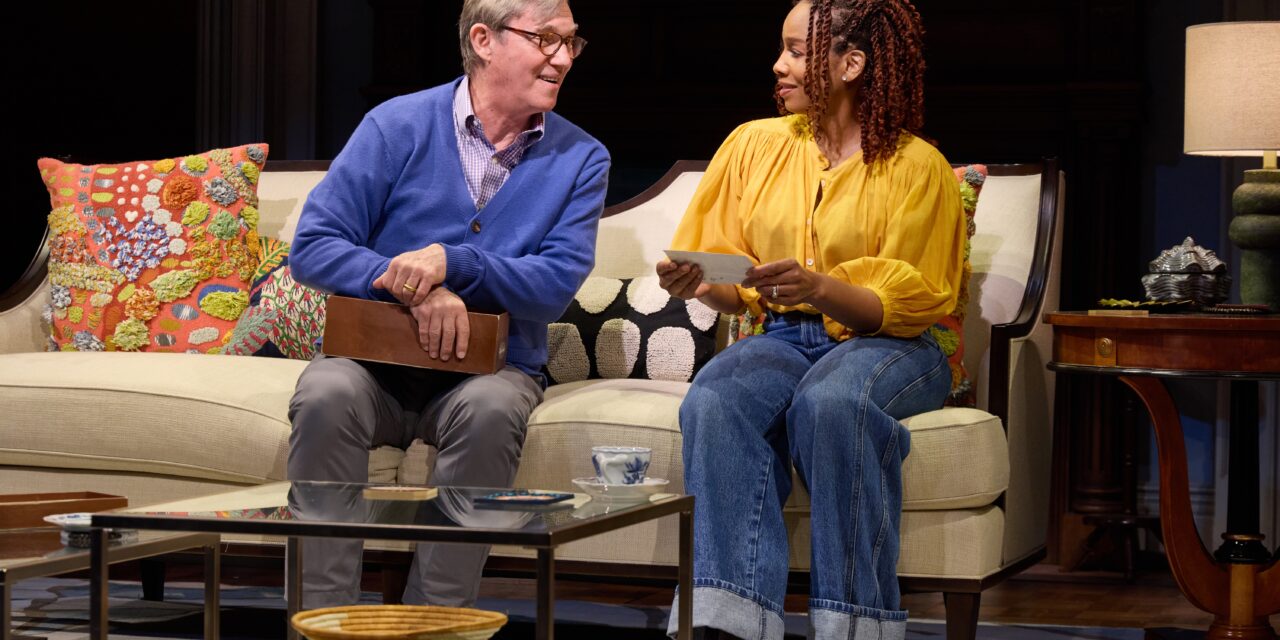
Headline photo: Richard Thomas and Anika Noni Rose in The Balusters.