By Samuel L. Leiter . . .
For all his status as France’s greatest playwright, it must be admitted that, like Shakespeare’s, some Molière plays no longer have much of a pulse, at least not when done in English. One example is The Imaginary Invalid, written in 1673, in which he starred briefly before succumbing to a non-imaginary ailment.
While productions of this farce have not been uncommon in American universities and regional theatres, New York has largely ignored it. Prior to its current, comically obese production at the Roundabout’s Todd Haimes Theatre, it was seen, for three brief twinklings, in 1917, 1922, and 1967. Off Broadway supported revivals in 2004, 2012, and two last year, one by Molière in the Park, the other by the Red Bull Theater. The only one I saw was the last, and perhaps I missed something in the others, but combined with the new one, I’ve been purged of any desire ever to see another.
From what I’ve seen and read about, the typical approach seems to be on pedal to the metal farce, in which directors take every opportunity to inject jokey steroids to pump up the laugh muscles. Brandon Dirden, best known as a fine actor and here making his Broadway directing debut, follows suit with an over-the-top mounting, costumes and wigs included, that comes off as a competition among gifted actors—led by the inimitable Bill Irwin—to discover who can outshout, out-mug, and out-exaggerate their fellow thespians.
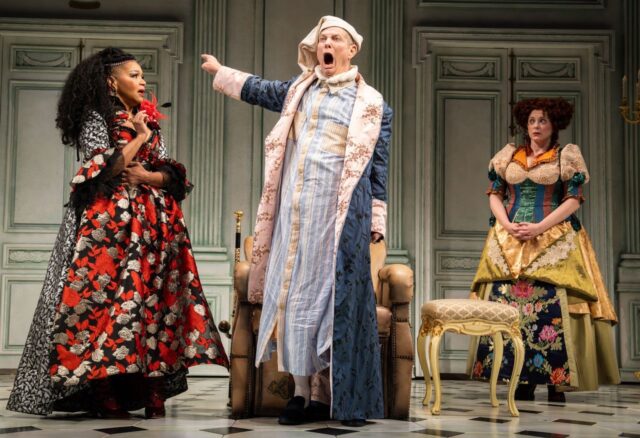
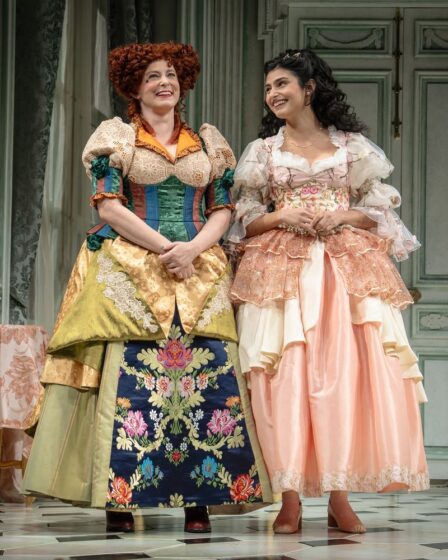
The Imaginary Invalid is vulnerable to these wishfully infectious hijinks with its situation in which a quarrelsome hypochondriac named Argan (Irwin), with a predilection for enemas, pays a quorum of quacks for a pile of prescriptions to treat the numerous ailments to which he believes his flesh is heir. His activities are overseen by one of those Molière maids, the skeptical, saucy soubrette, Toinette (Rachel Bloom), who also nurses along the affairs of Argan’s desirable daughter, Angelique (Ava Lalezarzadah).
Angelique’s in love with handsome Cleante (Daniel Croix Henderson), whom Argan rejects because he’s not a doctor, preferring Thomas (Hiram Delgado), the physician son of Argan’s chief physician, Dr. Diafoirus (Brooks Ashmanskas), so he can have a doctor around 24/7. Argan’s scheming second wife, Beline (Crystal A. Dickinson), involved with the shyster lawyer, Bonnefoy (Delgado again), hopes to get her hands on his fortune, while the play’s raisonneur, Argan’s brother, Beralde (Dylan Baker), strives to keep things under control.
The Imaginary Invalid owes its reputation to its broad satire of both hypochondria and the greedy, incompetent medical frauds who thrive on people’s fears. It’s one of a group of Molière plays in which a leading character’s extremism makes him ripe for mockery. The plot and characters, like so many, are replete with elements inspired by commedia dell’arte.
Dirden’s opening sequence reminds us of both that background and of the play’s origin as a comedy ballet, with the cast dressed in black, like a chorus of dottores, masks included, their white ruffs cleverly illuminated on the dark stage, their choreography (movement direction: Lorenzo Pisoni; music: John Gromada) timed to the scenery’s assembly as we watch. Designer Beowulf Boritt—who also designed last year’s Invalid—is responsible.
The rear and side walls come together as the ceiling drops in to create a beautiful forced perspective take on a classic French drawing room set, its charms enhanced by Allen Lee Hughes’s lighting. Two upstage doorways (no slamming, thank goodness, as in the Red Bull staging) and a secret one in a side wall provide for entrance and egress. At center, deliberately spoiling the formalistic aesthetic, is a decaying leather lounge chair from which Argan, dressed in bathrobe and night cap, rules his roost. It’s a brilliant moment, never matched by what follows.
Bill Irwin’s satisfactory adaptation of Doug Skinner’s translation thrusts at both old and new concerns in touching on health care costs, medical malpractice, legal malfeasance, pharmaceutical fakery, and nosophobia, with a strong infusion of metatheatrical wisecracks spoken directly to the audience. One of the few I laughed at alluded to the many doctors in the audience whose subscriptions support the Roundabout.
The play’s theatricality allows for such interpolations but it goes off the rails when each character is allowed free rein to ham it up, with no one—not even the rational brother—even approaching reality. The humanity of these characters—their heart—is sacrificed in the search for gags. Even if exaggerated in presentation, there must be a sense of real stakes involved; each actor here is capable of providing it. However, no sooner does someone enter than they’re speaking at the top of their voice or doing something suggesting that they’re the next step in a rising wave of hilarity that seeks to top what’s come before. It’s exactly what I found wanting—others disagreed, of course—in the Red Bull mounting.
Even the great Bill Irwin, although a tad more restrained than his costars, seems to be there not to embody a man with serious health delusions so much as someone seeking the next excuse to demonstrate his amusing physical skills. He can still bring it when it comes to vaudevillian shtick, which he demonstrates during the epilogue with a retrofitted derby, but it’s usually extraneous to the life of the man he’s playing.
Funny costumes (by Karen Perry), funny wigs (by Nikiya Mathis), and funny acting do not always add up to a funny farce when what’s needed is a heart transplant. And even an enema can’t replace that.
At the Todd Haines Theatre, 227 W. 42nd Street, NYC. For further information, please visit The Imaginary Invalid.
Photos by Joan Marcus.
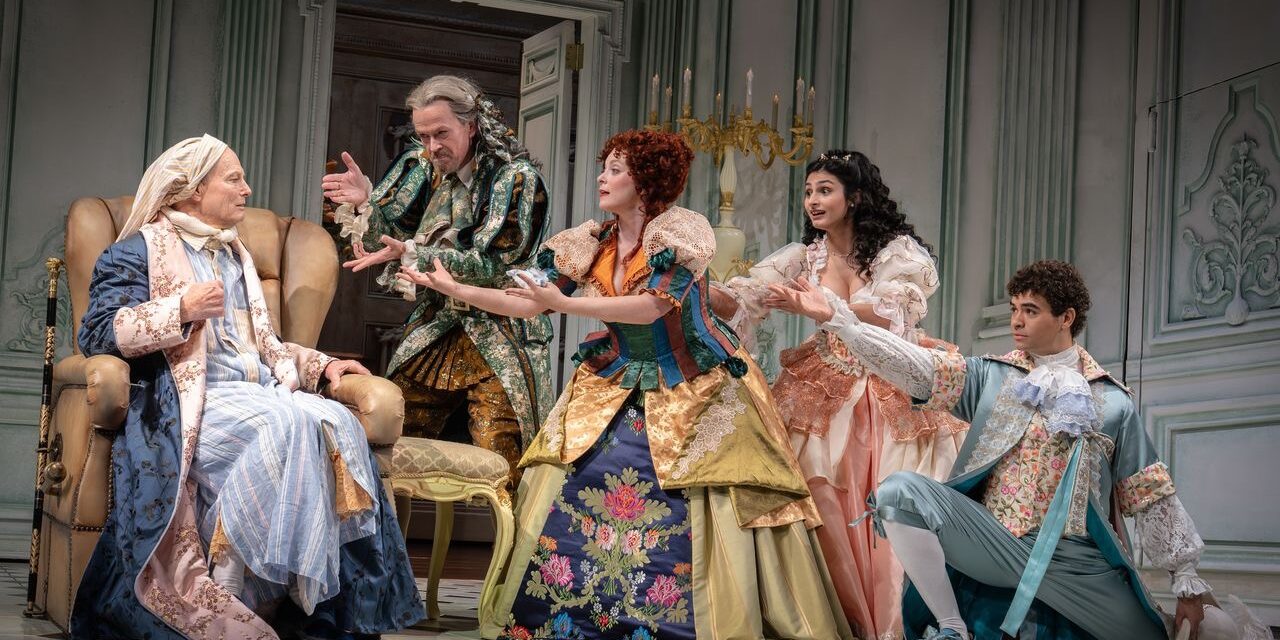
Headline photo: Bill Irwin, Dylan Baker, Rachel Bloom, Ava Lalezarzadah, and Daniel Croix Henderson.