By Alix Cohen
We hear the raucous, drunken “Black Gang” (engine room stokers) before we see them. It’s 1922. Immigrants, migrants, and disenfranchised factory workers make up what’s considered an underclass, forming a brutal brotherhood.
Yank (Jon Beavers) rules the roost by dint of size, raw physical power, callousness and a quotient of self justification that speaks for them all. He’s a simple man confident in his place. “It’s me that makes it (the ship) move.”
Suffocation, heat stroke, dehydration, and burns were common in the 110-130 degree heat of the engine room. It was a young man’s job. Among this crew, Paddy (the ever wonderful Irish Rep regular, John Keating) is an elder statesman.Old enough to remember a time before steam engines, he’s a storyteller, singer of songs (“The Miller of Dee” and “Whiskey Johnny” among them) and vouchsafe of history. “It was work with skill and darin’ too.” Atmospheric music (Ryan Rumery) faintly underpins tales.
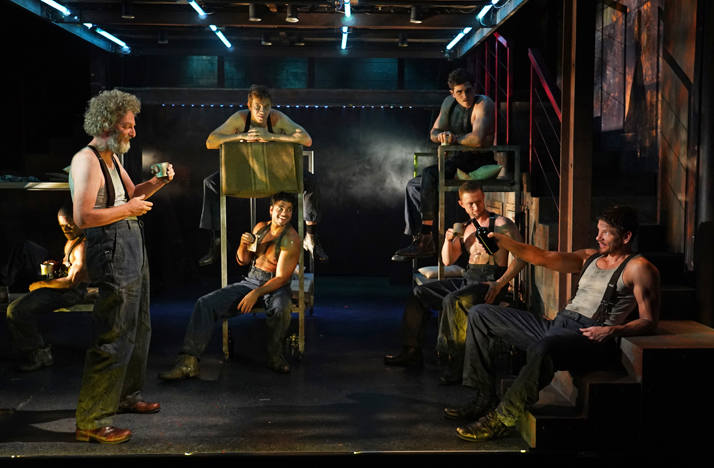
Hassiem Muhammad, John Keating(Paddy), Adam Petherbridge, Ariyan Kassam, Jonathan Crimeni, Harrison Tipping, and Jon Beavers (Yank)
The set, all the sets are marvelous. (Charlie Corcoran) Here are metal bunk beds and riveted walls- look at the ceiling detail! The stokehold reveals fiery furnaces (lighting – Michael Gottlieb). A platform creates the ship’s passenger deck and later, a two level jail. Everything is evocative, specific, and seamlessly morphs.
On deck, spoiled heiress Mildred Douglas (Elizabeth Teeter) sits with her chaperoning aunt (Joanna Glushak- imagine Edith Sitwell). She is, as usual, bored. Under the pretense of studying the less fortunate and against her aunt’s wishes, the young woman has arranged for a tour of the furnace area. Asked whether she’d like to change her white dress, Mildred shrugs.
Ciarán O’Reilly’s imaginative direction in tandem with movement by Barry McNabb is full of synchronization and sound evoking the mechanization of humanity. There’s rhythmic banging during songs, the in-step march to work resembling a chain gang, and methodically feeding fires badgered by the ship’s whistle – the cold voice of a ruling class. Use of the stage is creative and aesthetic; building of tension compelling.
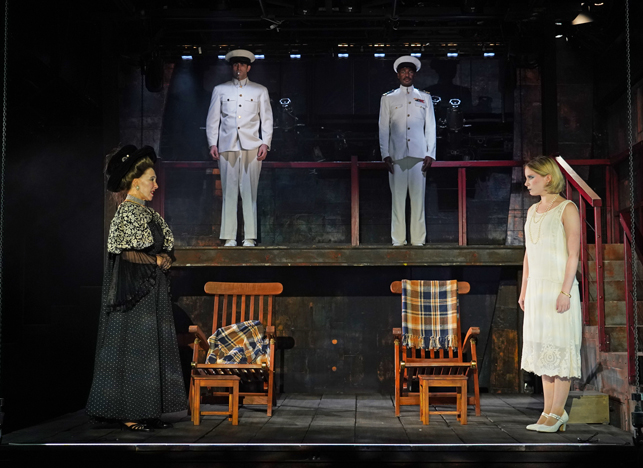
Joanna Glushak (Mildred’s aunt), Jonathan Crimeni, Nayib Felix and Elizabeth Teeter (Mildred)
Suddenly Mildred appears below just as Yank turns for more coal. He freezes half thinking she’s a ghost. She recoils into the arms of an officer calling the stoker a “filthy beast.”
Back in quarters, Paddy ribs Yank. “He’s fallen in love with a fine lady. Her old man’s a bleedin’ millionaire, but we’re his slaves…It was as if she’d seen a great hairy ape escaped from the zoo.”
The era’s obsession with and panic about Darwinism coined the terms “monkey” and “ape” designating “primitive”/uneducated people. Up till that moment Yank thought of himself as necessary to the system, not a slave, certainly not an animal. The protagonist loses his axis, abruptly feeling controlled by a social order he doesn’t understand.
Accompanied at first by his friend (Ariyan Kassam), Yank walks central Manhattan for the first time. Division of haves and have-nots is blatant. O’Neill’s stage directions are specific about the setting –Fifth Avenue- and the contrast between fashionable pedestrians and Yank.
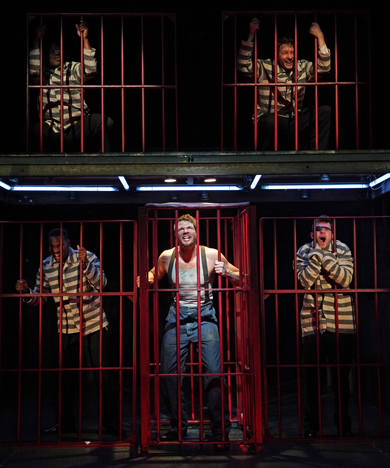
Hassiem Muhammad, Adam Petherbridge, Nayib Felix, Jon Beavers (Yank) and Harrison Tipping
Experience in jail (reflected in stacked cages and phyical expressiveness) and attempting to join the IWW (International Workers of the World) – “Am I not an American worker?!” provoke him further. As the IWW’s secretary a fine Adam Petherbridge is, to say the least, unsupportive and at most, reminiscent of those the hero is trying to escape. Frantic, Yank is reduced to identifying with the derogatory name he’s called. The end is wrenching, hopeless, violent.
Class conflict, industrialization, and the need to belong are strong thru-lines in Eugene O’Neill’s work. He was critical of capitalism, inequality, and the dehumanizing effects of contemporary society. This is not, however, a proselytizing or preachy play. It renders observations and beliefs through a fish eye of humanity.
In 1922, Alexander Wolcott called the The Hairy Ape “a bitter, brutal, wildly fantastic play of nightmare hue and nightmare distortion.”As AI takes over, we’re increasingly aware of dehumanization from a new, potentially devastating source. The play is pointedly relevant. Irish Rep’s innovative production approaches the story on both visceral and visual levels.
Stoker ensemble work is immensely effective. Mildred (Elizabeth Teeter), is aptly obnoxious, her aunt (Joanna Glushak) credibly frustrated. As noted, John Keating (Paddy) makes every moment come alive.
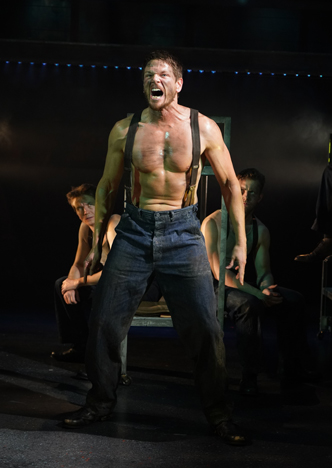
Jon Beavers (Yank)
Actor Jon Beaver (Yank) is, in my view, loudly angry too early. The actor better inhabits his character’s skin from about half way as vivid intensity of emotion is increasingly brakeless.
Additionally Featuring: Jonathan Crimeni, Nayib Felix, Hassiem Muhammad, Harrison Tipping
Costumes (Orla Long) are excellent- stokers are shabby, but for the aunt’s ensemble which looks notably eccentric rather than depicting a conservative relative.The city’s upper class wears silver glitter masks. Though anonymous faces are an arresting concept, these feel over the top.
There’s no credit for make-up. The aunt’s garish maquillage doesn’t land well. Mildred’s black lipstick and ghoul-eyes, clearly meant to skewer the upper class, instead take us out of narrative.
Photos by Carol Rosegg
The Hairy Ape by Eugene O’Neill
Directed by Ciarán O’Reilly
Through November 15, 2026
Irish Repertory Theatre 132 West 22nd Street
https://irishrep.org/whats-on?gad_source=1&gad_campaignid=24095316868&gclid=Cj0KCQjw8ofWBhCHARIsANBj4LuVHO2hRnyYOZkAV6EQkKKVMn2w17OLEuieZYjo0dsGEIIQ6H_9KrQaAnydEALw_wcB