By Stuart Miller…
Despite a strong cast and some powerful scenes, the play won’t stick in your memory.
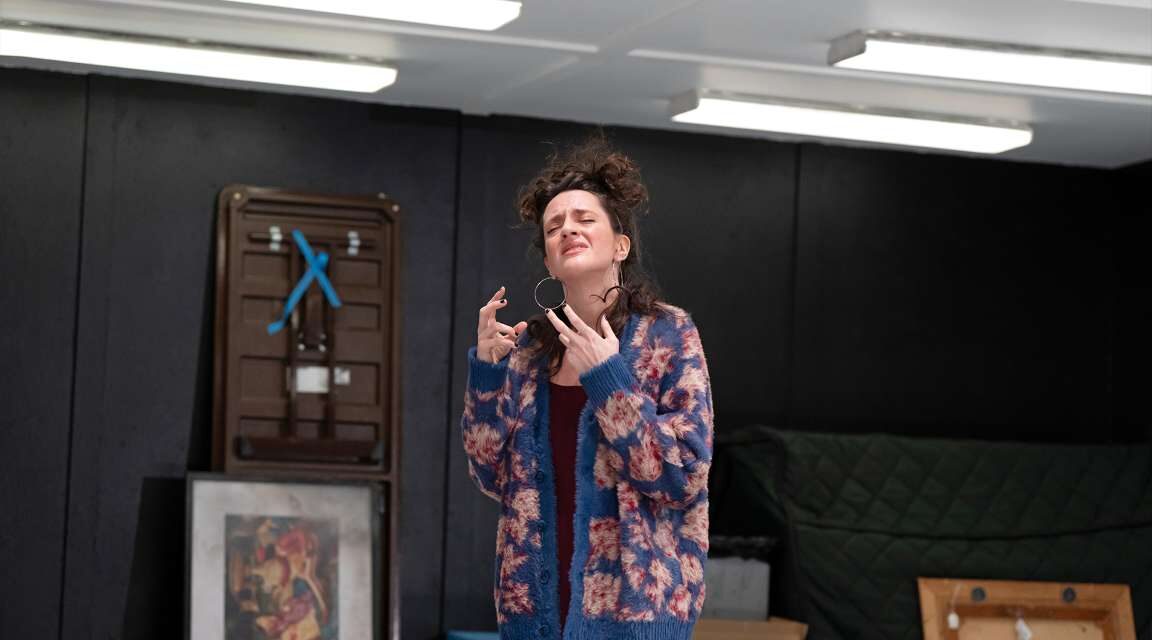
“The Dinosaurs” opens with a funny but poignant scene as Jane (April Matthis) tries to be welcoming to a jittery newcomer Rayna, who goes by Buddy (Keilly McQuail) to a meeting of Saturday Survivors, which turns out to be a small but devoted group of alcoholic women who nurture themselves and each other as they strive to stay sober.
Buddy wants help, desperately needs connection and Jane warmly tries to reach her but at the end of the scene, Buddy skitters away.
After such a strong opening—McQuail’s nervous energy pulses throughout the room– and with two theater icons– Kathleen Chalfant and Elizabeth Marvel– in the wings, I had hopes that this was the start of another vintage Playwrights Horizons play, like “Stereophonic” or “Downstate” or the many others that have offered entertaining but memorable examination of our strengths and foibles, our shared humanity.
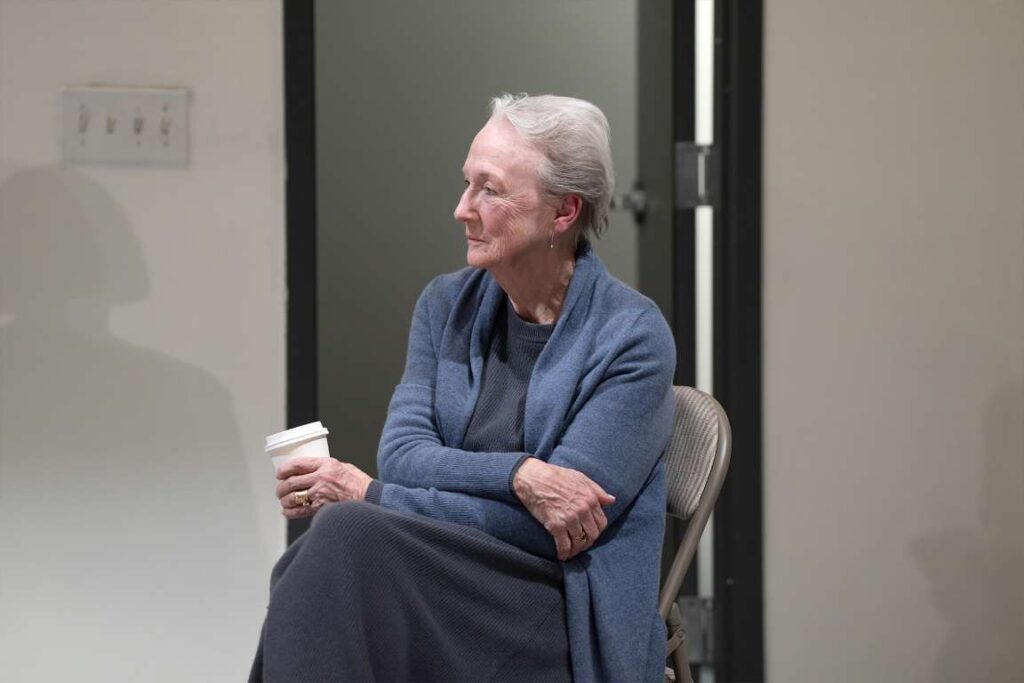
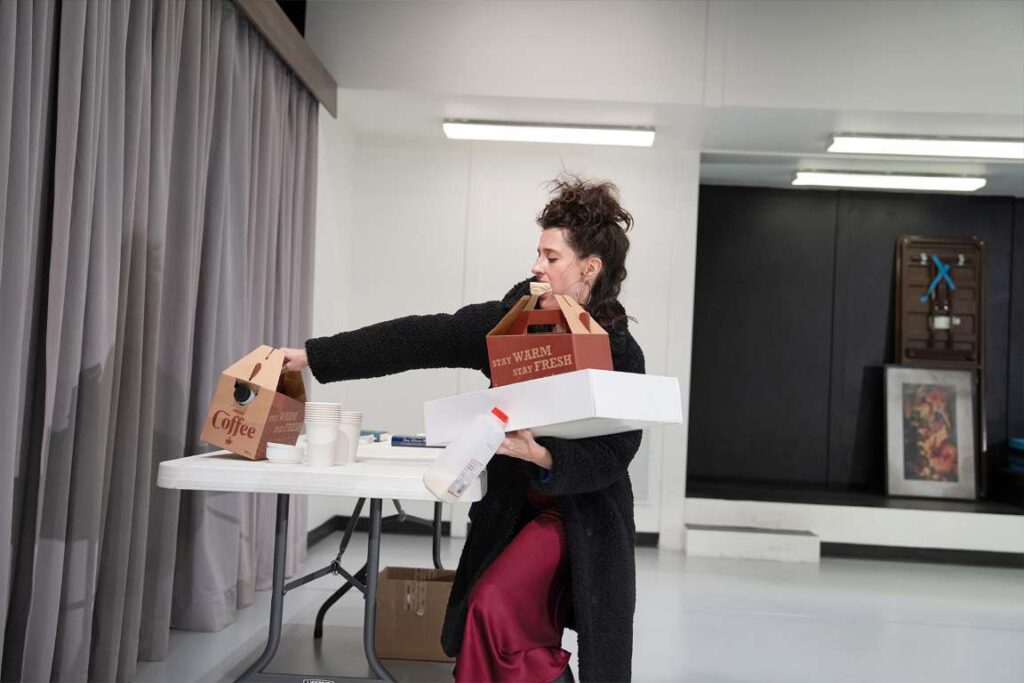
But playwright Jacob Perkins fritters away the strong start and the impeccable cast and while there’s nothing terrible about the writing in the “The Dinosaurs,” it fails to ignite or to stick in the memory.
The play was born from a commission sparked by a prompt from the downtown theater Clubbed Thumb in 2020: “Consider The Decameron by Giovanni Boccaccio—but don’t write about the plague.”
While Covid was the plague du jour at that point, Perkins, newly sober himself, saw alcoholism as an “internal” plague; the group spilling their struggles matched the “Decameron’s” collection of storytellers. He also added one clever gimmick, with time becoming a bit elastic in this sterile room where the women congregate. At one point Joan (Marvel) says, “Hi, my name is Joan and I’m an alcoholic…” and after being welcomed back, she says, “it’s 45 days back today;” the scene is then repeated with her saying 27 days, 10 days, 5 days, 1 day, and then 13 years. That compressed scene captures the never-ending struggle but also the hope that this group provides for those who keep coming back. (There are other ways in which the characters’ actions and language circle back and echo past conversations to emphasize this point.)
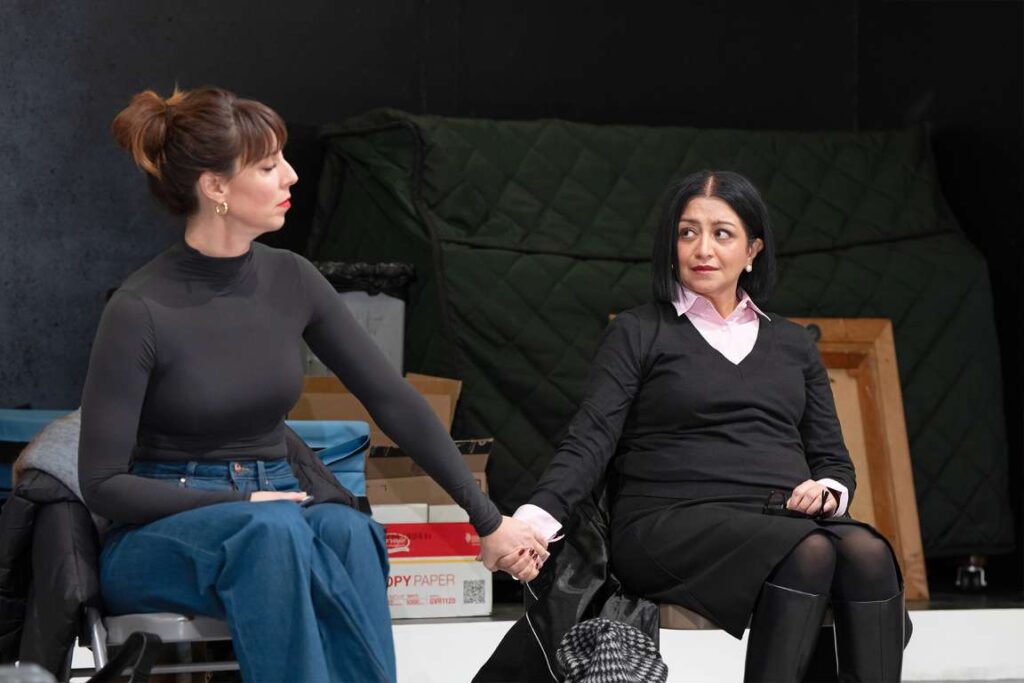
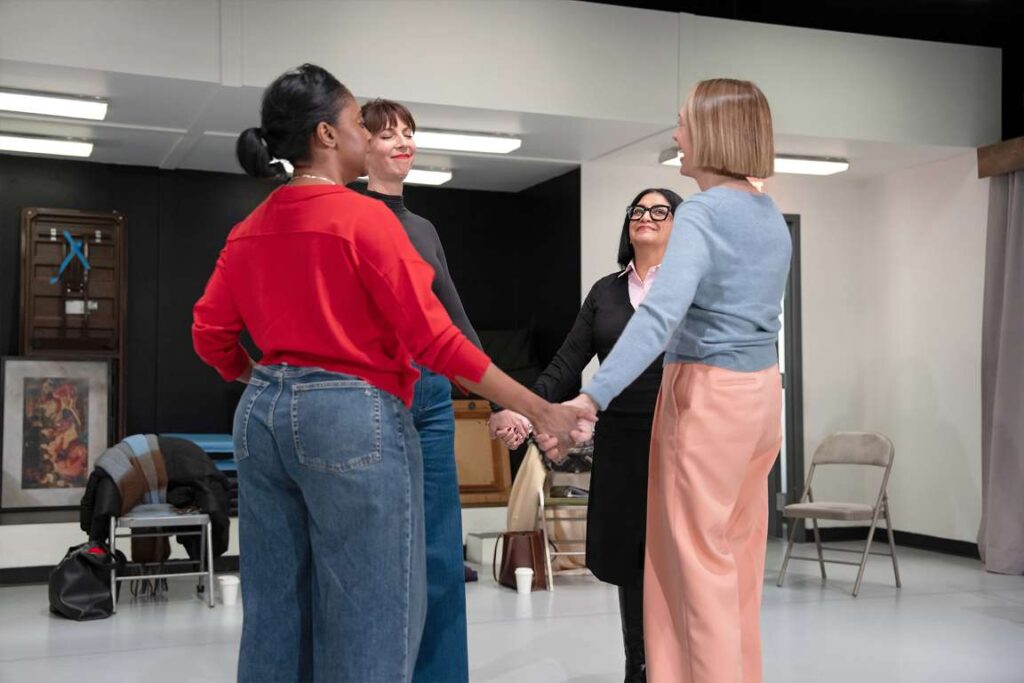
But beyond that concept (and the oddity that all except Buddy have names starting with the letter J), this short play, only about 75 minutes, never truly elevates beyond putting us in a support meeting for alcoholics. There are some strong and well-delivered soliloquies by Marvel (Joan), Maria Elena Ramirez (Joane) and Mallory Portnoy (Janet) as the women “share” what’s on their mind but these moments only give us the slightest glimpses into the character and beyond that we don’t get to know them very well.
In fact, I realized as I was writing that paragraph that while I usually write the character’s name with the actor in parentheses, I did the opposite here because much of my emotional reaction came from the performances, not from any way in which I felt connected to the characters’ lives.
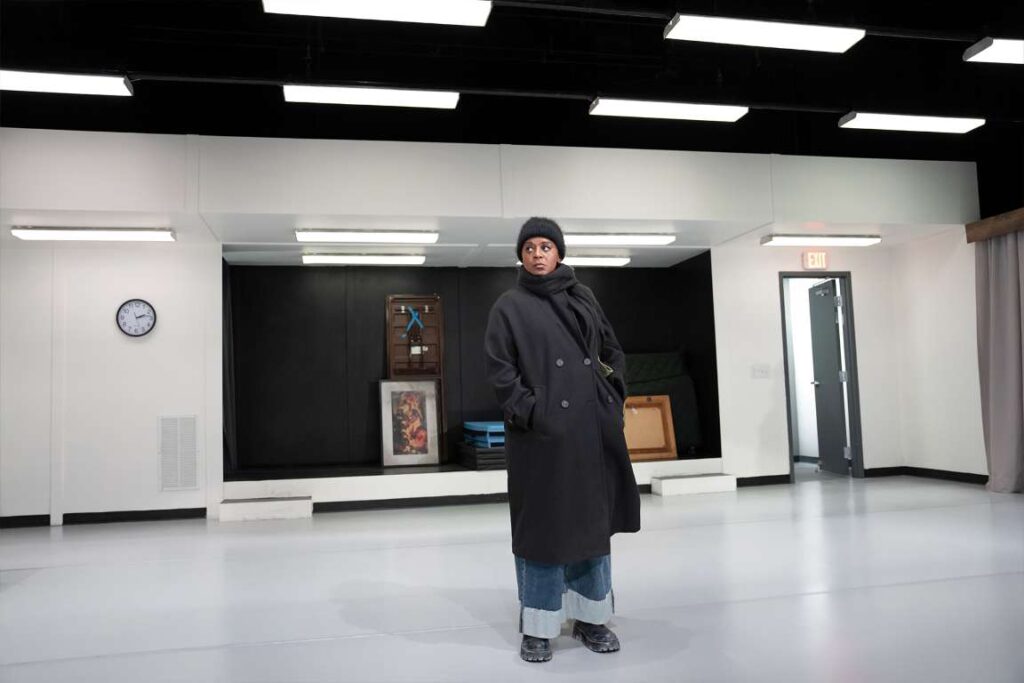
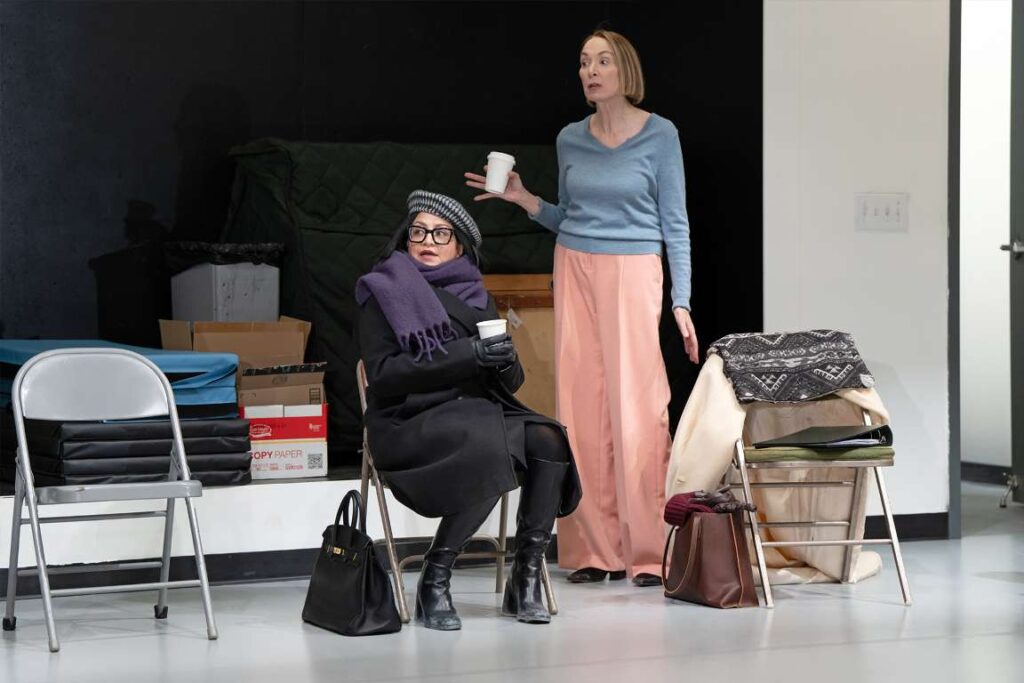
Frequently, when the characters say something that rings true, it’s couched so much in the language of support groups that it feels like a generic meeting, not a play. When they recite the AA serenity prayer and the lines “Keep coming back, it works if you work it so work it and live it, you’re worth it,” you realize that those lines have spelled out the play’s themes and motifs.
And Marvel, speaking of Chalfant’s character, says she taught her, “that the most foolish thing she ever thought… was that she knew she was in trouble whenever she thought she could do this on her own. She knew that the moment she thought that this was a solo journey, she was dead. The moment she couldn’t ask for help, end of story. We can’t do this alone.”
That’s true and maybe the play will resonate deeply with someone who has struggled with addiction or has a loved one going through it, but good theater needs to do more. Maybe Perkins should have written a longer play, fleshing out the characters’ more, even if it meant leaving behind the conceit of the prompt. While “Blackout Songs” at MCC was a dark but dynamic look at alcoholism and the struggles of recoverly “The Dinosaurs,” for all the hope it offers, fades from memory soon after it ends.
“The Dinosaurs” is playing at Playwrights Horizons, 416 W. 42nd Street through March 1st. Running time is 75 minutes.
Photos by Julieta Cervantes