A pick me up for the weary soul.
By Alix Cohen
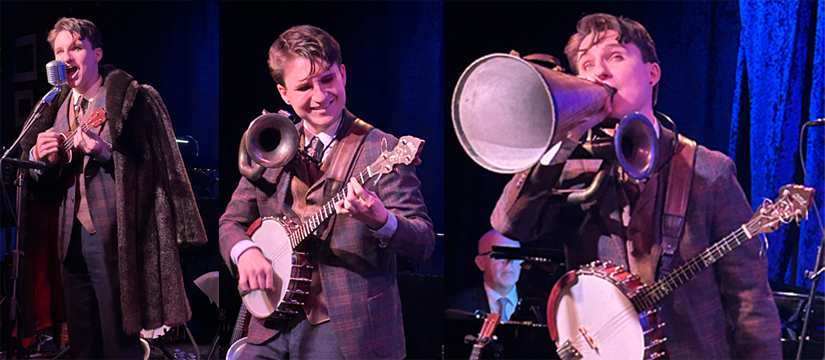
For those of you sadly unfamiliar, throwback Bryce Edwards plays and sings 1920s/30s songs as they would’ve been performed at the time, often on instruments from the era. Zealously sprinkling performance with origin stories and anecdotes, the musician is smooth on top notes, infectiously animated, has rhythm in his fingertips and delivers phrasing that would’ve made the ritziest nightclub sit up straight.
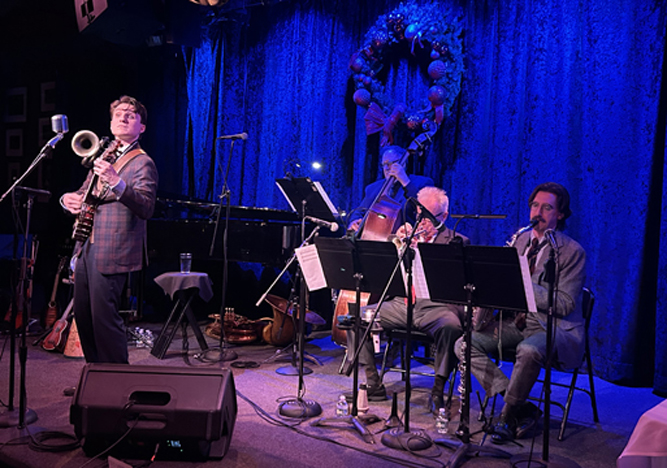
Bryce Edwards, (behind- Conal Fowkes), Brian Nalepka, Scott Ricketts, Ricky Alexander
“High brow, low brow, intermediate,/Make believe they’re all collegiate, soon,/To do the raccoon!…” Raymond Klages/ J.Fred Coots’ 1928 “Doin’ the Raccoon” is a playful Charleston-style wink at a college fashion craze. Cornet is pristine; sax, quick-step dancy; slap bass, resonant. Fun!
In 1920, when jazz and ragtime intermingled, Howard Johnson/ Joseph H. Santly wrote “The Moving Picture Ball.” Tuba keeps time. Cornet and clarinet reflect Dixieland. Almost jigging, forelock bouncing, Edwards concocts a banjo tune that mischievously darts in and out of melody. The terrific arrangement is buoyant.
“And Her Mother Came Too” (Dion Titheradge/Ivor Novello 1921) is the cheeky story of a thwarted romance, cleverly ending in a pun. It’s the kind of tune, that, in the vernacular, makes a shiek (heartthrob) tap his patent leather shoes and a sheba (“queen bee”) grin behind her cigarette holder.
The only other performer who does this justice is Steve Ross- in the audience tonight. In fact, he introduced the song to Edwards. Enacted frustration is deft. “Mothers ought to learn to leave a chap alone!” Sax slides and twirls; cornet lopes. The two instruments melodically skibble hand In hand. “I dedicate this to my lovely girlfriend Reilly who’s always very nice about hanging out with my mother.”
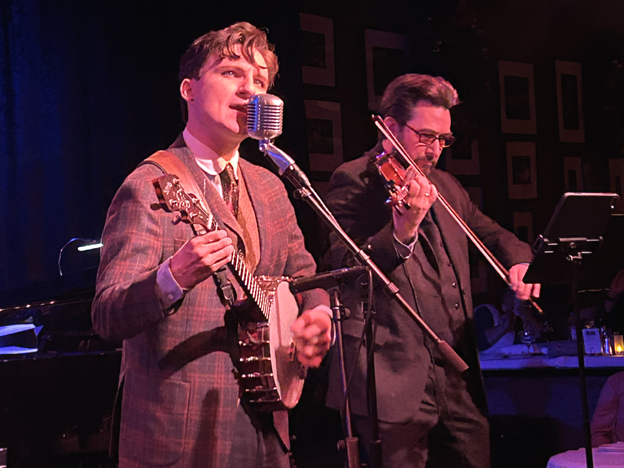
“Wait Till You See Ma Cherie” (Leo Robin/Richard A. Whiting 1929), was Maurice Chevalier’s first big Hollywood splash, Edwards is joined by accomplished violinist Jon Weber whose infectious, close-to-dance-while-playing adds immeasurably. Textures are bright and clean. Edwards scats. Slap bass is particularly fine. More please.
Edgar Leslie/Walter Donaldson’s 1927 “Tain’t No Sin (to Dance Around in Your Bones)” was outrageous enough to get laughs without crossing the line to indecency. “When it gets too hot for comfort/And you can’t get ice cream cones/Ain’t no sin to take off your skin/And dance around in your bones.”
Edwards kneads lyrics like good bread; notes slip/slide. He kicks back, wiggles, squints and eeks (early scat) close to a yodel. The artist’s instrument, a mechanically amplified Stroh Ukulele, was built for volume before electronic pick-ups. There are a very few extant. Cornet employs sassy mute. Sax is red hot. “Oh, oh, oh, ow!”
Guest Reilly Wilmit joins her beau for “When You and I Were Young Maggie/ Blues”, an 1864 Canadian poem turned into a sentimental song, then reborn as blues. (George W. Johnson/J.A. Butterfield 1866; Jack Frost/Jimmy McHugh 1922) The song begins with light banjo solo, then segues into swell counterpoint vocal. Inflection is pristine. Trained in musical theater, Wilmit’ ‘s personification of the 1920s has flowered.
“We’re gonna keep it pastoral” prefaces a duet of “Shine On Harvest Moon” (Nora Bayes/Jack Norwoth 1908) which begins with an unexpectedly sultry verse original fans might’ve called, soft as moonlight on the Hudson and smooth as a pressed tux. Edwards and Reilly affectionately sing side by side and back to back. Wilmit includes some apt warbling and light shades of Boop in her vocal. Cornet’s mute seems to flirt.
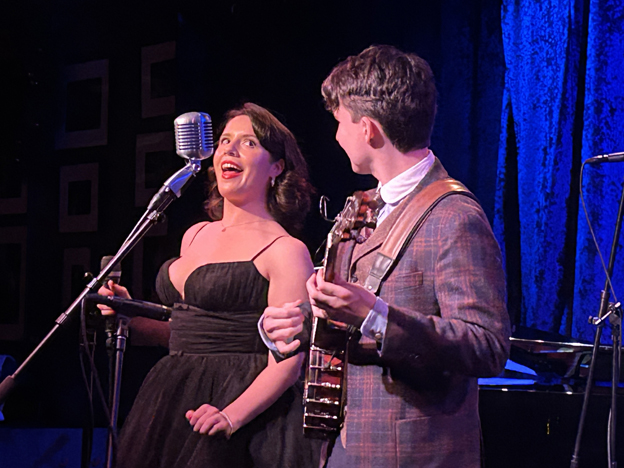
Reilly Wilmit & Bryce Edwards
Edwards once again unveils his acting chops with the written recitative of “Laugh Clown, Laugh” (Sam M. Lewis/Joe Young/Ted Fiorito from the 1928 Lon Chaney silent film) “Life is a play/We all play a part/The lover, the dreamer, the clown…” Ridi, Pagliaccio works its way into the arrangement. It’s theatrical and rather moving.
“Happy Feet” (Jack Yellin/Milton Ager 1930), with a very brief tap dance, showcases Edwards’ masterful banjo playing. One of Frivolity Hour’s signature numbers, “Everything is Hotsy-Totsy Now” (Irving MIlls/Jimmy McHugh 1935), serves as encore.
Each instrument plays its own theme, interweaving like a Disney animation. “Ah, Ah, Ah, Ah, Ah…everything is hahzee-tahtsee naow… Doo wacka doo…”
Someone should record this! A high spirited evening by virtuoso talents.
Photos by Alix Cohen
The Bryce Edwards Frivolity Hour
Bryce Edwards- vocals, banjo, ukulele, mandolin, songophone
Scott Ricketts- cornet
Ricky Alexander- clarinet, alto sax, vocal harmonies
Conal Fowkes- piano, vocal harmonies
Brian Nalepka- string bass, tuba
Reilly Wilmit- featured vocalist
Birdland 315 West 44th Street https://www.birdlandjazz.com/