By Alix Cohen
Tin Pan Alley originated in the late 19th century on West 28th Street in New York City, where music publishers and songwriters clustered to produce and promote popular sheet music. The name reportedly came from the clattering sound of many pianos playing at once, which a journalist likened to banging on tin pans. By the early 1900s, it had become the heart of the American popular music industry, launching the careers of major songwriters and shaping styles that influenced Broadway and early jazz.
What makes a song a hit today is very different from 100 years ago, host Kathleen Marshall tells us. In that era sheet music sales indicated success. Scott Joplin’s “Maple Leaf Rag” was a sensation, selling one million copies at 25 cents each. People would gather around pianos and sing, a far cry from the separateness of earphones, MTV, and Spotify.
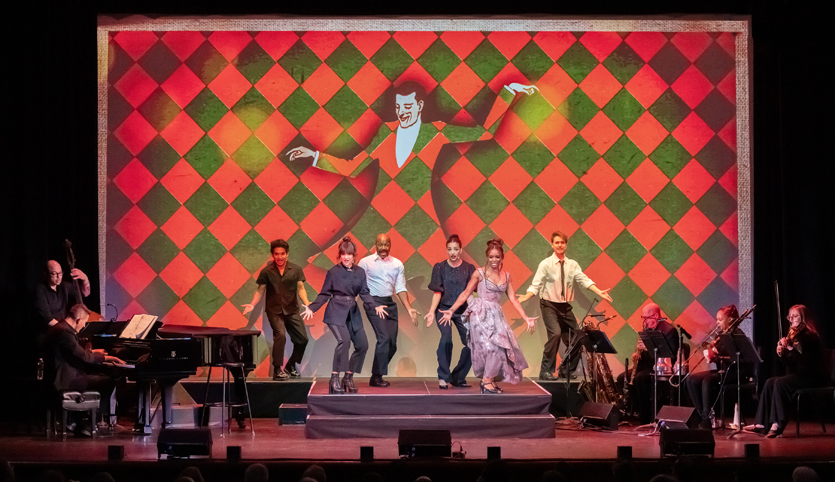
George Farmer (bass), David Chase (piano), Zachary Noah Piser, Sarah Stiles, T. Oliver Reid, Ana Villafañe, Krystal Joy Brown,
John Cardoza, Aaron Heick (Reeds), Taja Graves-Parker (trombone), Robin Zeh (Violin)
Perched on a stool, Krystal Joy Brown offers the Joplin song in traditional counterpoint to the company’s “Play a Simple Melody” (Irving Berlin) The next number, “Alexander’s Ragtime Band” sold 2 million copies. Songs arrive in chapters as defined by Marshall. Audience gets a feeling for the types and evolution of material.
“I Wanna Be Loved By You” (Herbert Stothart/Harry Ruby/Bert Kalmar), the first of a novelty song section, is performed by Krystal Joy Brown in American Songbook meets Betty Boop fashion so as, one assumes, not to seem parody. It works. Brown sashays between sax and trombone.
“Yes, We Have No Bananas” (Frank Silver/Irving Cohn) follows as the night the day. Vocalists reading lyrics robsthem of focus and us of apt expression. (Zachary Noah Piser, a yeoman, second banana-like character throughout) Piser’s “You Oughta Be in Pictures” (Dana Suesse/Edward Heyman) is lightheartedly staged with Sarah Stiles’ animated reactions.
In the late 19th and early 20th centuries, Burt Williams and George Walker were among the most prominent Black entertainers of their era. When a White star objected to Williams inclusion in the Follies, Florenz Ziegfeld told him, “I can replace any of you except him.”
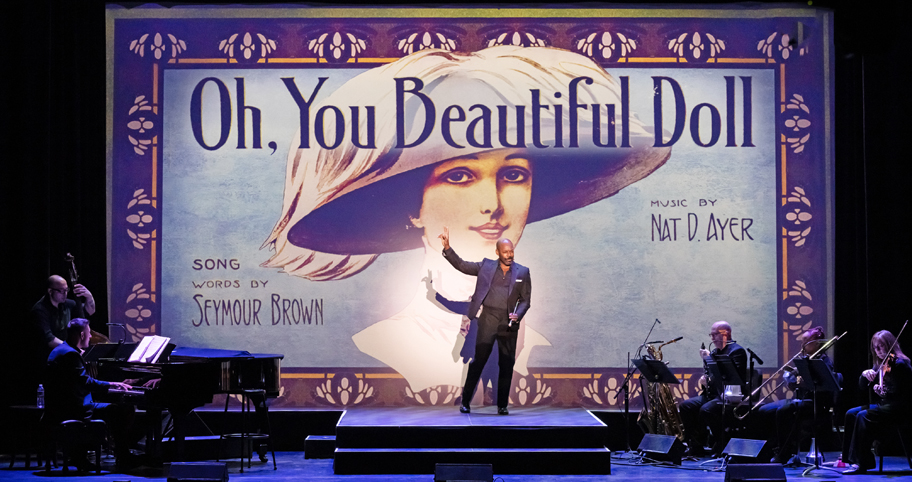
T. Oliver Reid
T. Oliver Reid’s best contributions are pastiche turns with attitude and movement of the time. For “Oh You Beautiful Doll”
(Nat D. Ayer/Seymour Brown), gravelly long notes are punctuated by a wielded cane. A version of “Nobody” (Bert Williams/
Alex Rogers), saluted by Kander and Ebb’s “Mr. Cellophane” in their musical Chicago, is a deadpan amble.
As presented by character thespian Sarah Stiles, “My Man” (Maurice Yvain/ Channing Pollock), arrives in a way its originator Fanny Brice might actually have performed. Instead of the usual torch, Stiles imbues it with unexpected drollery, lounging all over the piano, pausing and mugging. At first disconcerting, we realize its plausible veracity.
Songs during the Depression covered both sides of the fence, from “The Sunny Side of the Street” (Jimmy McHugh/Dorothy Fields) to “Brother, Can You Spare a Dime?” (Jay Gorney/Yip Harburg)
John Cardoza’s rendition of “Pennies From Heaven” (Arthur Johnson/Johnny Burke), accompanied only by piano and bass, is heavenly. The artist has a warm, engaging tenor. Later, he leads us into Fred Astaire/Ginger Rogers territory with an easy, stylish “The Way You Look Tonight” (Jerome Kern/ Dorothy Fields) – ending in hum. Cardoza and Brown foxtrot. Krystal Joy Brown’s
“A Fine Romance”, (Jerome Kern/Dorothy Fields) however, is too showy for its charming, casual attitude. From 1920-1949, 148 women joined ASCAP.
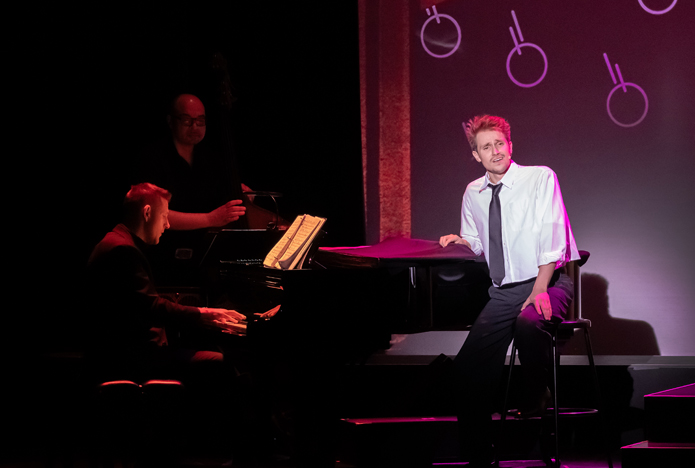
John Cardoza
The iconic “Stardust” (Hoagy Carmichael/Mitchell Parish) emerges in Ana Villafañe’s satiny interpretation as if she’s the girl singer with a popular dance band. One hand on the piano, gestures are minimal, focus on sway. The song was recorded 1500 times.
Group numbers like the trombone-driven “Ballin’ the Jack” – (Chris Smith/Jim Burris) – an expression used by railroad workers to mean going at full speed- and the familiar “Toot, Toot Tootsie (Goo’ Bye)” (Gus Kahn/Ernie Erdman//Dan Russo/Ted Fiorito) are vivacious.
During the company’s “Take Me Out to the Ballgame” (Albert Von Tilzer/Jack Norworth), bags of peanuts? are tossed into the audience. ‘A missed opportunity for bouncing ball sing-along. George M. Cohan’s “Give My Regards to Broadway” ends the evening on a sentimental, up note.
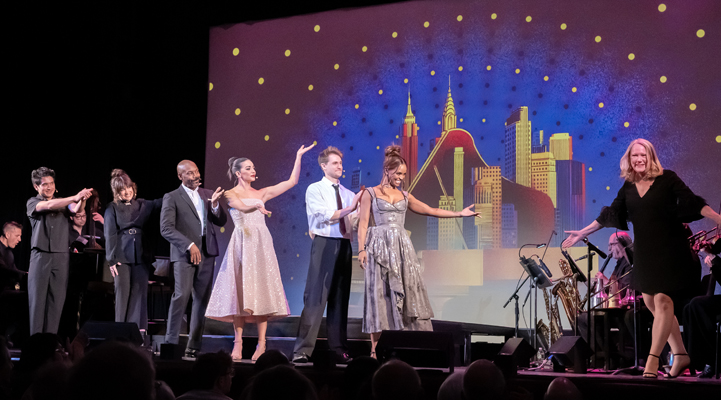
Kathleen Marshall’s staging and choreography are buoyant, often cute. Narrative arrives brief and informative. The program runs smooooth.
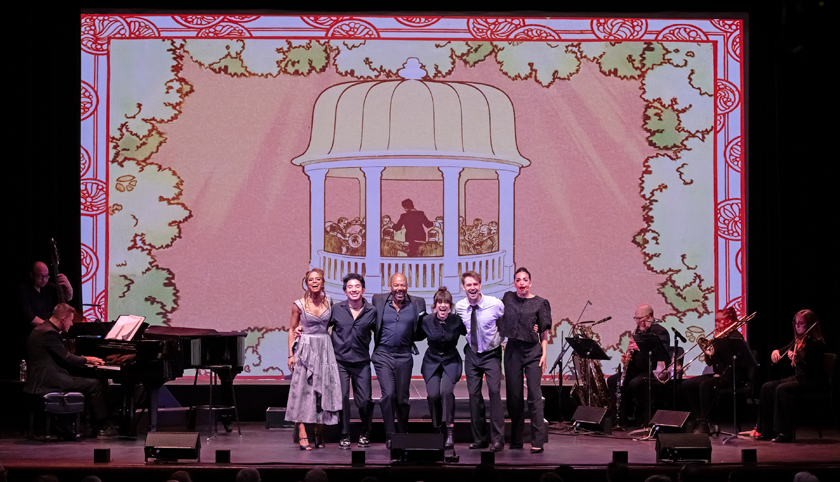
Krystal Joy Brown, Zazhary Noah Piser, T. Oliver Reid, Sarah Stiles, John Cardoza, Ana Villafañe
Projection Design, predominantly doctored sheet music covers, attractively conveys the charm of the era (Kylee Loera)
There’s neither reason nor rhyme to the visual dissonance of costumes which range from what looks like black scrubs to sequins to white shirts.
Photos by Richard Termine
Opening: Zachary Noah Piser, Sarah Stiles, T. Oliver Reid, Ana Villafañe, John Cardoza, Kathleen Marshall
92Y presents Lyrics & Lyricists
Stardust: From Tin Pan Alley to Broadway
Kathleen Marshall – Director/Choreographer/Writer/Host
David Chase – Arrangements/Orchestration/Music Direction/Piano
Gregg Anthony Rassen – Arrangements/Orchestration/Music Direction
Excellent Orchestra: Robin Zeh, Aaron Heick, Taja Graves-Parker, George Farmer
92Y 1395 Lexington Ave between 91/92 https://www.92ny.org/