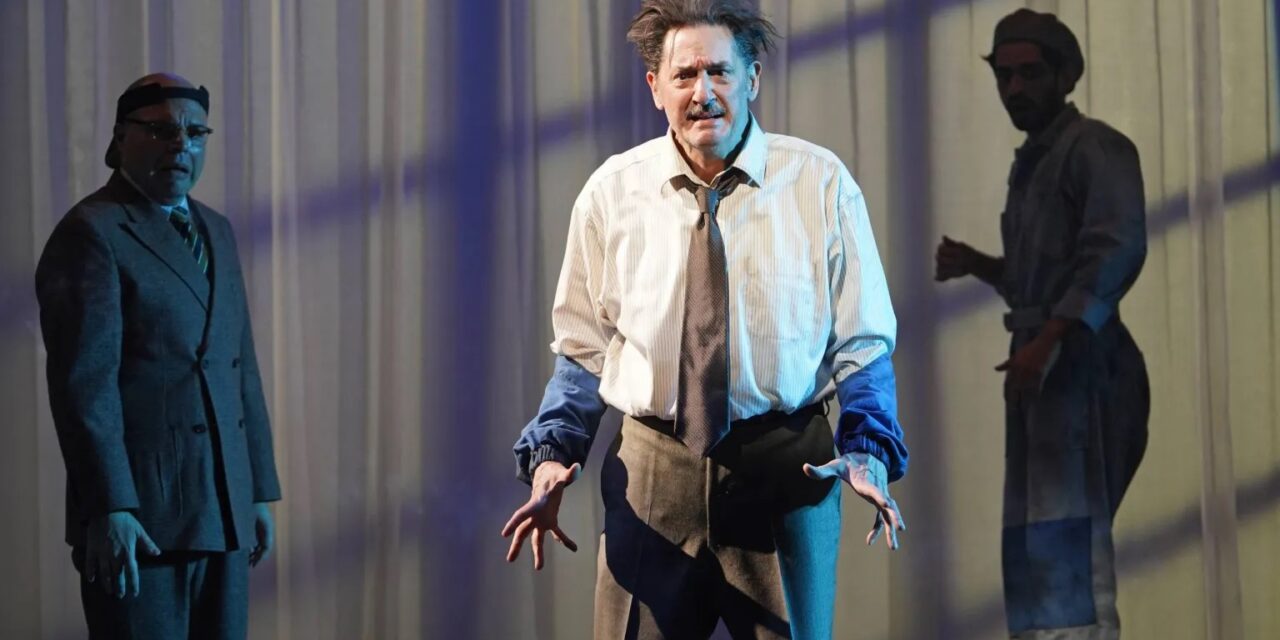
Rhinoceros, an allegory about fascism in which everyday people conform and transform into pachyderms, has long been celebrated as a prime example of Theatre of the Absurd. This movement, founded by a group of Parisian avant-garde artists in the mid-20th century, hailed dramatist Eugène Ionesco (1909-1994) as one of its most acclaimed members. When I heard that Rhinoceros was being done at the Yale Repertory Theatre, a play which first captured my interest when I read and studied it in college, I knew I had to head up to New Haven. In all the intervening years I had yet to see it onstage, so the idea of a company led by Broadway regular Reg Rogers as the milquetoast everyman Berenger felt like something I needed to experience. Appreciating its many merits, I’m glad I took the trip.
Ionesco, born in Romania and reared in France, didn’t enjoy success as a playwright until the age of age thirty-nine with The Bald Soprano (1948). He followed it with The Chairs (1951) and Exit the King (1962), while fellow absurdists like Samuel Beckett (Waiting for Godot, 1953) and Jean Genet (The Balcony, 1957) were fine-tuning what Theatre of the Absurd could accomplish. The journey of Rhinoceros began in Germany in November 1959, followed quickly by a production in Paris with Jean-Louis Barrault, famous for starring in Marcel Carné’s 1943 wartime masterpiece, Les Enfants du Paradise (orChildren of Paradise). Then, in April 1960, came a London Rhinoceros directed by none other than Orson Welles and starring none other than Laurence Olivier (opposite wife Joan Plowright). The fights that occurred during rehearsals and into performance were so juicy that it was dramatized in 2000 by actor/playwright Austin Pendleton in his play, Orson’s Shadow, which has been produced at numerous regional theaters over the years and in New York as recently as 2024.
The play takes place in a small provincial town in France where citizens suddenly find themselves inexplicably transformed into rhinoceroses. Berenger, a meager clerk who drinks too much and is practically alone in the world, save for his friend Gene, a boorish poseur, is unable to understand why his co-workers are willing to change into rhinos without any resistance. Born in Romania, Ionesco lived in both his homeland and France during the years leading up to World War II and seeing former friends embrace fascism took its toll on him. Though absurdist and comical in nature, Rhinoceros is all too serious.
When Rhinoceros opened in New York in 1961, it was met with some prominent critical head scratching. Some recognized its genius, others were stumped and, in one case, critic Ward Newhouse even decried its appropriateness for Broadway: “Rhinoceros, with one horn or two, is Circle in the Square material, hardly suited to the Longacre Theatre” (Morehouse is referring to the old Circle in the West Village, long demolished, which was the heart of the then-burgeoning off-Broadway theatre movement). Starring the redoubtable Eli Wallach as Beringer and the titanic Zero Mostel as his friend John (Gene in this production), the Broadway cast featured a host of Actors’ Studio stalwart like Wallach (himself a founding member), his wife Anne Jackson, Mike Kellin, Jane Hoffman, and Lucille Patton. No surprise, as it was directed by fellow Studio member Joseph Anthony, a fine actor in his own right and a major Broadway director in the 1950s and 60s (The Lark, The Most Happy Fella, The Best Man, and Mary, Mary).
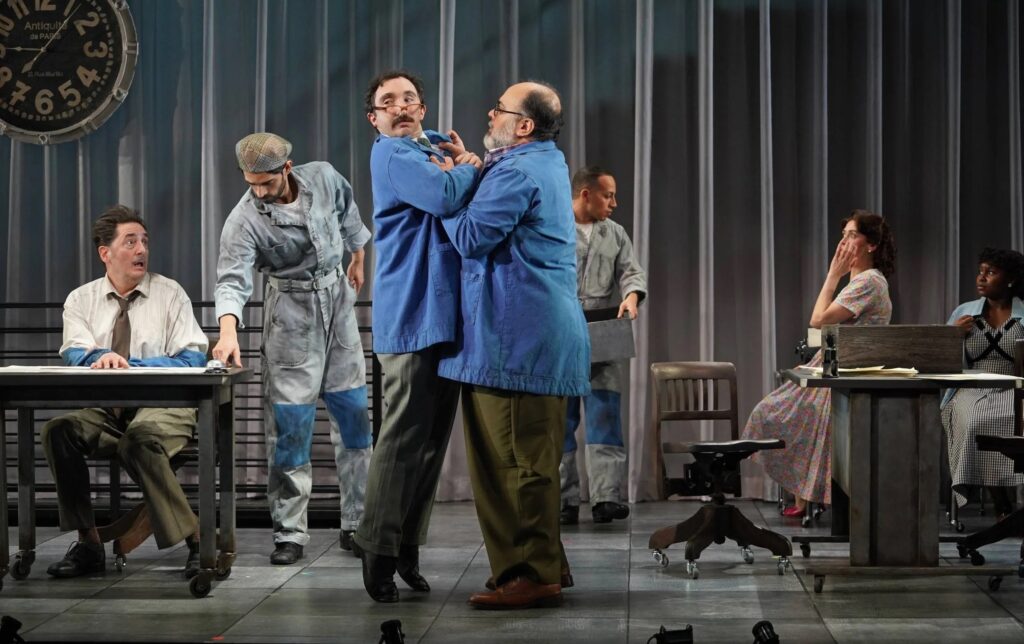
A the time of the play’s opening, Wallach told a reporter, “In this play the rhinoceroses rush right across the orchestra pit. By the second act, you’ll move back to give them room.” That sense of realism has also been conveyed in Liz Diamond’s streamlined staging. Using the bare minimum of scenery (designer Jennifer Yuqing Cao) and a maximum of superior sound effects (Zoey Lin), the important elements in the writing are free to take bloom. When the unseen rhinos charge, we are treated to dust clouds and thunderous noise. I loved it.
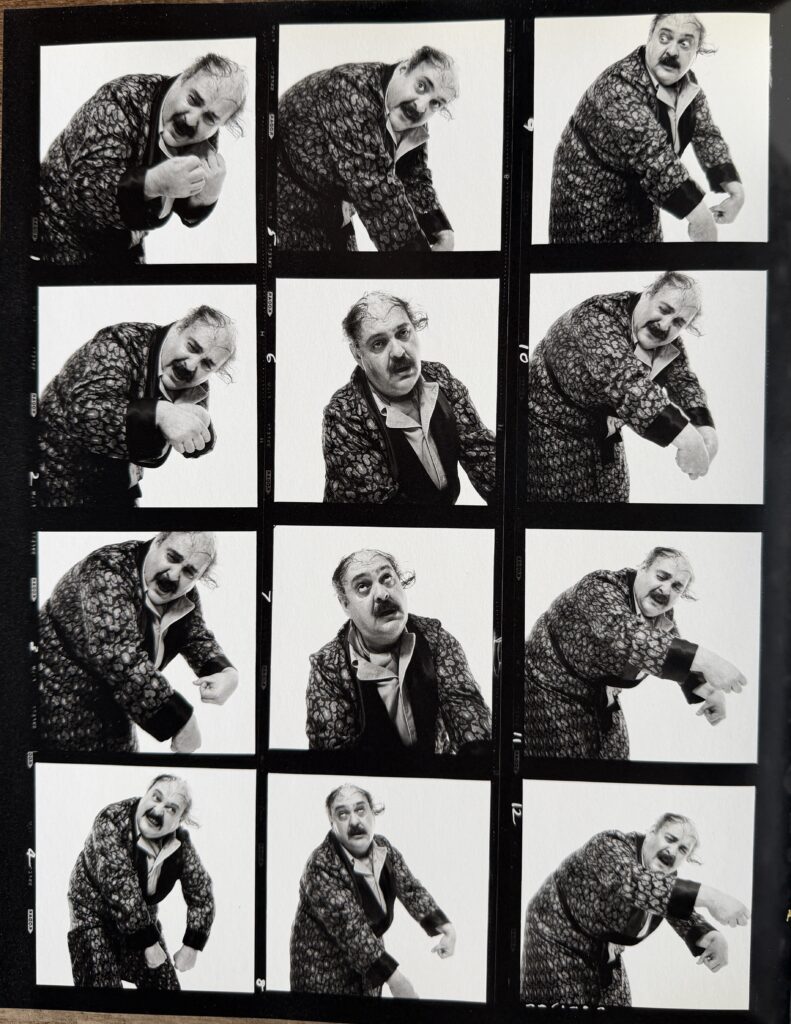
This being Diamond’s 20th show with the Rep, she has chosen sensibly by using Frank Galati’s cut down adaptation, which runs an intermission-free ninety minutes, instead of three acts and two intermissions. She has also built a solid cast made up of both professionals and Yale students. In the flamboyant role of Gene (or John, as he is named in the original Broadway production), Phillip Taratula does splendidly, using his bulk to great advantage while metamorphosizing into a rhinoceros with a full blast of creative energy. Winning the first of his three Tony Awards over a five-year period, Zero Mostel was said to have pulled off a tour de force in his transformation scene, photos of which only give a taste of what the complete effect was like (he used no makeup or a prop horn). This proof sheet is by Richard Avedon from his book Performers (2008):
Something of an avatar, Berenger serves as Ionesco’s stand-in towards the extremist ideologies he witnessed throughout his life. In Reg Rogers’ performance, he is brought to full life, with the actor tamping down his usual eccentricities, focusing instead on the character’s complete bafflement—the only one who sees what’s happening and questions it. And as Daisy (Elizabeth Stahlmann), the play’s third main character and Berenger’s love interest that almost gets reciprocated (before you-know-what occurs), Stahlmann portrays a proper mix of contradictions that feels true to the role.
From a play first produced seventy years ago, mainly as a response to the trauma inflicted by European fascism, who could have foreseen how much we’d be suffering the same way here in the U.S. right now? Rhinoceros couldn’t be timelier and, as it turns out, Yale Rep isn’t the only nearby regional theatre doing so: there’s one currently being cast for an ART version opening in Boston in a few months that will star John Turturro as Berenger. That one might be worth another trip north.
Rhinoceros was presented March 6-28 by the Yale Repertory Theatre, 1120 Chapel Street, New Haven, CT. For information of future programming at Yale Rep, click here.
Photos by Carol Rosegg.
Headline photos: Reg Rogers as Berenger in Rhinoceros.