By Alix Cohen
This brilliant channeling of one of the most pivotal artists of the twentieth century and the succession of abjectly devoted women he destroyed has only three more performances. GO.
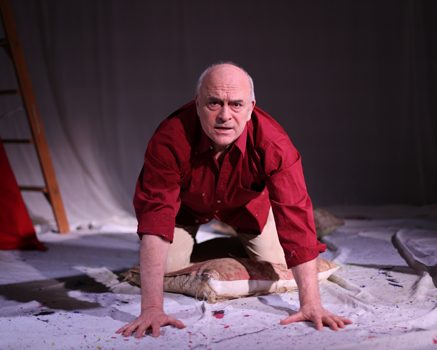
I’d conjecture that every female in the audience and I suspect many men, are drawn to the powerfully charismatic, viscerally seductive man we see on stage. (Peter Tate) History is either judgmental about human decimation the artist (1881-1973) left in his wake or justifies it in the name of art. You decide.
In his presence, one begins to understand why so many women put aside their own lives, submitting to the cruel, fickle demands dictated by a consuming ego.
“Pablito, stop looking at the sun, you’ll go blind!” the artist calls out to his grandson. “I stopped listening to mama when I was two years old…” The artist describes cowering in a corner, his mother consumed by a new baby. Attention had been wrenched from him.“The image never leaves me – and I became Picasso!”
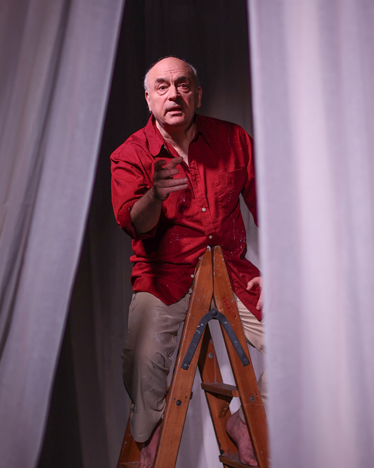
“When I love a woman everything is torn apart, myself my soul. I have no control over this.” The memory play is bookended by a young female journalist and poet, according to my research, the only fictional affair in the piece.
The protagonist then recalls a succession of overlapping women with brief, pithy synopses, playing both roles. His women speak lightly – no vocal exaggeration. Between liaisons, the stage turns red and an enmeshed Picasso dances to Spanish music. He’s riveting, marvelous.
Picasso meets Fernande Olivier when both are part of the bohemian Montmartre art scene. They’re 23. He calls her, “My beautiful vagrant, my already married runaway.” She poses for others as well. He says they need the money. Drink and opium pervade.
This first influential woman inspired the warm aesthetics of his Rose Period and the very first stages of Cubism. “Miraculously, my paintings started to sell.” Stylistic phases are referred to without academic explanation. When Picasso changed women, his home, circle, and often his art changed as well.
While working on designs for the Ballets Russes, Picasso met ballerina, Olga Khokhlova. She (Milena Vukotic) appears on screen in one of many intermittent visuals. Though staged, it appears genuine. “I’m insanely jealous of anyone who lifts her…I understand Olga. We’re both exiles…”
Though he’s is an atheist, the artist indulges his new obsession by marrying in a Russian Orthodox church. They have a son. He tells her she’s perfect. Olga opens his mail- to protect; when ill, she repels him.
Picasso refers to magic powers. “I am a Shaman… When you look at my work, you’re under the spell of my personality!” He speaks of glorious bullfights “the battle against death” as if masticating and swallowing the experience.Eventually infidelity breaks them up. Under French law Olga could claim a substantial portion of Picasso’s assets. Instead, they remain legally married while living separately until her death in 1955.
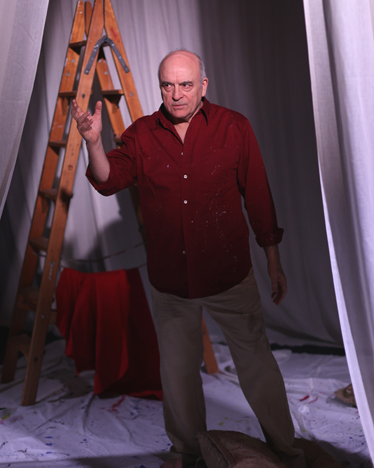
Innocent, seventeen year-old Marie-Therese Walter, known as Picasso’s “golden muse” is next. “I want to share everything with you…” he purrs, “but never question or contradict me…I want you to learn about the mystery of the Minotaur. If a maiden truly loves a Minotaur, she sacrifices her life…” Paintings are full of sinuous curves.
Sex is deftly depicted with Picasso on his knees, back or front to us, undulating, jerking, collapsing onto his forearms. Simple moves are immensely evocative.
Marie -Therese (Margot Sikabonyi on screen) gives birth to Maya. Though he would visit for 10 years, Picasso moves on. “I need a woman to TALK to me! Life with you is BORING!”
Dora Maar (Sandra Collodel on screen) is a depressive; also a photographer, intellectual, and artist. She documents the creation of Guernica. A painting sells at Christie’s New York for an astonishing $179.36 million. Times are flush.
During their relationship, he physically abuses Dora and makes her fight (some say literally) with Marie-Thérèse for his affection. In his art, she’s represented as a tortured woman.
Françoise Gilot is herself a serious, young painter when Picasso invites the young woman to his studio. The artist is 40 years her senior. She moves in, handling the complex life/schedule of the now, icon. These women, these muses, enabled him to work.
Claude and Paloma are born. Picasso’s Art becomes brighter, more playful, more family-oriented than it had been during the war years.“And I paint nothing!” Françoise complains. “You’re the mother of two Picassos!” comes the cocky response. This is the only lover who leaves rather than being left by him. He rages, threatens, and never gets over it.
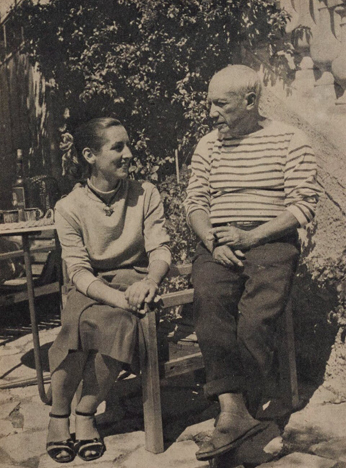
With Francoise Gilot 1952 (Public Domain)
Jacqueline Roque is the artist’s final companion and second wife. They meet at a pottery workshop. She speaks to him in Spanish. The dominant figure in the last two decades of his life, she appears in more portraits than any other woman.
This one talks back to him. She calls Picasso her Lord and Master, yet insidiously affects behavior. “Best be careful or you’ll lose your place under the sun,” he warms- yet is ultimately grateful. Forty-six years apart, they marry in 1961.
When Picasso dies in 1973, Jacqueline bars his grandson, 24 year-old Pablito, from attending the funeral.No one knows why. Consequences are tragic. In a state of despair, the young man drinks a bottle of bleach and dies three months later.
Picasso denies responsibility for both that tragic death and clear damage to discarded women and children. Last words resonate.
Writing is so essential, another ten minutes of detail could be accommodated. Barely touched interaction between his women is a fascinating part of the real story.
Peter Tate, who strikingly resembles Picasso, radiates passion and authenticity. Declarations of love and need compel. Rage chills.The actor dances with masculine sensuality and provocation conjuring a figure somewhere between Zorba and the snake in Eden.
Director Guy Masterson engineers pacing to perfection. The small space is admirably utilized. No gesture is extraneous. Sex is evocatively manifest. And oh, the dancing!
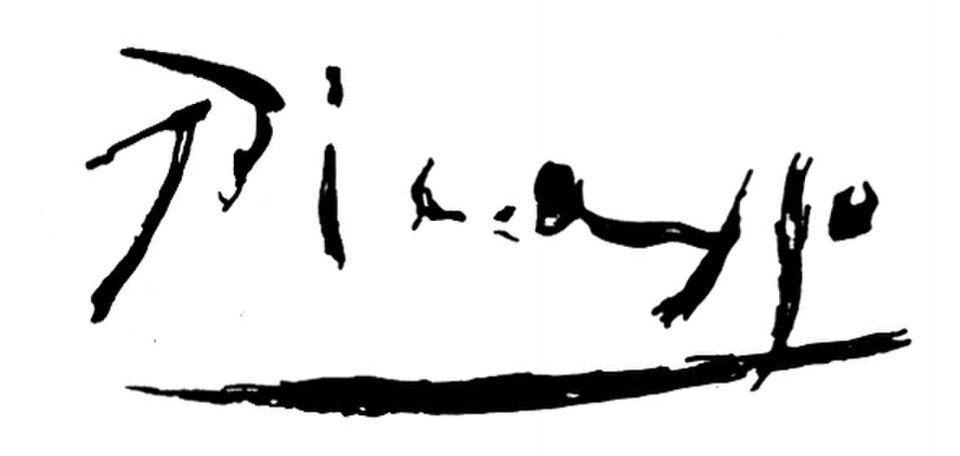
Signature (Public Domain)
Eirini Kariori’s Set Design looks like a drop cloth, serving projections, mercifully keeping it simple.
There’s no credit for music which is splendidly chosen and employed. The song used most often is “Qui Sas?”, a famous Cuban bolero written by Osvaldo Farrés in 1947. It translates into “Perhaps.” Lyrics describe an indecisive lover who constantly avoids answering direct questions like “when, how, and where” they will commit to a relationship.
Photos by Brigitta Scholz Mastroianni
Picasso: Le Monstre Sacré
Adapted for solo performance from Terri D’Alfonso’s The Loves of Picasso by Peter Tate and Guy Masterson
Starring Peter Tate
Directed by Guy Masterson
La Mama Theatre 66 East Fourth Street
https://buytickets.at/theplaygroundtheatre/2084762