By Samuel L. Leiter…
This unusual reimagining deftly expresses the play’s inherent drama even as its historic visual and aural attractions have been replaced or pared away.
In the 1890s, when Englishman William Poel attempted to stage Shakespeare in what was believed the authentic Elizabethan manner, his innovations were considered revolutionary to a world that had grown used to the elaborately realistic sets and costumes used for standard revivals on proscenium stages. By that time, the traditional, scenically spare methods of Shakespeare’s day had been lost to the mists of time and had to be reconstructed through historical research.
In Japan, however, the traditions of its classical kabuki theatre, a form born at the beginning of the 17th century, remained relatively fixed. When the wave of Western theatre influence washing over the country at the turn of the 20th century threatened to topple kabuki, it doubled down on cementing its methods so as not to lose them under the tide of realism. Thus, if you were now to see a standard production of Kanjincho, a dance-drama dating in its present form to 1840, you’d be likely to see something that—despite interpretive variations introduced by important actors—looked and sounded much the same wherever and with whomever it was performed.
Still, over the years there have been occasional, if rare, attempts to stage such traditional plays through a modernist lens, much as Shakespeare—the relatively few “authentic” stagings aside—is generally presented in an imaginative manner paying no attention to standardized notions. Now comes a Japanese company called Kinoshita Kabuki, founded in 2006 by Yuichi Kinoshita, which has made its mark by reexamining kabuki plays using contemporary methods, abandoning (or adapting) the established forms (kata) of familiar costumes, makeup, props, sets, and acting to bring the plays closer to a present-day sensibility.
To date, it has produced over half a dozen modern interpretations of iconic kabuki plays, including Kanjinchō, known in English as The Subscription List, which is available in excellent English translations by both A.C. Scott and James R. Brandon. In 1966, Brandon’s rendition was directed with American actors in New York by two kabuki stars, Matsumoto Kōshirō VIII and Nakamura Matagorō II, in a former burlesque house on 42nd Street, where Theatre Row is now. I took part as a formal stage assistant (kōken) so I could write about it.
Premiered in 2016, Kinoshita Kabuki’s Kanjinchō, which opened last night at the Japan Society, is a surprisingly effective transformation of the play, although it may appeal more directly to those unfamiliar with the classic version, from which so much has had to be eliminated. What Kanjinchō has, making it a perfect vehicle for such reconfiguration, is a powerful dramatic core, even without the usual design appurtenances.
So popular is this dance drama as a chance for actors to show their mettle that multiple revivals of it continue to be staged every year. For leading actors of male roles in kabuki (which continues to use female-role specialists—onnagata—for women’s roles), the characters of Togashi and Benkei provide benchmarks of their talent. The same actor playing Benkei in one production is likely to play Togashi in another, much as Othello and Iago used to do when it wasn’t politically incorrect for a white actor to play Othello.
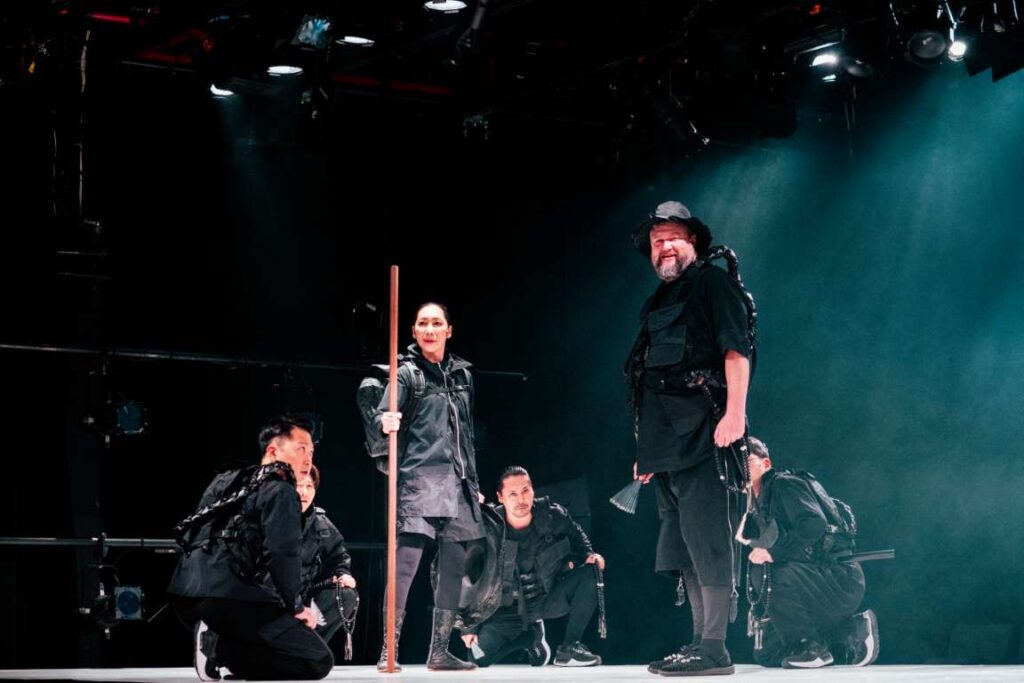
Yoshitsune is often played by an onnagata because the kabuki convention is to consider him delicately beautiful, contrary to the facts. Here he is performed by an actress, Noemi Takayama, lithe yet gifted with a strong, almost masculine voice. Benkei (Lee V), a rumbustious mountain priest, is imagined as a hugely powerful figure, but most Japanese actors who play him fail to fit that description. Not Lee V, however, the bearded white American in the role at the Japan Society. Fluent in Japanese, and talented as well, he’s the closest physical embodiment of the character I’ve ever seen.
Simply put, the plot (enacted in Japanese with English surtitles) concerns General Yoshitsune (Noemi Takayama), one of Japan’s most beloved heroic figures, being pursued by the forces of his jealous brother, Shogun Yoritomo. Yoshitsune is disguised as the lowly porter to a team of four warrior mountain priests (yamabushi) whose leader is the powerful mountain priest Benkei. Seeking safety in a remote domain, they must pass through the barrier gate of Ataka. There, the vigilant guards and their noble leader, Togashi (Ryotaro Sakaguchi), are aware that just such a cohort of priests may try to sneak through. The priests and Yoshitsune arrive, and Benkei clashes with the suspicious Togashi, using his wiles to convince Togashi that their mission is to raise funds for Todaiji Temple in Nara.
This requires that Benkei not only improvise what is written on a blank subscription scroll but brutally beat Yoshitsune with his pole-like staff, as if he really were a porter. For a retainer to so treat his master (think Peter beating Jesus, suggests one writer) is such a sacrifice that Togashi, even though he’s pretty sure that the porter is Yoshitsune, allows the men to pass, realizing his own fate has now been sealed.
Based on the noh play Ataka, and inspired by a 12th-century incident, the original version is performed without conventional scenery on a stage backed by a painting of a pine tree, emulating the appearance of the much smaller noh stage used for Ataka. Instead of noh’s four upstage musicians, kabuki employs as many as 20 upstage musicians, seated on red platforms, who accompany the action playing nagauta-style music, combining choral singing accompanied by shamisen, flute, and percussion.
A hanamichi runway through the audience is used for the dramatic entrance of Benkei and his men, and for an even more dramatic solo exit by the hero, Benkei, who bounds off in ferociously powerful steps called roppō. The flamboyant, elaborate costumes are based on those of the noh, themselves adapted from what the characters would have worn. The border official Togashi wears long, trailing trousers, like those seen in formal settings in samurai films.
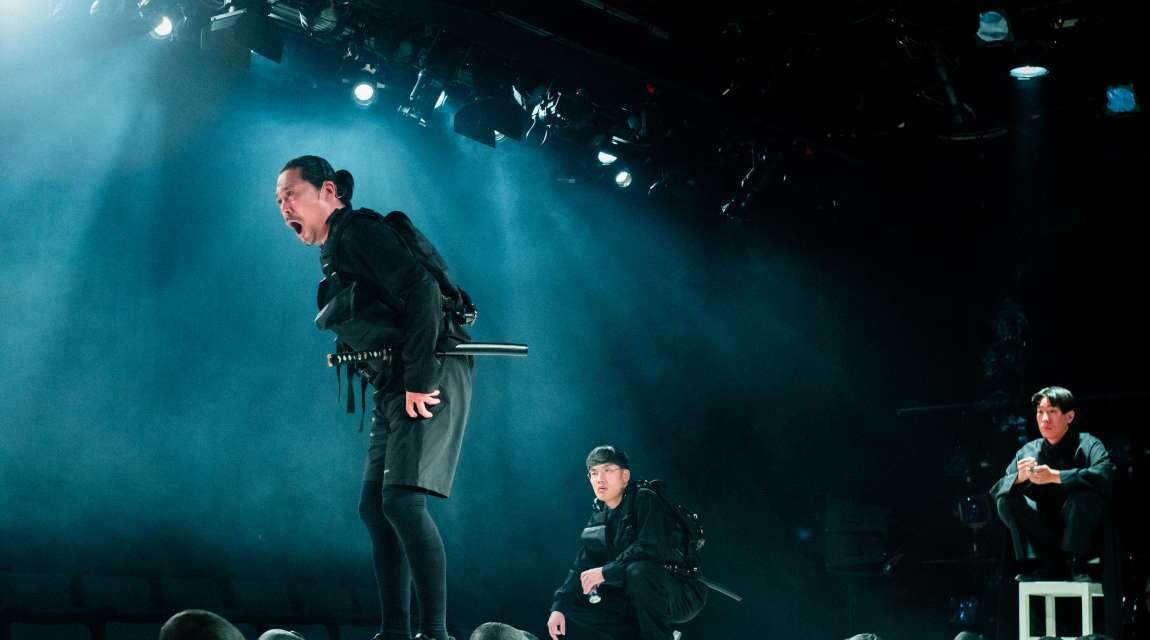
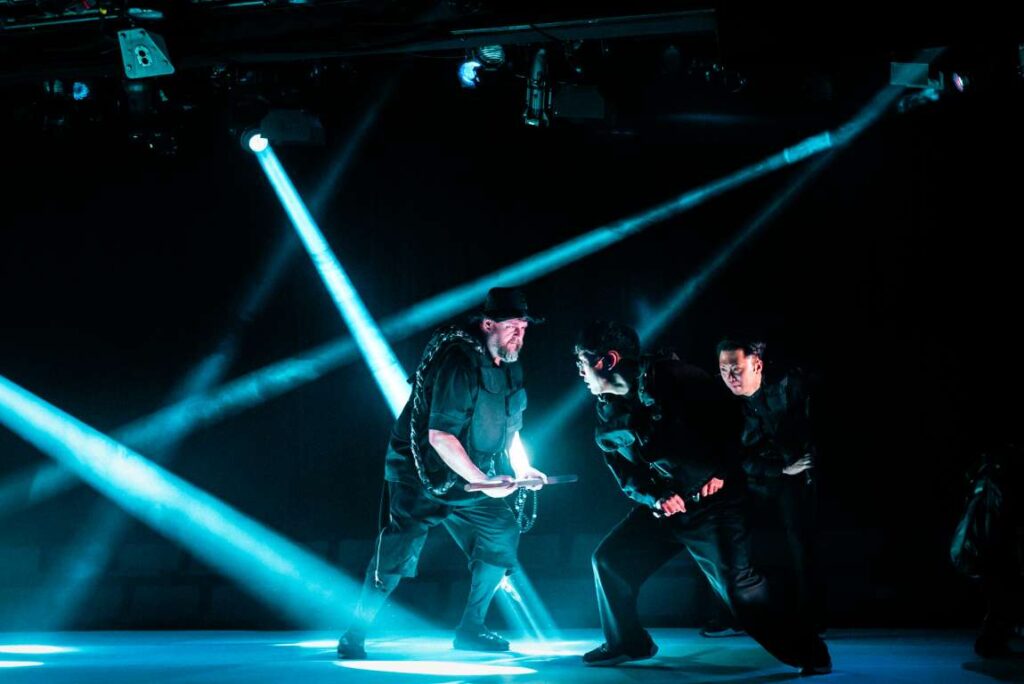
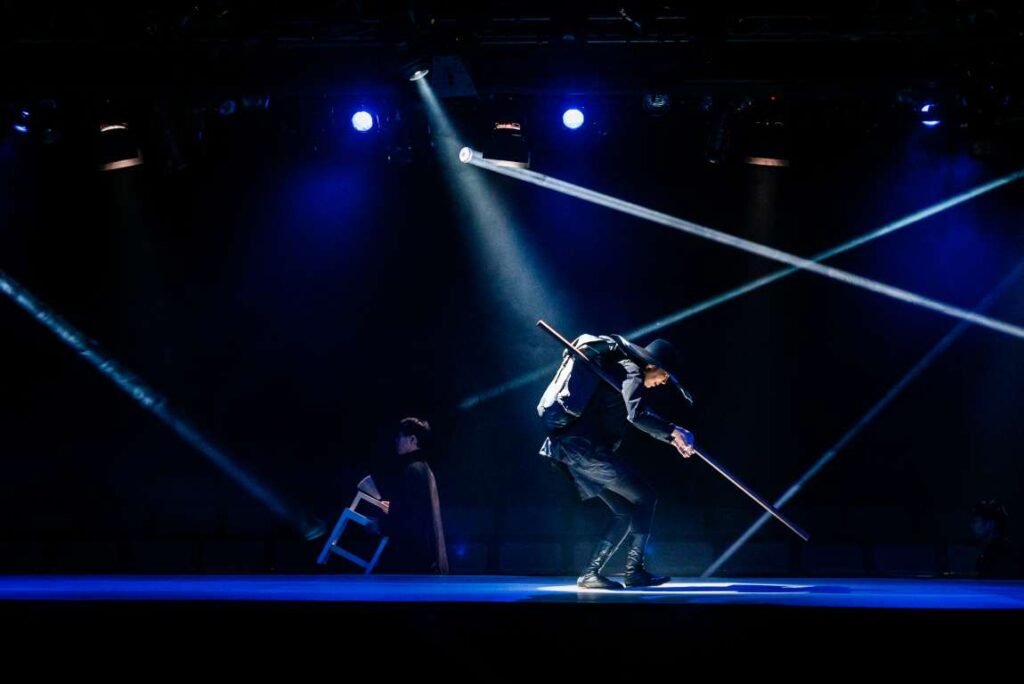
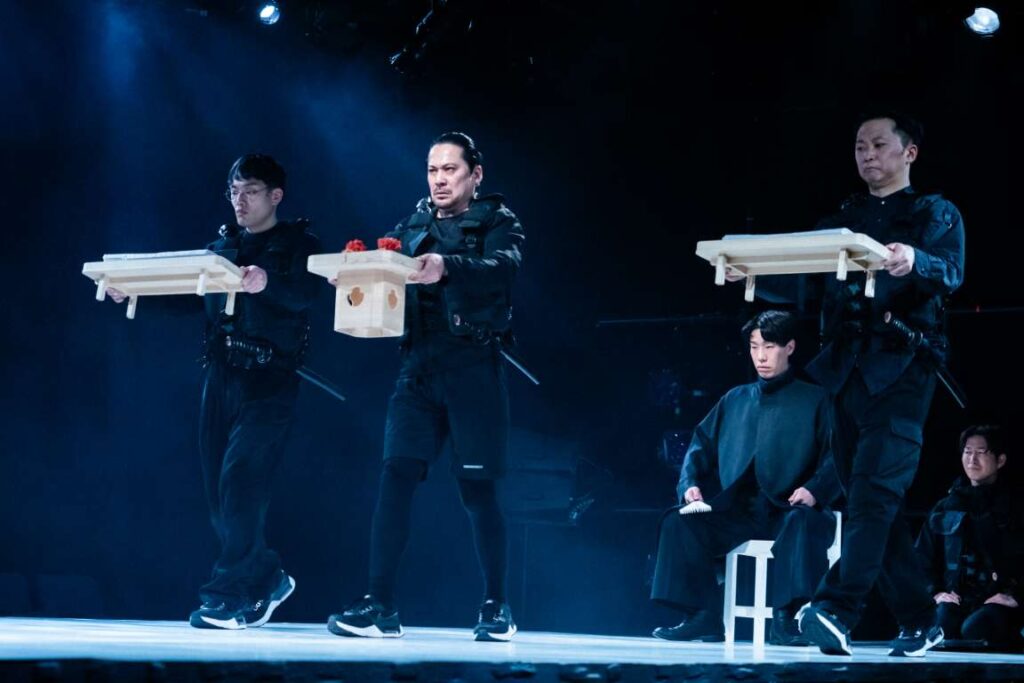
In the show at the Japan Society, designed and directed by Kunio Sugihara, the set is merely a long, narrow, black platform placed parallel to the front of the stage, with audience members seated upstage of it, facing us. All semblance of medieval Japanese garb is gone, everyone being dressed in black. Benkei’s and Togashi’s men, played by the same quartet who rush back and forth as needed, wear simplified combat gear and sneakers. Togashi is in a below-the-knees robe-like garment, Yoshitsune abandons his classical black lacquered sedge hat for a cloth one of similar wide proportions, and Benkei replaces his priestly wooden backpack with a conventional modern one.
Makeup: none noticeable. Onstage assistants: none. Lighting (by Masayoshi Takada, Arisa Nagasaka, Naruya Sugimoto): terrific use of pin spots, with narrow, laser-like beams crisscrossing each other in striking patterns. Music: ah, here we need a word.
A traditional Kanjincho uses nagauta music almost throughout, with lyrical choral interludes and instrumentation heightening the emotional values enormously. The Kinoshita version has many silent periods, like at the beginning as Togashi and his men wait for whomever might be arriving, but it also has many passages of original music, by Taichi Kaneko, and songs in a variety of upbeat, contemporary styles, electronic, pop, and rap. Even nagauta gets sprinkled in. Dance is limited, but the original’s most famous dance, performed toward the end by the drunken Benkei, is here performed (with choreography by Wataru Kitao) by a retainer in a mish-mash of exaggerated styles—none of it traditional—designed to get laughs. (The production has several comic moments.)
Sugihara’s clever direction emphasizes rigorously composed movement sequences and realistic acting, including the kind of vocal overkill samurai characters in movies often demonstrate when deeply moved. There are no mie, the dynamic poses for which kabuki is famous. While no attempt is made to replicate the familiar blocking, some of the highlight passages can’t resist adapting it. This includes the potently climactic bit when Benkei is improvising with the blank scroll and Togashi tries to sneak a look at it, or when Benkei tries to restrain his men with Yoshitsune’s staff and the actors move by twisting their ankles back and forth. It’s here where the artistic disparity between authentic and pseudo-kabuki most emphatically stands out.
Those who know the original will lament some missing bits, like the moment when Benkei, thirsty for as much sake as he can swallow, gulps down gallons from a lacquered sake cask cover before becoming inebriated. Here, though, when offered a metal bowl to drink from, he rejects the opportunity. After all, his drunken dance is now another’s. On the other hand, Yoshitsune, who must spend long periods motionless, is beautifully posed and lit in a way that captures his forlorn persona with exquisite elegance and grace.
It’s possible to view the production as dealing with pertinent social issues, such as border crossing, geographical, personal, class, and even sexual; or to ponder its depiction of the lengths to which loyalty might be taken; or to consider when it’s acceptable to defy official orders. But the chief value of this unusual reimagining for me lies in how deftly it expresses the inherent drama of a landmark play even when its historic visual and aural attractions have been replaced or pared away.
Japan Society
333 E. 47th Street, NYC
Through January 11