Book review by Samuel L. Leiter…
Lucian Msamati, The Godot Diaries: Behind the Scenes of Beckett’s Play (London, New York: Methuen/Drama,2026). 213pp.
Until I was invited by Methuen to review his engrossing book about a 2024 West End revival of Samuel Beckett’s Waiting for Godot, I had no idea of who Lucian Msamati was. (If I were reading this aloud I’d have to very careful about pronouncing his family name, something people in his book consistently stumble over.) Seeking information on him, I discovered that I had just seen, and been impressed by, his performance in a supporting role on a Netflix series called Run Away.
A glance at his Wikipedia page reveals an abundance of outstanding stage, film, and TV credits, including his being the first Black actor to portray Iago in Othello for the Royal Shakespeare Theatre. So, while this 50-year-old actor may not be a household name over here, he’s surely much better known across the pond, even if his name is often mispronounced.
I now know full well not only who he is but have a pretty good idea of what kind of person he is. Msamati is a Black actor born in Britain, raised in Zimbabwe, but officially Tanzanian by virtue of his family heritage. Regardless, his having been cast to play Estragon/Gogo opposite actual household name Ben Whishaw in a nearly 120-performance London revival of Godot, directed by James Macdonald,is a sign of high respect for his considerable histrionic talent. For Msamati, a vastly experienced actor who had been sidelined from stage work for five years by both Covid and screen assignments, it was such a scary undertaking it took him months after signing on before he could open the script.
Msamati is a gifted writer, as demonstrated in the colorful, often profane, prose of The Godot Diaries, a worthwhile book for theatre people, especially actors. However, the army of academics excited by anything Beckettian will appreciate reading how a sensitive, intelligent, well-read, but non-academically-oriented actor approached Beckett’s often mind-bending play, famous for inspiring countless “What does it mean?” inquiries. Msamati discloses that, when asked that question by people seeing the show, he politely demurred; on the other hand, he ends his book with a letter to the late playwright offering his opinion on what, after wrestling with it for so long, it came to mean for him.
Msamati’s book, written largely as it happened, with dated entries, begins with some memoir-like background on his life, but is mainly a chronological account of a London actor’s life, from casting to performance, replete with details on what he endured, including an accident to his foot. He doesn’t really get involved with Godot until more than 40 pages in. When he does, many passages reflect the joys, friendships, breakthroughs, and collaborative highlights experienced amid a well-balanced company of mutually supportive artists, some of whose own difficulties are recounted.
Readers will greatly appreciate Msamati’s descriptions of his creative process, audience behavior, post-show navigation of fans and autograph seekers, performance contretemps, scheduling complexities when also filming on play days, and transportation difficulties. We also observe how a play like Godot evolves during a run as new discoveries are made. Not having closely followed the London theatre scene recently, I admit to not recognizing many of the plays and actors he cites. While recognizing the more familiar names dropped, like John Lithgow and Ralph Fiennes, with whom he filmed Conclave, I had to look up many of the other actors, such as Dan Poyser, Abigail Graham, and Pete Landi.
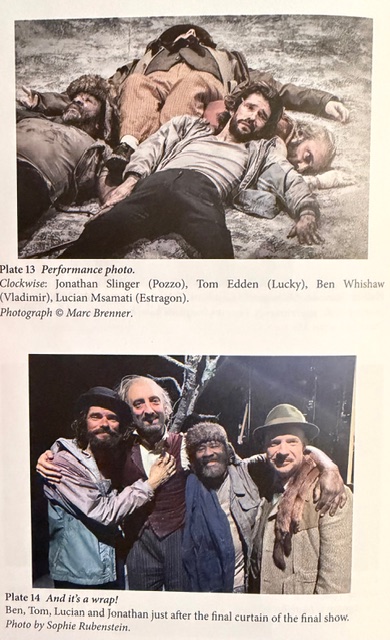
Msamati comes off as a decent bloke, an actor deeply devoted to his art and aware—painfully at times—of his limitations. He’s also someone who speaks of his fellow thespians in only the most loving and deferential terms, his partnership with Ben Whishaw, for example, coming off as memorably warm and mutually respectful. He extends the same admiration for the production’s Lucky (Tom Edden) and Pozzo (Jonathan Slinger), understudies David Lee-Jones and Dean Graham, the three kids who alternated as Boy, and every member of the creative team and stage crew.
Still, the diary format, with its often telegraphic style and frequent resort to “I” sentences, recounting minute performance notes for a production most readers probably never saw, and of a play with which it would be best to have close familiarity, can seem vague, repetitive, and unintentionally solipsistic. While the writing, with its many f-bombs, helps bring an immediacy to the events described, some sections can be a bit of a slog. On the whole, however, the considerable strengths of The Godot Diaries outweigh its minor drawbacks. It is both a valuable document of a first-class company of professional British actors creating an acclaimed revival of a major modern classic, and an introduction to an actor about whom I suspect we’ll be hearing a lot more in the future.