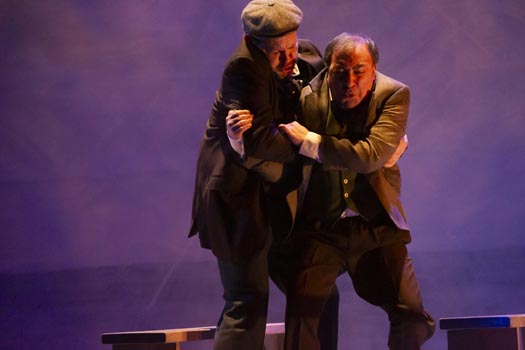
By Alix Cohen
Playwright Eugene O’Neill had a strong personal connection to the sea from his time as a sailor and an interest in New England’s whaling culture. Though he never went whaling himself, the sea became a powerful symbol in his plays, representing both freedom and inevitable fate, an unpredictable force that mirrors the inner turmoil of his characters.
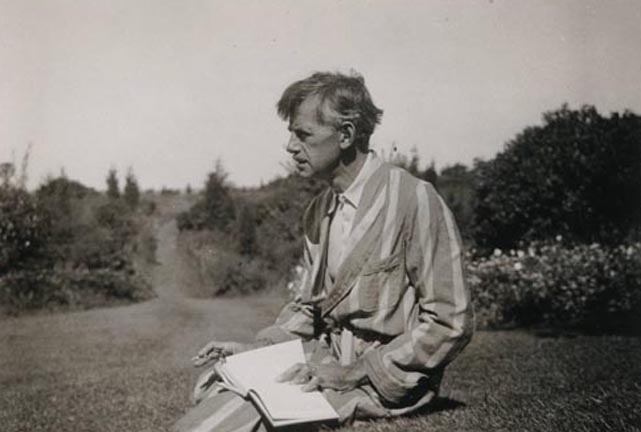
Eugene O’Neill (Public Domain)
Ile (1917) by Eugene O’Neill
Captain Keeney (John Long) is obsessively determined to keep his whaling ship stilled in the Arctic Sea until ice disperses so that he can fill his cargo with oil before returning home. Sailors’ two year contracts are up. Food is running low. “Better men than ye have eaten worse,” the captain retorts. Tempers are high.
The steward (Steven Rattazzi), second mate (Simon Feil), and cabin boy (Jesse Castellanos) commiserate. Mutiny is in the air. Keeney has a gun at ready. Wife Annie (Charlotte Cohn), having insisted on accompanying him, is not so quietly going mad and literally begs her husband to relent. She points out that they don’t need the money. Pride rules.
The drama is too low key in both writing and performance to make its ending effective. Acting is hit or miss with the ever reliable Rattanzi, Simon Feil and in a thankless role, Charlotte Cohn holding their own.
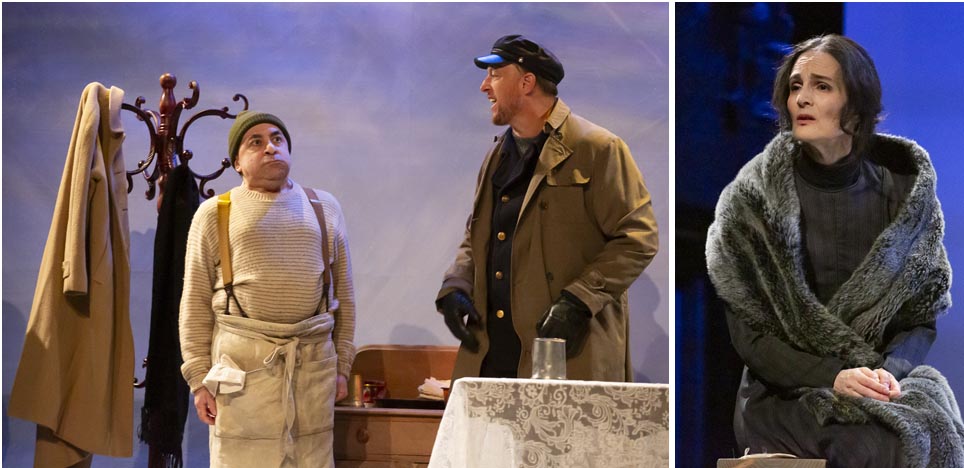
Steven Rattazzi (steward), John Long (Captain Keeney), Charlotte Cohn (Annie Keeney)
Fog (1914) by Eugene O’Neill
A wealthy Businessman (Steven Rattanzi) and a Poet (Simon Feil) are adrift in an oar-less lifeboat off the Grand Banks of Newfoundland. A Polish immigrant woman and her now dead son rescued by the Poet remain beneath a blanket. Fog is so thick the boat seems to be floating on an abyss of nothingness.
The Businessman is sure they’ll be rescued. From a comfortable, first class life, his perspective is one of optimism. The Poet, likely traveling second class as the play says he “visits” steerage, feels not only sympathy but affinity with the poor mother and son. Beaten down to nihilism, he suggests they would’ve had terrible lives in any case and are perhaps better off. In fact, the Poet would have purposefully gone down with the ship had he not noticed the frightened woman.
The two men debate social responsibility and the value of human life. When an iceberg appears simultaneous to sounds of a potential rescue steamer, a moral question arises: If they beckon the ship, it might crash against the monolith. If not, it could pass leaving them to starve and freeze.
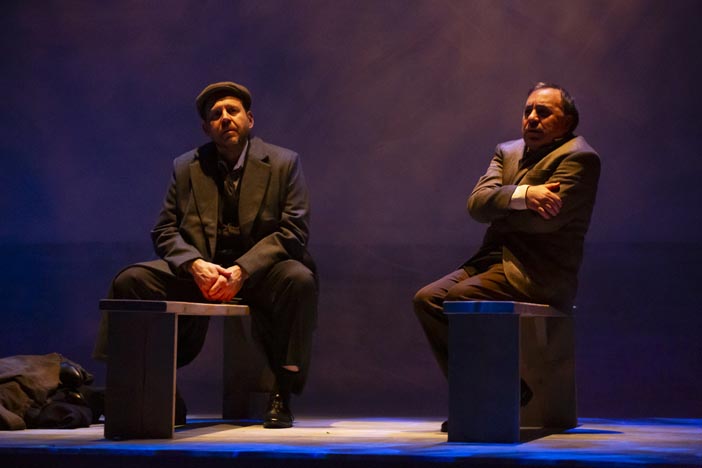
Simon Feil (Poet) and Steven Rattazzi (Business Man).
O’Neill called himself a “philosophical anarchist.” He was a left-leaning radical in youth with sympathies for the working class. The argument here is well articulated; the play’s ending satisfies. Both actors are earnest and distinctive in character.
Fog and Iie were considered somber and unconventional, limiting broader commercial appeal. Later, they were viewed as stepping stones to the playwright’s development.
The Brink of Silence (1914) by Esther E. Galbraith, an American playwright best known for her early 20th-century works exploring social themes and women’s roles in society. There’s limited documentation of additional works.
We’re inside a lighthouse on a rocky island in Antarctica. Cole ne Darton (John Long) has been at a post in this forbidding southern climate 8 years. When an ambitious expedition failed, he was the only man standing.
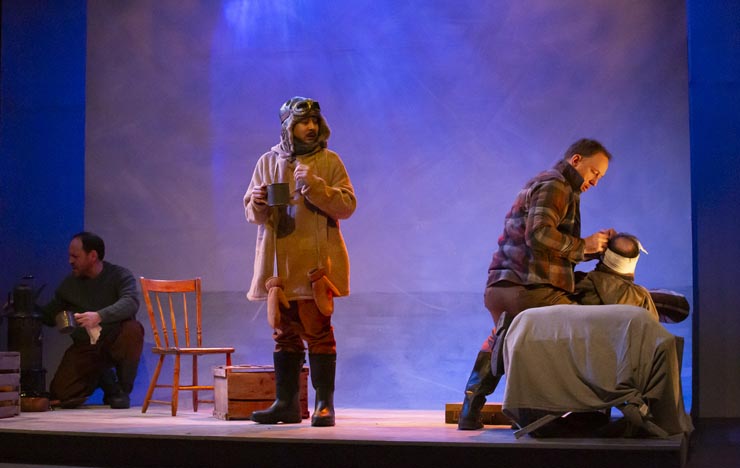
Simon Feil (Macready), Jesse Castellanos (Darton Jr.) John Long (Cole/Darton), (hidden) Steven Rattazzi.
Ambivalent about returning in shame and assumed dead, the explorer let his wife and son move on, exiling himself in favor of a maintaining pristine legacy. It’s taken two years to tell current companion Macready (Simon Feil) his story. Macready finds Darton’s sacrifice unfathomable and the posting untenable. He plans to take the next ship out.
The young leader (Jesse Castellanos) of an expedition returning to pick up an party, arrives at the lighthouse with a wounded man (Steven Rattanzi.) The leader turns out to be Darton Jr. Cole is proud his progeny is finishing what he started. Macready will hitch a ride home. And Cole?
Actors fare well in this piece. John Long’s subtle expressions are that of a man, even when surprised, at peace with curious choices. Simon Feil’s Macready is grounded and believable. As Darton Jr., Jesse Castellanos’s energy and enthusiasm create a whole character and add balance.
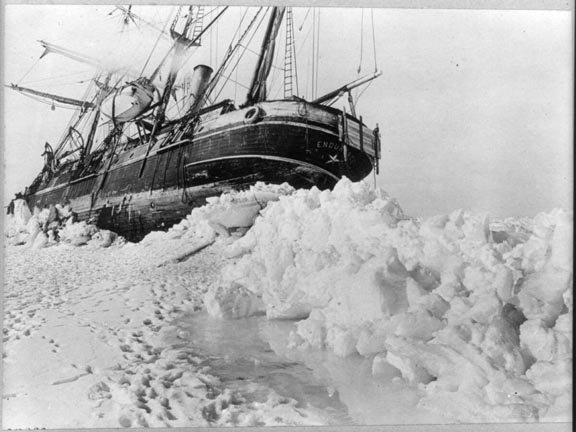
Shackleton’s Antarctic Expedition 1916 (Public Domain)
All three plays depict the search for meaning and connection under challenging circumstances on a hostile sea.
Director Jerry Heymann would make his work more credible if he employed small business onstage. Despite focus, actors are too often left sitting with nothing to do as if waiting to speak. Pacing is good; movement realistic. The last play offers more frequent nuances, but then there’s more meat on its bones.
Scenic Design (Brian Dudkiewicz) utilizes painterly sea photos of clouds by Japanese photographer Hiroshi Sugimoto universal to all three pieces. Minimal wooden furniture serves well. Julia Squier’s Costumes are appropriate and well worn.
Lighting (Max Stroeher) and Sound (Andy Evan Cohen) are immensely effective, enhancing and coloring every scene.
While a few hover over New England, dialects are, for the most part, all over the place. (Laura Espisito)
Photos by Hunter Canning
Opening: Simon Feil & Steven Rattazzi
Fog & Ice– Three one-acts, two by Eugene O’Neill and one by Esther E. Galbraith
Directed by Jerry Heymann
Theater Row 410 West 4nd Street
Through February 28, 2026
https://bfany.org/theatre-row/shows/fog-and-ice-an-evening-of-three-one-acts/