Review by Ron Fassler . . .
Recently delivering one of his three Oscar acceptance speeches, writer-director Paul Thomas Anderson took a moment to shout out the five nominees for Best Picture from fifty years ago: One Flew Over the Cuckoo’s Nest (which won), Barry Lyndon, Jaws, Nashville, and Dog Day Afternoon. It’s generally been forgotten that Cuckoo’s Nest had previously been adapted into a Broadway play a dozen years before it hit the screen, but trying to imagine these other titles as stage plays would be almost unthinkable. Yet here we are one month later with Pulitzer Prize-winner Stephen Adly Guirgis (Between Riverside and Crazy) providing a new take on Dog Day’s beloved Academy Award winning screenplay by Frank Pierson. How do you take a film, with such a distinctive look and feel, directed by a master like Sidney Lumet—then at the height of his powers—and bring life to it on a Broadway stage? And more importantly, why?
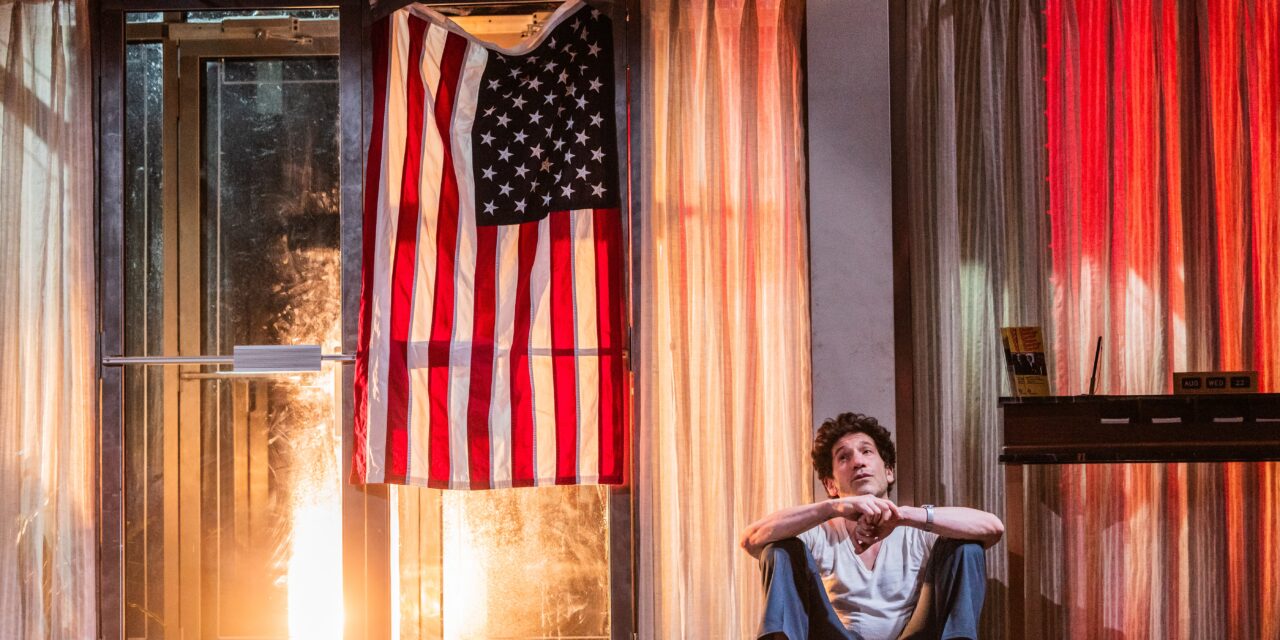
Well, we know why. It’s a branded title that the Warner Bros studio owns, which has been producing plays and musicals based on intellectual property from their film library for decades (currently represented by the hit musical The Outsiders). The choice to retell Dog Day is that it’s one hell of a grippingly good true-life story that takes on even more resonance today than it did a half-century ago. Most attractively, it offers actors the chance at roles they can sink their teeth into. Jon Bernthal, making his Broadway debut as Sonny, a bank robber with a poor plan to begin with and no backup when things go awry, has figured out a way to pay homage to Al Pacino as well as make the character his own. Pacino’s are big shoes to fill and without the use of closeups (Pacino’s best friend), Bernthal must command the stage from start to finish, accomplishing that with an honest charisma, a true voice made for the theater, and solid acting chops.
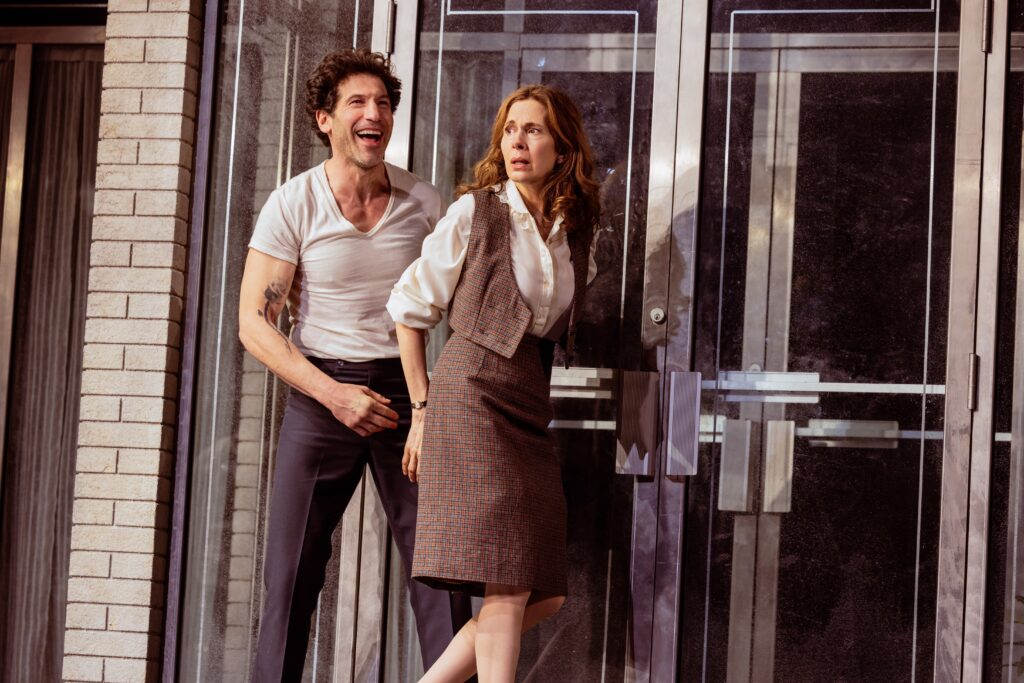
For those who love the film as much as I do (I’m sure I’ve seen it a half-dozen times), this is a tall order and I’ll admit that going on I was skeptical. But under the wise guidance of British director Rupert Goold, the script is not a carbon copy of the screenplay. Guirgis has worked to strengthen several of the characters’ back stories, while bravely removing most of the most memorable lines from the film, the opposite of what we get with so many film-to-stage adaptations these days. By doing so, the playwright has added much needed surprise and a bit more complexity. Most unexpectedly, Guirgis has created a first act that is broadly comic which, at first, did not convince me was a smart idea. However, it ultimately works at setting up a second act that’s as different in tone as day to night, which is literally what happens as the stakes build in intensity.
That Pacino was willing to play a gay man so sensitively as far back as 1975 was revelatory as homosexuals were mostly portrayed on film as either unhappy, near suicidal, or mentally unbalanced. Onstage, the film’s most extraordinary set piece has been left intact: the phone call between Sonny and his wife that carries the emotional center of the story.
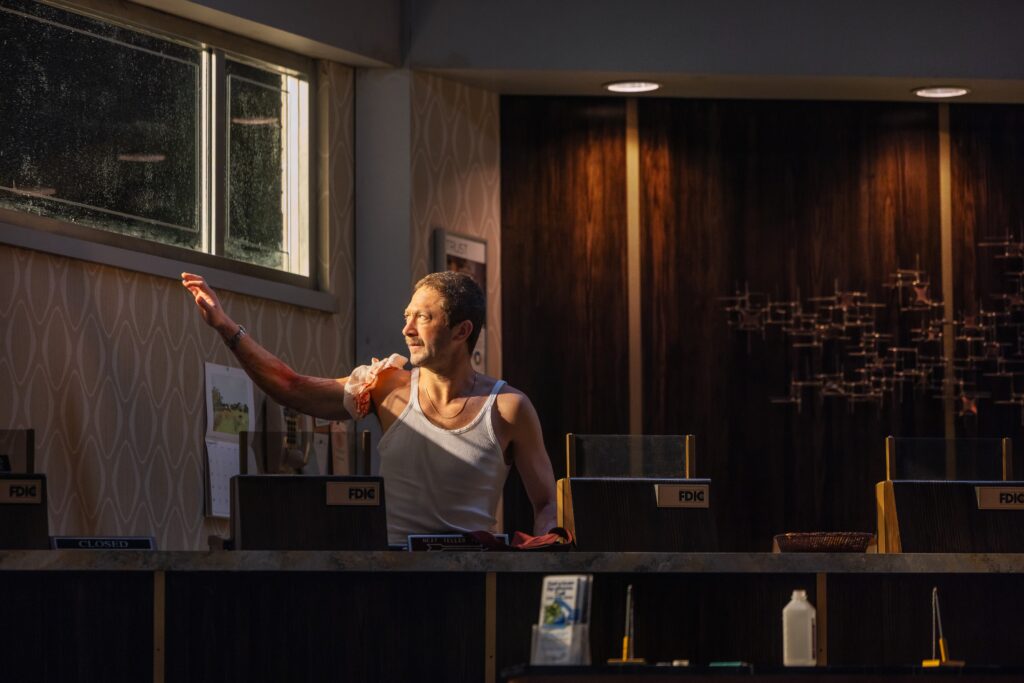
The incident, upon which Pierson based his screenplay, is taken from a magazine article in LIFE Magazine titled “The Boys in the Bank,” that occurred in the dog days of August in 1972 when the twenty-seven-year-old John Wojtowicz and nineteen-year-old Salvatore Naturile attempted to rob a Chase Manhattan branch in Brooklyn. Whether or not it was because Wojtowicz wanted the money solely for his wife’s gender surgery has been debated, but what’s fact is that it all failed miserably. The pair ended up with seven bank employees on their hands as hostages with Wojtowicz attempting to negotiate with the police over a fourteen-hour-period to try and get out of it safely with nobody hurt or seriously injured. The result was a media circus of TV crews with snipers on the rooftops and eventually the FBI called in, while 2,000 people gathered in the streets surrounding the bank. As one journalist reported, “That was a Brooklyn crowd that night. It was a full-blown show.” Wojtowicz, happy to perform for the cameras when the police delivered pizzas to him and the hostages, tipped the delivery guy with cash grabbed straight from the tellers’ drawers.
Goold, a director with a wonderful visual sense, has several past accomplishments on Broadway. Amon them a mesmerizing 2008 Macbeth with Patrick Stewart, 2010’s underrated Enron, and 2019’s Ink about Rupert Murdoch (the less said about his contributions to last season’s Tammy Faye the better). Working for the first time with designer David Korins (Hamilton), they solve the difficult problem of the play’s indoor/outdoor settings with an expansive and brilliant revolving stage which may bring the prolific Korins his first Tony Award. The costumes by Brenda Abbandandolo (Good Night, and Good Luck) project the 70s with aplomb and wit, and the lighting design by Isabella Byrd (An Enemy of the People) is consistently good in all its variations. There’s also excellent sound design from Cody Spencer (The Outsiders—Tony Award) that reaches a fever pitch towards the end of both acts. All these elements aid immeasurably, allowing the audience to be swept up in the proceedings.
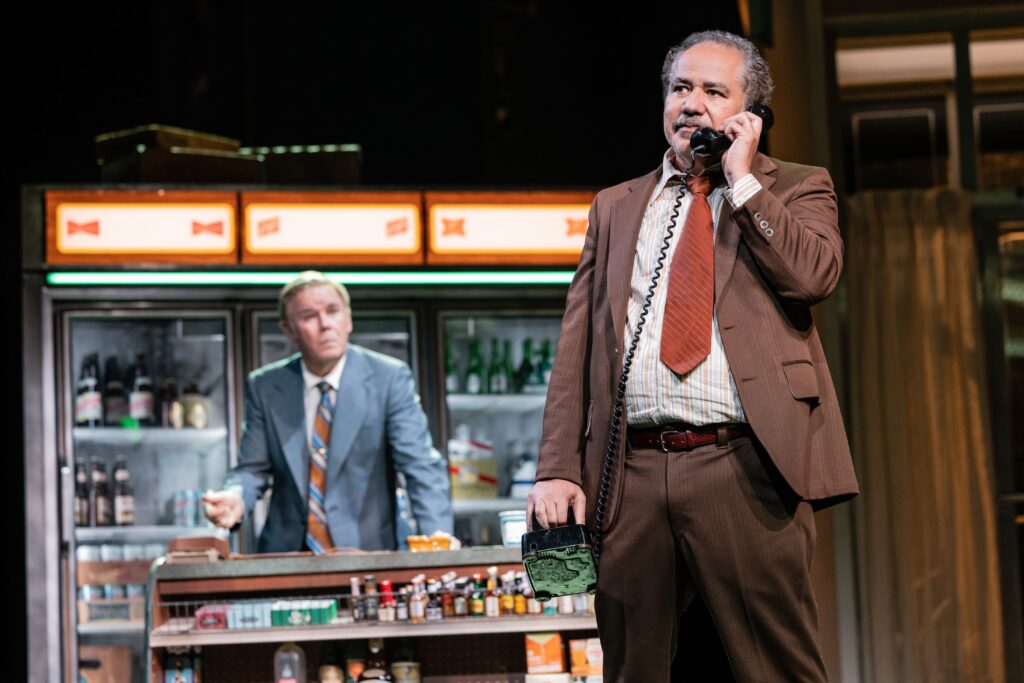
Goold has cast this production beautifully, drawing especially good performances from Jessica Hecht, pitch perfect as Colleen, the head bank teller. Her character is but one example in which a small role in the film has been expanded in all the right ways. In a similar fashion, I enjoyed Paola Lázaro as Guadalupe, a hippie bank teller, created from whole cloth by Guirgis, and Wilemina Olivia-Garcia as Lorna, a veteran bank teller, as well as a veteran of Guirgis’s LAByrinth Theater Company. In more substantive parts, Esteban Andres Cruz brings dignity and an unpredictability to Leon, Sonny’s wife. Jon Ortiz’s usual combination of gravitas and good humor are put to good effect as the officer in charge of the hostage situation, and Spencer Garrett, a TV and film mainstay of many years, seems to be relishing the chance to play a hard-hearted FBI guy. Along with character actor par excellence Michael Kostroff, who has a field day with Butterman, the Bank Manager, the pair are proof that good things come to those who wait. Both Garrett and Kossoff are making long-overdue Broadway debuts here. Bravo.
And what of Ebon Moss-Bachrach as Sonny’s dim-witted aide de camp, Sal? Played memorably in the film by John Cazale, Moss-Bachrach goes for a more tormented, physically frightening portrayal. With Sal’s psychological profile expanded by the playwright, what’s gained is some depth also loses someone to sympathize with—a thing Cazale mastered with every facial expression (again closeups can be an actor’s best friend). It’s hard to top the skillfully calibrated and sensitive performance Casale pulled off, but Moss-Bacharach, a fine actor, does what he can even if it feels like he’s hamstrung by how Sal has been repurposed and reconceived. What could be incredibly interesting (and possibly a major selling point) is if these two actors decide to switch roles at some point. I, for one, would return.
The audience with which I attended Dog Day Afternoon overwhelmingly loved it. I did notice after intermission some empty seats indicating walkouts; surely unhappy at the sight of a favorite film of theirs unjustly mangled in their eyes. Fifty-one years is a long time, and strong memories can be fierce things. But fiercely themselves, Guirgis and Goold have gone where most adapters refuse to—presenting purely their own thing with no apologies. Cue applause.
At the August Wilson Theatre, 245 W 52nd Street, New York; dogdayafternoon.com.
Photos by Matthew Murphy and Evan Zimmerman.