By Alix Cohen
“Maybe if we stopped chasing grace, we’d learn to love the process of becoming Grace.”
Elizabeth Addison apparently has no theater and barely any music training. Like Irving Berlin, she can read “basic music”, but not write it. She listened to everything. “It was necessary to get past the idea of what musical theater looked like…I learned on the job, building the plane as I was flying.” Now 14 years sober, her 20s were spent as an alcoholic.
An unnecessary preamble finds Grace getting fired at the end of an awful 24 hours. She’s additionally nervous about speaking on Recovery Day, a national celebration to raise awareness, reduce stigma, and showcase long term addiction rehabilitation. 550,000- 600,000 women per year enter addiction programs in the United States. Millions more suffer without receiving treatment.
Act I: We’re at a recovery facility unfortunately named End of Despair. A rehab center is a clinical facility focused on medically supervised detox and intensive therapy. A recovery residence is a transitional, community driven environment focused on long-term maintenance after treatment.
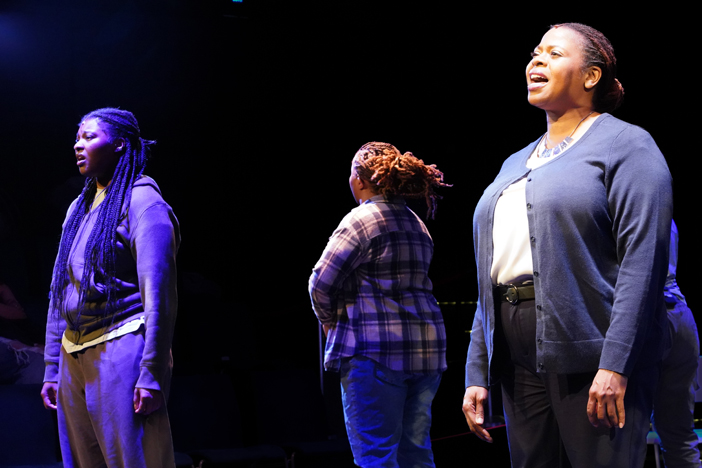
Harper Miles (Grace) Kiara Wade (Sheri), LaDonna Burns (Ms. Caroline)
Women in the program occupy a semi circle of white chairs. They are: mentally challenged Tessa (Tracey Conyer Lee), Taniesha (Marliana Powell), “uppity” Cece (Shamiea Thompson), Sheri (Kaiara Wadw), and Kelsey (Theo Michaela.) Grace (Harper Miles) has just arrived. The session is lead by former addict, Ms. Caroline (La Donna Burns)
“What are your values? How do you measure self worth?” she sings. The rhythmic ballad is enhanced by flute and gospel without getting too large. Well arranged and varied, Pop, R & B, and musical theater songs ensue. “There’s power in your testimony. It starts here,” Caroline continues. The women circle. A dance parenthesis is less theater than the hood, an extended expression of feelings. (Apt choreography – Brian Harlan Brooks)
Grace tells case worker Ms. Anita (Chantelle Guido) that she’s 27 and has been abusing alcohol for 8 years. In and out of rehab, this is her first time in recovery. “I’m tired of the walk of shame,” she sings. The heroine is shy and not yet acclimated; the women testy, embattled, unfriendly. Presumption is that Grace is more educated/polished. Perhaps the others think she’s a snob. A hierarchy exists. Alas, we’re told nothing about her background.

Gabrielle Beckford (The Writer)
A few women do share. Much like the series Orange is The New Black, varied history takes the cliché out of their fates. Women line up for meds. Behind closed doors some still secure drugs and have sex; they gripe, connections are made, journals acquired. Funding is an ongoing issue. In 2026, thousands of mental-health and addiction grants worth roughly $1.9 billion were abruptly terminated.
Act II: A younger or older Grace called The Writer (Gabrielle Beckford) is living with supportive partner, Janessa (Kiara Wade.) She’s
5 years into developing a musical based on recovery experience when a potential Broadway producer (Chantelle Guido) calls from New York. The entire cast gets on a plane to participate in workshopping.
The Writer is saddled with a Tony Award winning writer/director/star and “dear friend” (Shamiea Thompson) of her producer.
Her so-called collaborator is as stereotypical and exploitive as they come: swagger, big shades, a fur coat, black boots and cringy, idiomatic speech.
Her nascent musical morphs from raw and real to tonally deranged -something wedged between cultural appropriation and Uncle Tom. It’s hackneyed and bigoted. Its heroine is suddenly a middle glass innocent inadvertently addicted while taking opiates for an injury. Instead of being one among her peers, she’s appalled at their behavior.To the choreographer’s credit, an excerpt production number is Broadway generic. Its star wildly overacts. ‘A gloriously terrible deviation.
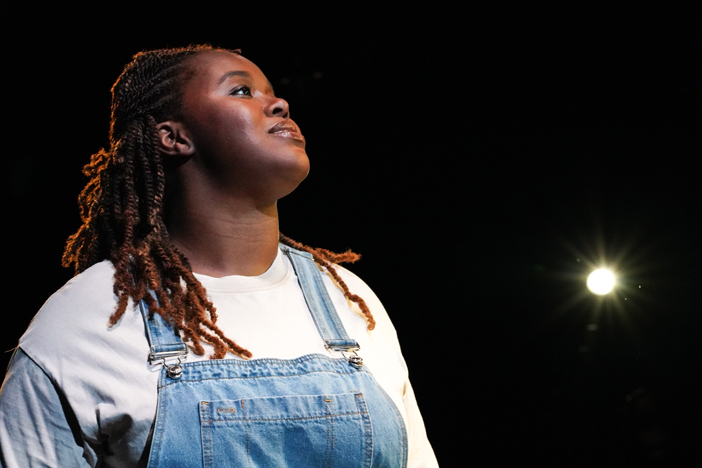
Kiara Wade (Janessa)
The Writer feels trapped. “What’s true is that they have what I want and if I want it, I have to do what they want me to do.”
She’s losing Janessa, her cast, and her “voice.” How many artists have sacrificed the integrity of work to the altar of production and the chance of success? We never learn what happened to the musical, only that The Writer, now alone, remains sober and continues pursuing her dream.
Chasing Grace wants editing. The musical within is too long. A single number bookended by dialogue would suffice to wincingly deliver the message. There are loose ends and unanswered questions.
Like Sunday in the Park with George, the show feels as if a one act was later augmented. Here, subjects in Act I and II, both valid, relate less well as written. Confusion about the identities of Grace and The Writer intrude.
Still, Chasing Grace shows remarkable talent. Elizabeth Addison’s script is intriguing and engaging. Lyrics are frank and specific. Direction is fluid, evocative, and visually appealing.
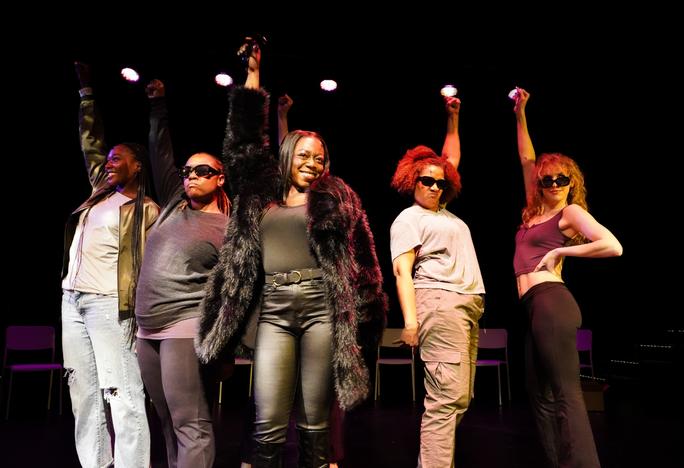
Shamiea Thompson and Co. in the show within the show
Almost all voices are very fine with Harper Miles (Grace) and Kiara Wade (Shari/Janessa) standout singers and actors. Tracey Conyer Lee’s Tessa is wonderfully credible and respectfully portrayed. Chantelle Guido manifests the cloying, politically incorrect producer with authority. The band is excellent.
Elizabeth Addison is an artist to watch. This is a worthy bearing witness by a veteran on the front lines, affecting and entertaining.
The artist is now a creative recovery coach, story coach, and trauma informed facilitator with The Meghann Perry Group, a consultant for The Opioid Response Network, and the resident artist at The Grayken Center for Addiction at Boston Medical Center
Photos courtesy of the company
Opening Harper Miles (Grace) and company
Chasing Grace
Book, Music, Lyrics, and Directed by Elizabeth Addison
Music Direction Jacinth Greywoode
ART/NY Mezzanine Theatre 502 West 53rd Street
Through March29, 2026
http://www.shenycarts.org/ChasingGrace