By Alix Cohen
Henry Darger was an American outsider artist and reclusive writer whose work remained largely unknown during his lifetime. Born in Chicago in 1892 his mother died when he was young and his baby sister was given up for adoption. Darger spent part of his childhood in institutions and orphanages, then lived a solitary life, working mostly as a hospital janitor while secretly producing an enormous body of creative work in his small apartment.
His most famous creation is the sprawling illustrated manuscript The Story of the Vivian Girls, in What Is Known as the Realms of the Unreal, a fantastical narrative of more than 15,000 pages depicting a war between innocent child heroines—the Vivian Girls—and oppressive adult forces. Alongside the text, Darger made hundreds of large watercolor and collage illustrations, often tracing images from magazines and children’s books and combining them into vivid, unsettling scenes.
Because young children—especially girls—appear in vulnerable or violent situations, sometimes with male genitalia, suspicions of pedophilia arise. There is no scholarly proof of this. Darger attended church frequently, and had very little documented interaction with children beyond unsuccessfully trying to adopt.
Some art historians interpret the imagery instead as reflecting psychological trauma, confusion about anatomy (possibly from copying images), religious ideas about innocence and martyrdom
After his death in 1973, his landlord, Nathan Lerner, discovered the vast archive in Darger’s room, revealing a singular imaginative world that would later make Darger one of the most celebrated figures in outsider art. Today his work is recognized for its obsessive detail, emotional intensity, and complex blending of innocence, violence, and fantasy. The highest recorded auction sale for a Darger work is about $745,000 for a large double-sided watercolor sold at auction in 2014.
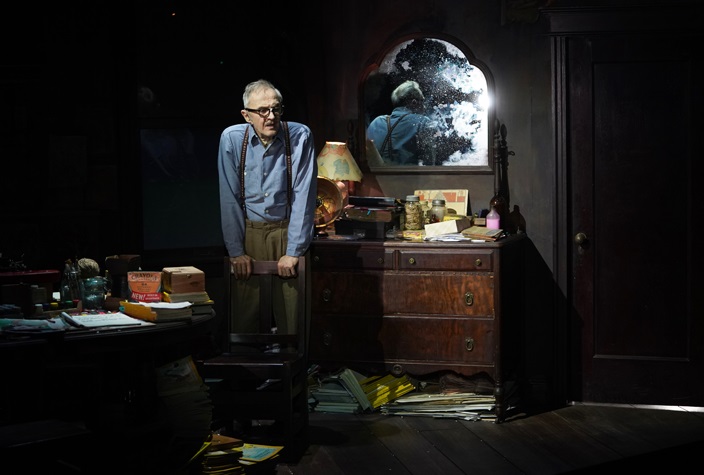
Bughouse (‘no idea what the title signifies) is an aural and visual foray into Henry Darger’s mind. Actor John Kelly’s personification is completely credible- focus unwavering, mind jumps unsettling. The character speaks to himself and outwards though unaware of ‘us.’ That which we see and hear is unquestionably real to him.
The multidisciplinary “image theater” of Martha Clarke blends dance, circus, and theater to explore complex, often dark themes. She focuses on evocative stage pictures rather than linear narrative. Subjects have included, in part, Hieronymus Bosch, the decadence and decay of fin-de-siècle Vienna, and themes of emotional starvation in Kafka’s oeuvre. Clarke is a theatrical alchemist.The originator’s direction is realistic and compelling. No move seems out of place or manufactured. Variety holds the eye as well as the ear.
Unexpectedly by Beth Henley, whose work most often involves family relationships, the script features excerpts from Darger’s fiction and other writings, but it’s fluid train of thought that makes sense of flitting attention. Counter intuitively, we don’t feel jerked by a pinball mind, but rather lead from one polestar to another.
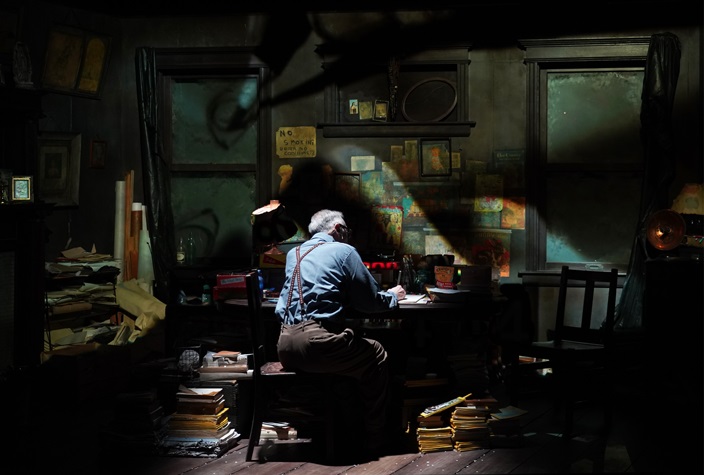
John Narun’s projection design, Fred Murphy’s cinematography, and Ruth Lingford’s animation of Darger drawings appear and fade on the walls of his room, peek in through two windows and illustrate roiled weather. Black and white photos and video add context. Manifestation of the protagonist’s thoughts is seamless.
Incredibly detailed production design by Neil Patel creates a hoarded apartment based on photos of Darger’s home that can be viewed with background text in theater corridors. Objects are dated, dirt and dust omnipresent, vestiges of projects visible.
Faye Aron-Troncoso- set decoration and props.
Lighting (Christopher Akerlind) and sound (Arthur Solari) ably contribute, especially with intermittent storms.
The piece is fascinating and very well executed on all fronts. Your cuppa?
Photos by Carol Rosegg
Bughouse
Conceived and Directed by Martha Clarke
Script by Beth Henley
Adapted from the writings of Henry Darger
Vineyard Theatre 108 East 15th Street
https://vineyardtheatre.org/#2
Through April 3, 2026