By Alix Cohen
“First you take a drink, then the drink takes a drink, then the drink takes you.” F. Scott Fitzgerald
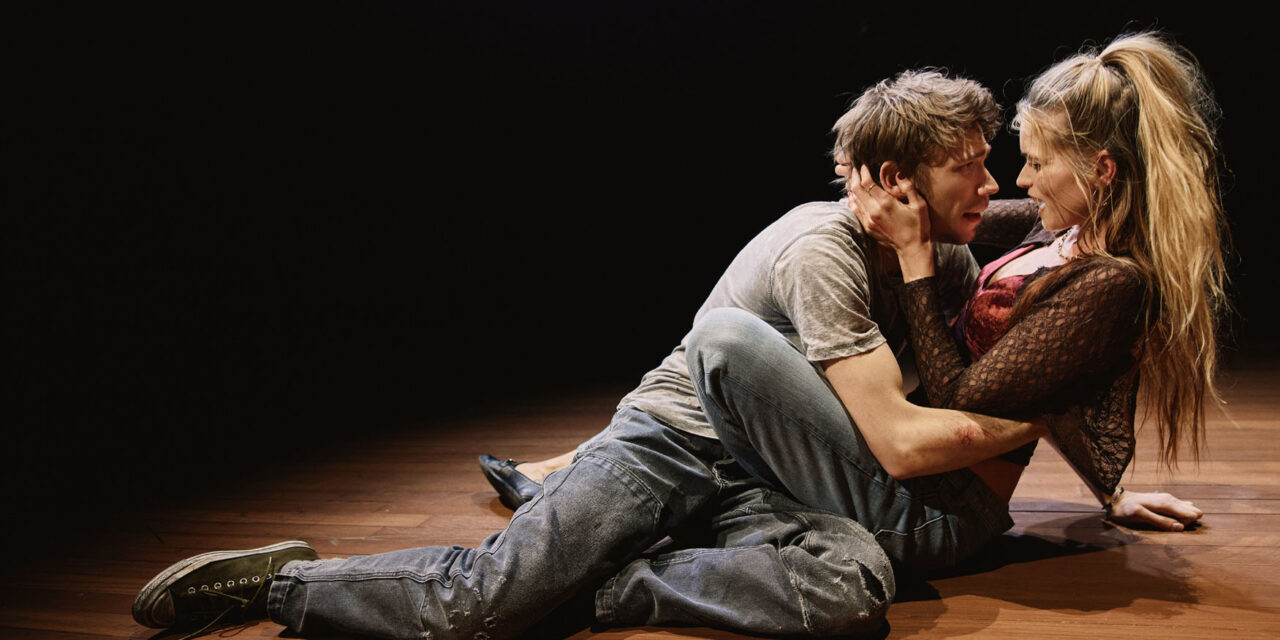
They meet in a church basement outside an AA Meeting. “She” is clearly an old hand at circumstances, which is to say, being outside a meeting. An extremely attractive young woman, she’s aware of her sexual appeal and its commodifying usefulness. There will always be another free drink, a place to crash should she not find her way home.
“He” arrives wiping vomit from his mouth having just gone cold turkey. His entire body shakes. He stammers. (Both credibly) This will be his first meeting and desperate last chance. Art college, the only place he kind of belongs, has threatened to expel him. He’s sick and lost.
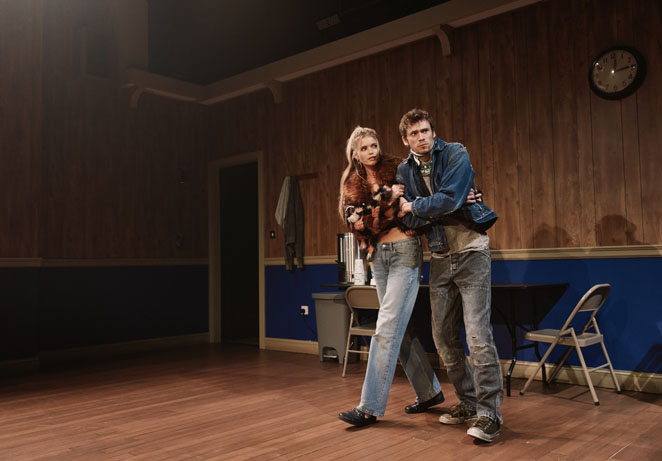
She advises him he can’t just stop. “I know all the tricks. You just need a bit of care.” Like Lilith, she entices. They drink. In the morning he’s besotted. He no longer shakes, the stammer is gone, as is an unexplained neck brace he wore the night before. He tells her the two of them broke into his college dorm last night, to see his art. She has no recollection; in fact, doesn’t know who he is.
Based on the most recent data from National Surveys on Drug Use and Health (NSDUH), there are approximately 5.9 million young people in the U.S. between the ages of 12 and 25 who meet the clinical criteria for Alcohol Use Disorder. Despite high rates, only 1 million people in that age group received treatment.
Stage blackouts define every vignette. Time passes. “I’ve been looking for you since I got kicked out of college,” he tells her. “Can we just start again?” she responds, deflecting. They concoct elaborate new identities and go to a bar. Suddenly, he’s spitting (effectively manifest) blood. She wants to take him to a hospital. He won’t go, sure the institution won’t let him leave.
Research indicates when blood alcohol content (BAC) reaches 0.16% (twice the legal driving limit), there’s a roughly 50% chance of experiencing a blackout.
“After the first glass, you see things as you wish they were. After the second, you see things as they are not. Finally, you see things as they really are, and that is the most horrible thing in the world.” Oscar Wilde
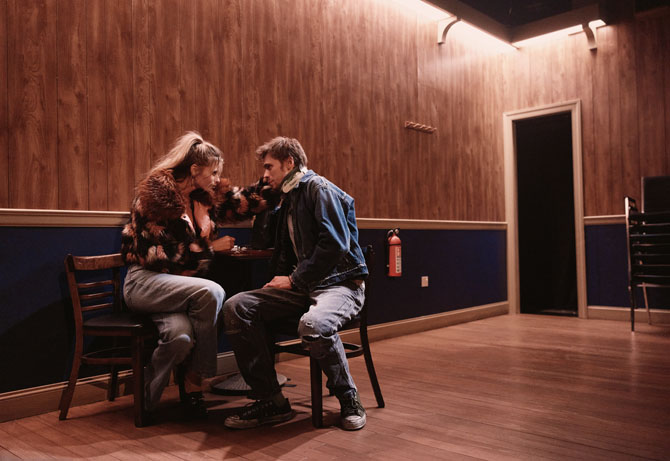
He’s diagnosed with Cancer. She forgets him, then reappears. He’s abstaining and has misplaced his muse. Being convinced that intoxication is the only way to create art is almost historically endemic.
The couple struggles together or perhaps he struggles while with her. They spiral. It’s difficult to tell who’s weight baring. She disappears again. The power and punch of each segment could give you whiplash.
In the last chapter, he’s demonstratively sober – clean clothes, eyeglasses (nifty touch.) He has a girlfriend and an exhibition. She shows up to the gallery…wanting him. It’s not over yet.
Joe White has written a nightmare of addiction and codependence. Think of it as a contemporary Days of Wine and Roses on steroids or Greek tragedy. There isn’t a false moment. Undoubtedly meant to be exhausting, the play might nonetheless fare better slightly edited. My only other caveat is that Miss Lee’s strong, lower class British accent is too often unintelligible, especially in the first part of the play.
Director Rory McGregor uses every inch of the open stage making us feel caught up in a cyclone. Physical acting is demanding, wrenching; emotional expression- committed, mercurial, all in. Vignette-style dramatization leaves one breathless. Actors are flat out marvelous.
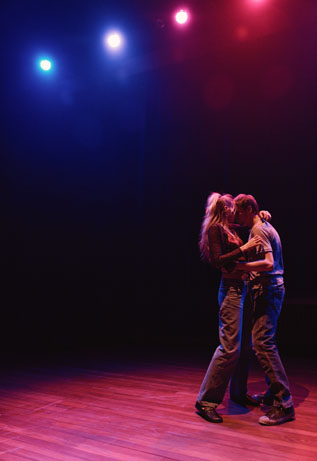
Abbey Lee’s “Her” is detached from everything but liquor and sex. She’s palpably vacant, or callous, needy, and selfish.
As “Him”, Owen Teague has been reduced to a shell she fills. A known demon is less frightening than that which is as yet unrevealed. His pain affects. Chemistry is incendiary.
Scenic Designer Scott Pask offers an almost blank stage with minimal indication it’s a church basement. The play is all.
Costumes by Avery Reed not only fit character, they aptly morph to the moment.
Lighting (Stacey Derosier) is used as punctuation, unforgiving and sharp.
Photos by Emilio Madrid
Blackout Songs by Joe White
Directed by Rory McGregor|
The Susan & Ronald Frankel Theater in The Robert W. Wilson MCC Theater 511 W 52nd St in Hell’s Kitchen.
https://www.blackoutsongs.com/?gad_source=1&gad_campaignid=23356349195&gclid=Cj0KCQiAyvHLBhDlARIsAHxl6xrOkJFK3PT3bHe4O1scT7Thh_G__eQfkIfcOlRAzJ-yh6wbIzfw1mIaAh2cEALw_wcB