By Stuart Miller…
Jonathan Spector deftly delivers fully human characters debating complex political issues.
Most of the three hours and twenty minutes of Jonathan Spector’s “Birthright” is an emotional and intellectual thrill ride– witty, occasionally dizzying dialogue from complex but relatable characters who grow closer and then are pulled apart by the mundanities of life and the impossibilities of modern Middle East geopolitics.
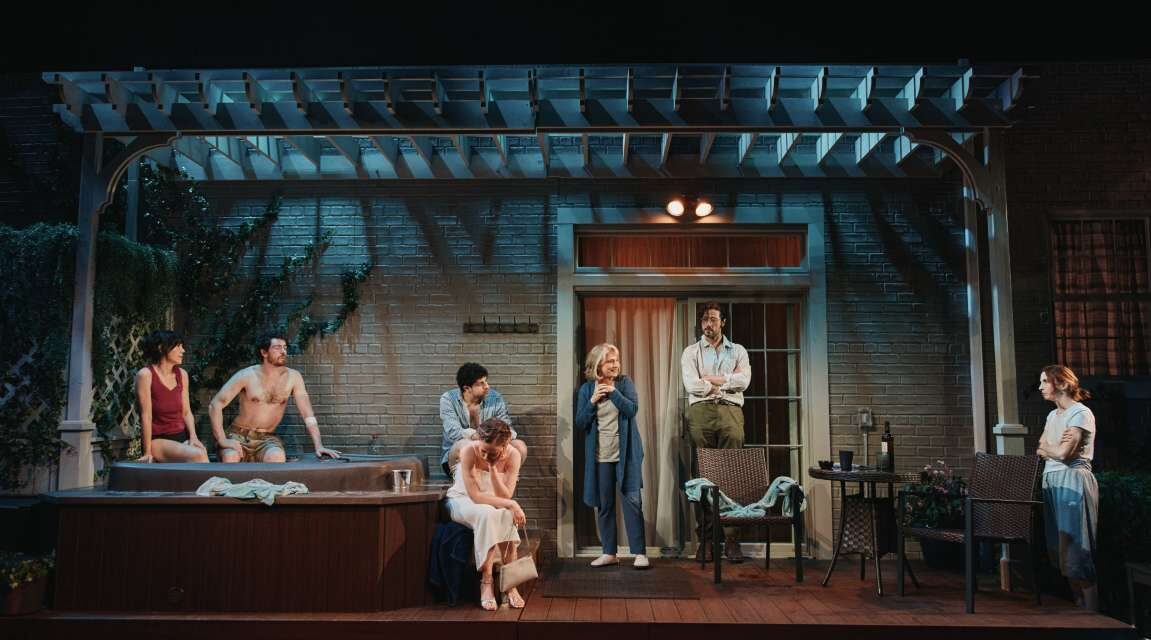
It’s a remarkable feat that the play is always engaging, never feels its length, and rarely gets bogged down by the politics or turns didactic. At the very end, unfortunately, there are some inorganic moments. Spector pulls up short, relying on a plot twist and a religious ritual to distract us from his unwillingness to truly challenge his characters and the audience at a crucial moment. (A little didacticism, or at least authorial intent, is missing there.) Yet the play is still worthy, a vital and moving look at being Jewish in America at a moment when that identity is fracturing.
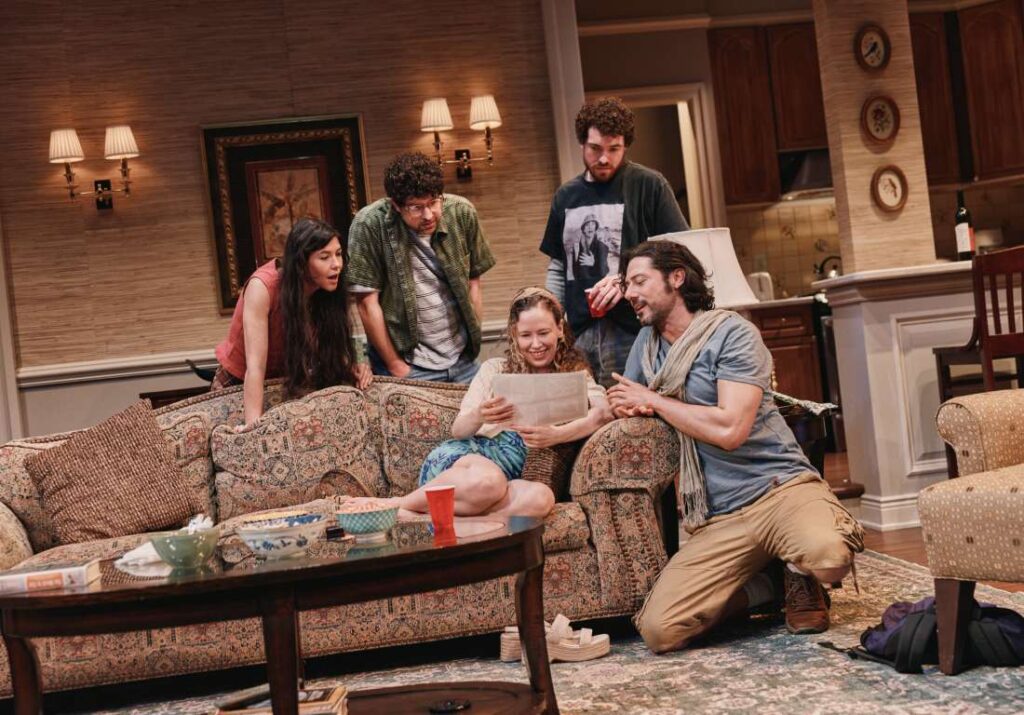

The play opens in 2006 with a group of twentysomething American Jews who recently returned from a Birthright trip to Israel, which is alternately described as an eye-opening experience, a drunken orgy, and political propaganda. It’s probably a mix of all three and those ten days bond this group for life: the second act jumps forward to the eve of a wedding in October, 2016 and the third to the aftermath of a funeral in June, 2024.
The second act is deft in not overplaying the “Oh, Hillary will definitely win” bit and keeping the politics relevant to the characters lives. The show is building, of course to the third act in the aftermath the horrors of Hamas’ brutal attack and Israel’s disproportionately devastating (and never-ending) response.
Spector, who brilliantly used screens to comic effect in his vax vs anti-vax masterpiece, “Eureka Day,” uses them here to assist in the time travel between the acts, filling in the gaps with group emails, Facebook posts, group texts and WhatsApp conversations. We learn about marriages, babies, career changes and just how much this found family cares for one another even as it becomes harder to stay in touch off the screens.
(Ah, those screens: in the third act, two characters engage in a bitter debate about Zionism that’s undermined by the fact that they keep stopping to Google for points to back up their arguments– they’re screaming others’ words at each other. Meanwhile, the show has some nudity and so audiences are forced to put our phones in pouches. You can get them out at intermission, but don’t– this play has earned the right to keep you in its world for the entire night.)


Along the way, the characters search for community, understanding and meaning as they muddle their way through their personal, religious and political lives and the painful intersections of the three.
Chaya (Zoe Winters) starts a sexually liberated sorority girl who has few Jewish friends but she evolves into a political powerhouse, working in the Obama White House and then a non-profit executive whose protective feelings toward Zionism puts her on a collision course with Izzy (Molly Bernard), her childhood friend. (They’re the only two who knew each other before the trip.) Izzy is queer, although in the opening scene she’s also reflecting on an interrupted experience with one of her new compatraiots that left her reeling with confusion; she becomes increasingly anti-Zionist, especially as Israel succumbs to Netanyahu’s more belligerent attitudes both before and after October 7th, 2023.
The result is a widening fissure between Izzy and Chaya and between Izzy and Alona (Molly Ransom), who we meet in 2006 after she lost her virginity to an Israeli soldier during Birthright. She’s now enamored with Israel and plans to ditch her Yale graduate program to move there; while her friends open her eyes to the folly of that plan, she does ultimately marry an Israeli and moves there, although she returns home in 2024 while Israel is committing either ethnic cleansing or genocide in Gaza. (The word choice and whether it matters is a point of heated debate within the play.


Izzy is the least developed character and has the least stage time (she is sent off stage for a conveniently super-long Facetime call in the third act), the closest thing Spector has to a political prop. By contrast, the most layered character is Lev (Hale Appleman), who worried his new friends by vanishing mid-trip. He shows up back in the States with personalized gifts for all along with stories of his travels to Egypt, Jordan and even the West Bank, the kind of unedited experiences Birthright doesn’t allow. Lev is sweet and charming and he’s a thoughtful philosopher, bringing insights to the importance of properly understanding the way Jews perceive their own history. But as the show goes on and we learn about how Lev’s life unspools, we realize that Spector had dropped early hints that Lev’s restless searching also reflected mental distress.
Emerson (Nate Mann) is more obviously troubled, an aspiring rock star with plenty of charisma and a dangerous taste for drugs and alcohol. He has an extremely shallow understanding of Judaism but also a curiosity that offsets his casual airs. And finally, there’s Noah (Eli Gelb) who’s smart and knows it but who often relies on offering historical context, intellectual arguments and witty quips to avoid putting himself on the line. (But he’s usually right and really funny– — his first act anti-Bush, anti-Boomer rant is performative but scathing and insightful as is his take on the Jewishness of “Seinfeld.”) Noah morphs from blogger to journalist to podcaster and who sheds his schlubby hunching over as he comes into himself but he never stops pining for Chaya.
The cast is excellent across the board. (There’s also comic relief and charming exposition from Chaya’s mother Deborah (Liz Larsen)– her tasteful Washington D.C. home is the gathering place for these friends– but realistically her scenes could have been cut without much being lost.)
It feels weird to say I don’t want to give too much of the plot specifics away in a play that’s essentially three hours of conversation and debate but the couplings, the fights, the breakdowns and conversions are largely realistic and well-grounded in these characters. They argue about the “contradiction and complexity [that] is inherent in Judaism,” but they are filled with those same traits and as he did in “Eureka Day,” Spector excels at making you care about even those with whom you’ll ardently disagree.
Of, course, it’s that compassion for others (his characters or his audience) that undercuts the power of the final act. When Alona talks about people close to her being slaughtered on October 7th it’s horrifying but her reaction– emotional and intellectual– to Israel’s military reaction feels unrealistic compared to how hardened and even hateful most Israelis were at that moment. Even worse, is that Spector doesn’t let the others respond; Alona is concerned about her children being fearful and it’s hard to imagine that Noah or especially Izzy would not have countered that the children in Gaza were beyond fear, they were starving and dying. Instead, Spector– who wrote this on a commission that he initially resisted– offers a plot twist that brings a moment of quiet rabbinical wisdom followed by a soothing religious ritual and a taste of delicious corned beef. It’s a soft landing after such a realistically bumpy ride.
Perhaps, however, the fault lies not in the playwright but in ourselves: there’s no way to bring to a satisfying conclusion a play about something still so viscerally present in our personal and political lives. At least Spector gets people leaving the theater thinking and talking about these characters and these issues.
“Birthright” is playing at MCC Theatre at 511 W. 52nd Street through August 23rd. It runs three hours and twenty minutes but doesn’t feel that long.
Photos by Emilio Madrid