By Alix Cohen
Who were you in 1969? Richard Nixon was inaugurated, The Vietnam “conflict” continued at full throttle, Women’s Lib expanded its footing, Woodstock cemented the power of counterculture, Apollo 11 landed on the moon. Of which were you aware? Did you participate?
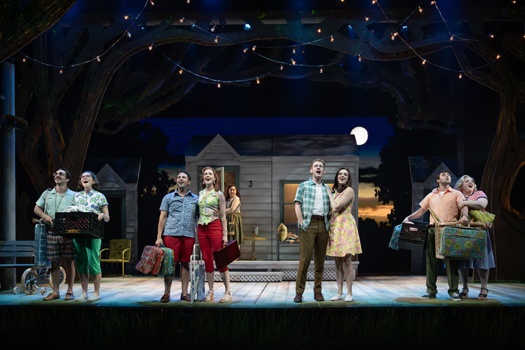
Dr. Fogler’s Bungalow Colony is a summer pilgrimage for Jewish families who see one another year after year. It’s “The Catskills with no frills/And nothing to do but barbecue,” guests brightly sing.
The Kantrowitzs come annually. Mom, Pearl (Talia Suskauer) is a housewife. Straight-arrow husband Marty (Max Chernin) works at a television repair/rental shop. Like other spouses, Marty commutes into the city. His capable, observant mother, Lillian (Andrea Burns), helps with the kids. She has an unnerving talent for reading tea leaves and tarot cards.
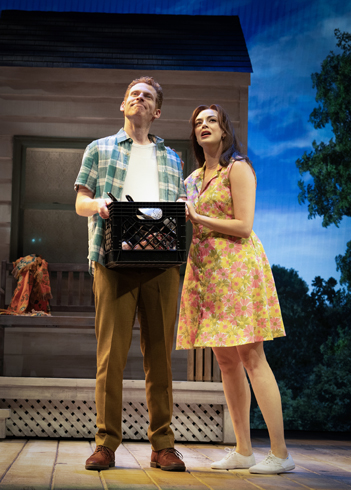
Max Chernin (Marty) & Talia Suskauer (Pearl)
Brooding teenage daughter, Alison Kantrowitz (Sophie Pollono) is obsessed with music, left leaning politics, and boys. She meets guitar-wielding Ross (Oscar Williams) in the woods. He’ll be the first to blow her mind. Young Danny (Leo Caravano) still wears dinosaur pajamas. Imagine Norman Rockwell in 1969.
Women in the community play mahjong talking about their husbands, sex, and Betty Friedan’s The Feminine Mystique. “We’ve got no time/We’re girls with something to do/Whoo Whoo,” sing the “trad wives.” (prioritizing homemaking and child-rearing.)
Everything shifts when Pearl meets the new “blouse man” = a traveling salesman who drives from bungalow colony to bungalow colony selling women’s clothing.The attractive Walker – imagine a sandy-haired James Taylor back then (Sam Gravitte), is saving to move to San Francisco , where it’s “at.” In the otherwise conservative community, long hair and jeans stand out.
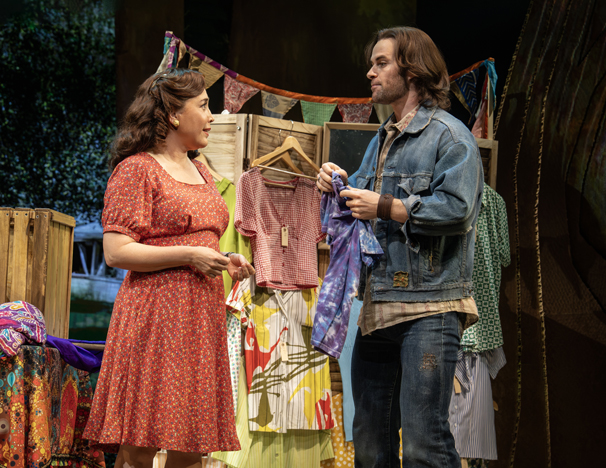
Andrea Burns (Lillian) & Sam Gravitte (Walker)
Female neighbors make a fuss. They all buy blouses. Walker has something special for Pearl, a tie-dye t-shirt. “You can’t control the outcome. It’s like the blouse makes the decision,” he explains. She ambivalently accepts his phone number-in case return or exchange is warranted.
The heroine wears her new acquisition for Marty as if it has the sexual impact of a corset. He rejects it. This is a man who depends on status quo. Even the packaged cake he eats must never change brands. When Marty’s stuck at work during the moon landing- watched by the entire community at Fogler’s casino- Pearl calls Walker. They meet.
She wakes on her porch from a dream where overhead speakers announce “Mrs. Kantrowitz is schtupping the blouse man.” (a vulgar informal term that means having sex.) Where gossip thrives, it takes a moment to understand the declaration is not real.
Shaking it off, Pearl finds herself euphoric with afterglow. “Everything is mine/I’m not losing it/I’m choosing it!” she sings in one of the few original songs. Smitten with Ross, Alison asks her mom about love. The women connect; they beam.
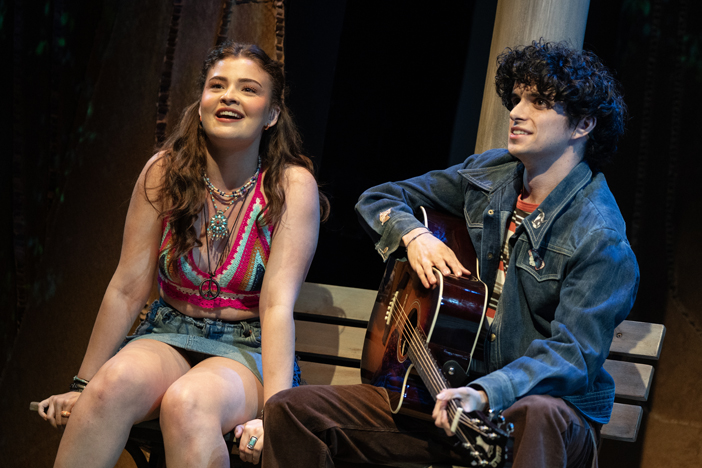
Sophie Pollono (Alison)& Oscar Williams (Ross)
This is a story about the road one didn’t take when opportunity existed. We all remember them. Everyone has a pocket of what-ifs. Pearl suddenly feels stifled, left behind. She wants to break out of structure, habit, to grow. Previous toe-in-the-water attempts have been fruitless.
Though torn, she indulges in the affair- metaphorically walking on the moon, risking everything (her family.) The new blouse man wants to take her to California. In the meantime, Woodstock beckons. She’s discovered with him. Immediate consequences are devastating. Standing in emotional rubble, Pearl has a decision to make.
Though characters are cliche, the story is universal, realistic. Its book lands both serious and humorous aspects with skill. Mostly awkward lyrics, however, try to fit in every thought- too much arrives as prose. Song format is pedestrian and similar throughout. Jewish idioms are appropriate, wry and comprehensible.
This is an affable, nostalgic, empathetic piece with little artistic distinction.
The cast is uniformly good. Talia Suskauer (Pearl) has a clear, strong pop voice. Andrea Burns (Lil) is, as always, consistently believable. Sam Gravitte makes Walker an appealing temptation. Max Chernin’s family interaction is warm and rather dignified..
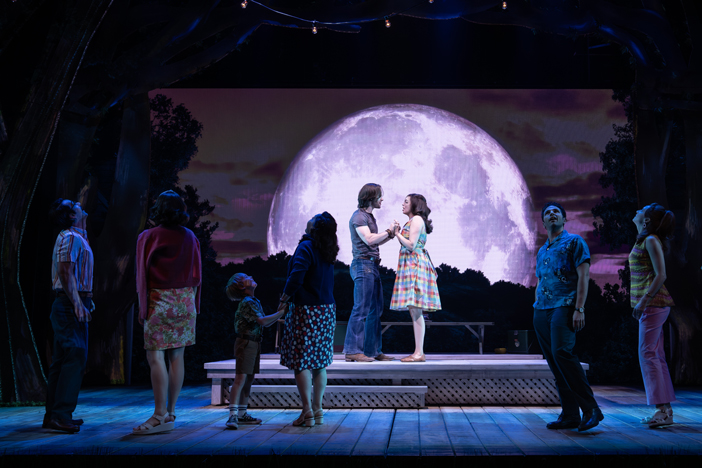
Sam Gravitte (Walk), Talia Suskauer (Pearl) and the company
Direction (Sheryl Kaller) is naturalistic. Actors listen. Pauses are used to good effect. Emotion is understated. When the company is onstage, composition is adept.
Scenic & Video Design (Tal Yarden) are a decidedly mixed bag. Cut out trees look like cheap community theater, while the compact bungalow is nifty, evocative. Projected scenic backgrounds and black and white video of the era work well,
though they get muddy on top of one another. Psychedelic effects look like fungus.
Ricky Lurie’s Costumes are exactly right.
Sound (Justin Stasiw) adds layers of verisimilitude.
Sordelet Inc./Rick Sordelet handles Intimacy Coordination with a sure hand.
Photos by Joan Marcus
A Walk on the Moon
Music & Lyrics- Annmarie Milazzo
Book & Additional Lyrics- Pamela Gray
Based on the motion picture written by Pamela Gray
Laura Pels Theatre at The Harold and Miriam Steinberg Center for Theatre
111 West 46th Street
https://awalkonthemoonmusical.com/