
By Stuart Miller…
“Spare Parts” asks challenging questions but with a flair for the dramatic.
Would you drink from the fountain of youth if it meant harming someone close to you? Would you sell out your beliefs for a chance to change the world? Would you sell out a friend or a lover for that chance?
David J. Glass’ new play “Spare Parts” is packed with weighty topics and serious debate on each yet the play’s mostly strong writing and twisty plot aided by its stellar cast are enough to overcome some serious contrivances and ensure that the story feels organically alive, instead of being reduced to a series of talking points.
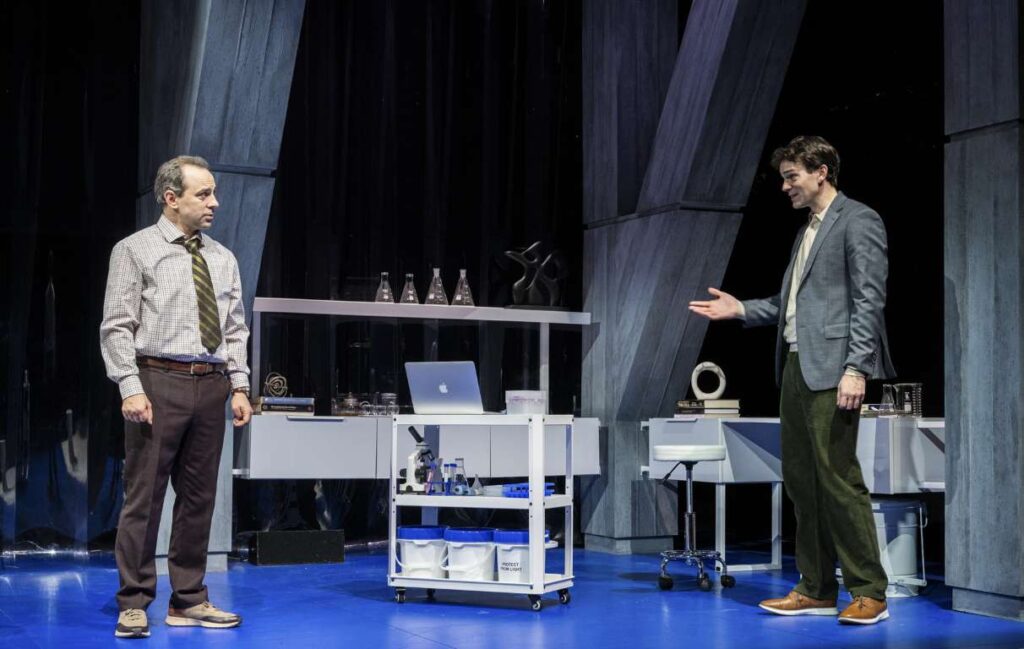
The play opens with a meeting between an elite anti-aging Columbia professor Chris Coffey (Rob McClure, the cast’s biggest draw) and a tech billionaire Zeit Smith (Michael Genet). They each bring their seconds to this battle of egos and ideas: a striver grad assistant named Jeffrey (Matt Walker) for the professor and a poised and savvy personal assistant named Ivan (Jonny-James Kajoba).

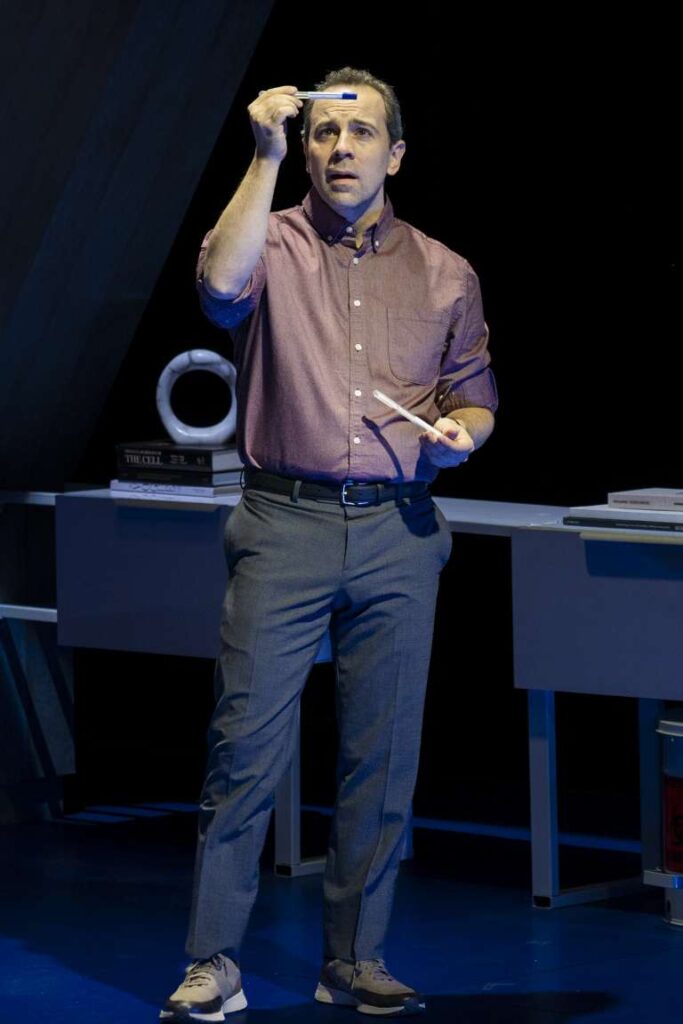
In a torn-from-the headlines touch, the professor is eager for the meeting because university research funding and grants are being slashed, creating a crisis for science. But Chris, who works with flies and worms, is deeply ethical. Zeit is not– he knows what he wants and is willing to pay for it and he thinks anyone who plays by the traditional rules with ethics and guardrails is a fool; he wants a chance to turn back the clock and will throw more money at the problem than a professor, and especially a grad student, has ever imagined. He has no use for rules and while he believes that buying innovation may eventually benefit society he doesn’t really care– he’s only concerned with himself. He’s 64 and he wants to be younger. Now. And forever.
Zeit’s offer fuels Jeff, who like Zeit, grew up poor in Queens, to cross a line, suggesting an experiment that works on mice, that involves using blood of younger rodents to extend the lives of their elders. (I’m not sure of the science but Glass is a doctor and biotech researcher so I’ll happily trust him on this front.)
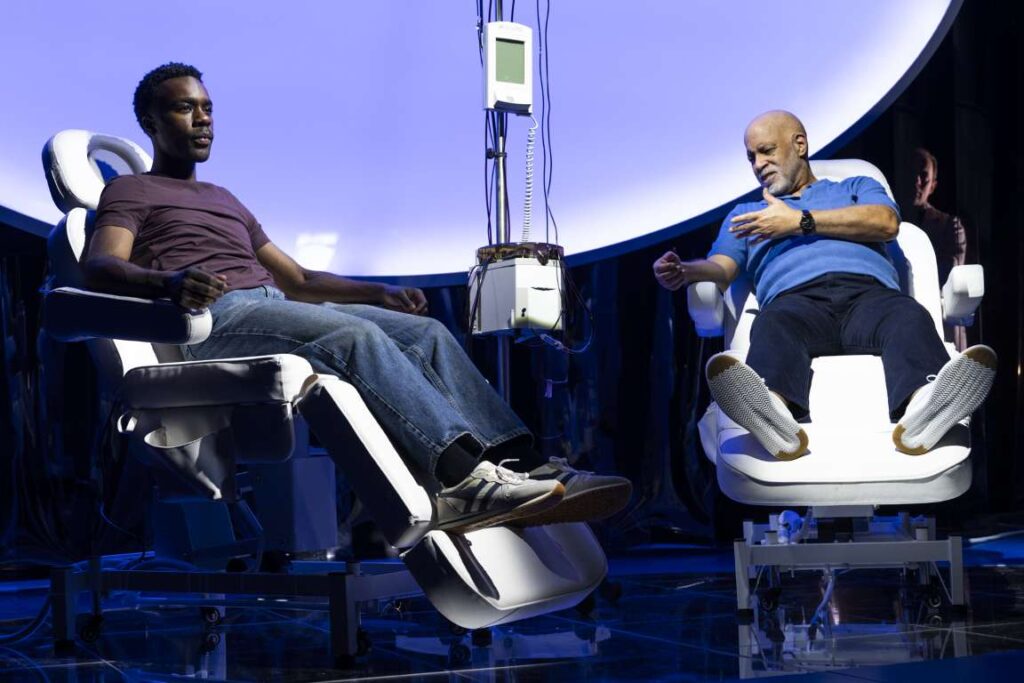
I
n the name of science (oh, and a small fortune), Jeff volunteers to swap blood with Zeit… even though his horrified boss cautions that even if the experiment somehow worked, it would mean that Jeff would age prematurely as he took on Zeit’s older blood.
Meanwhile, Zeit, who has all the scruples of, well, a tech billionaire, encourages a romantic relationship between Jeff and Ivan, something he believes he can work to his advantage. (This set-up feels forced though the dynamics between Jeff and Ivan work well in the end; similarly, the revelation that Jeff’s father was schizophrenic is shoehorned in but what it means in terms of the experiment is intriguing.)
Zeit has used science for his own purposes before and he understands what he’s asking far better than he lets on. But as smart as he is, he is spectacularly bad at understanding people and how they can be driven by their emotions. When Chris’ cheek swabs, done in search of matching blood types, produces a bombshell revelation, the play shifts to another level.
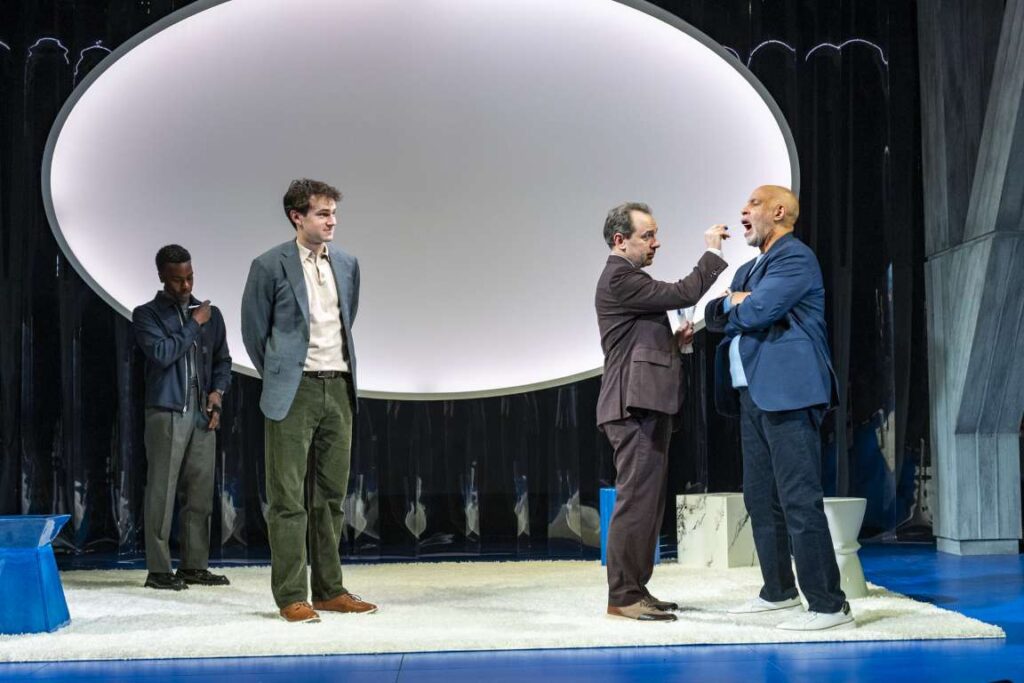

McClure is excellent, a subtle actor who conveys plenty with a shrug or a sidelong glance while Kajoba and Walker provide the emotional heft that ensures the play stays grounded in human behavior and not just abstract ideas and ideals. (One fascinating aside: Walker studied neurobiology at Harvard and just earned a PhD in genetics from Columbia so he knows whereof he acts.) But the linchpin is Genet as Zeit Smith, who plays the bully without overselling it or ever veering into caricature. . He has a few too many billionaire villain lines (“Never show people your soft spots.” and “If someone knows what can hurt you, they’ll exploit that”) but he nicely underplays them, delivering his lines naturally enough that every moment feels lived in.
Glass is clearly choosing sides in the big picture arguments but with each new plot twist he forces Jeff, Ivan and Chris to face moral quandaries that no one would envy; each proves more malleable than they believed themselves. (Zeit has no real morals so he’s more the catalyst of everyone else’s woes.)
A few of the biggest emotional scenes feel a bit rushed as Glass packs more and more ideas into his play but it remains gripping throughout and the ideas will spark debate and conversation after all the characters are revealed to be all too human to play god.
“Spare Parts” is playing at Theatre Row through April 10th. It runs 90 minutes without intermission.
Photos by Russ Rowland