Casual notes on show-biz books, memoirs and studies, dust gatherers and hot off the presses.
Book Review by Samuel L. Leiter . . . .
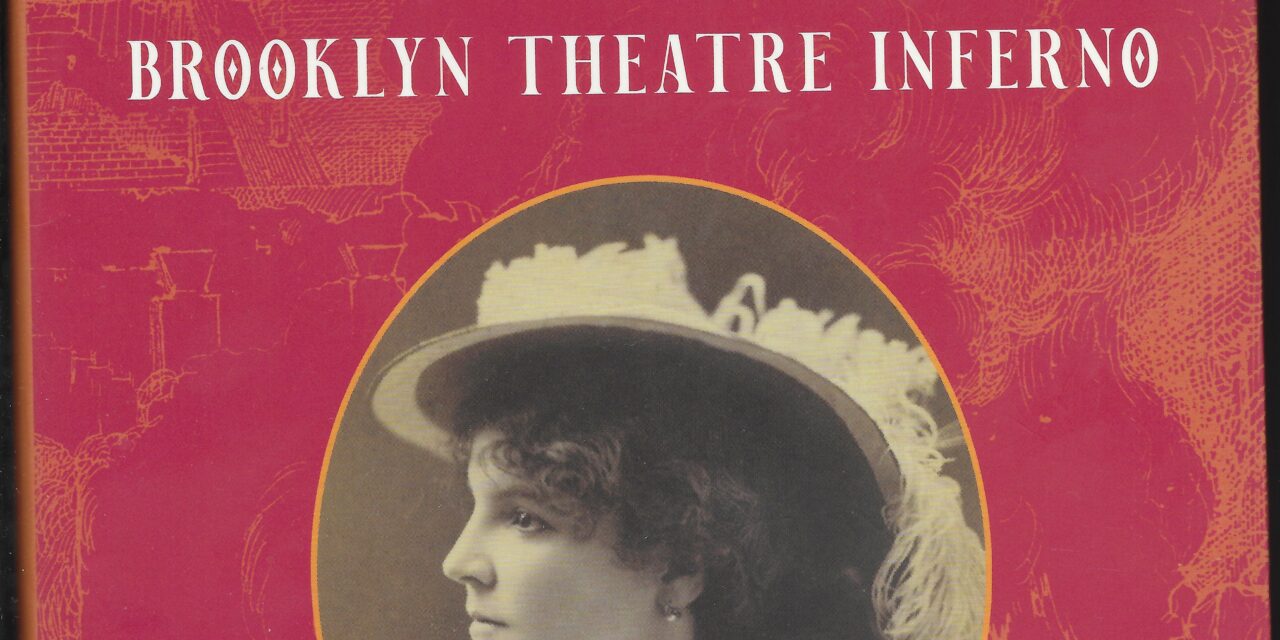
Melanie Gall, Fire Witch: Kate Claxton and the 1876 Brooklyn Theatre Inferno (Essex, CT: Lyons Press, 2026). 257 pp.
As revealed in my last two book reviews, I’ve been preoccupied lately with famous American stage stars of the late 19th and early 20th centuries. While I have a shelfful of new and old books about them ready for consumption, I realized last month that I’d never come across one about the popular melodrama actress Kate Claxton, who had a very particular relationship to Brooklyn. She figures in my 2024 book, Brooklyn Takes the Stage: Nineteenth-Century Theater in the City of Churches, and my newest book A History of the Brooklyn Stage: Across the River from Broadway (1898-1903) (1903-1908), to be published in two volumes by Palgrave Macmillan.
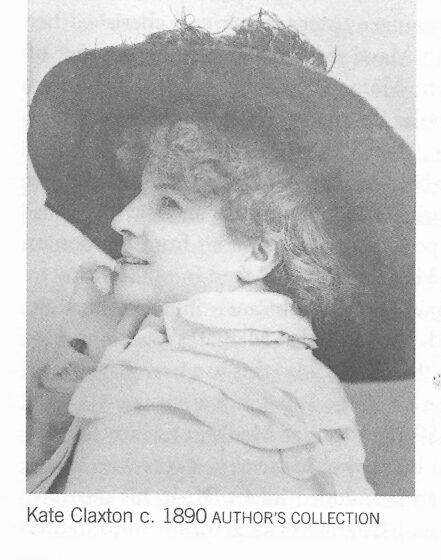
By purest coincidence, I was thrilled to discover that a Canadian writer named Melanie Gall had just published the first biography of Claxton, its title being Fire Witch: Kate Claxton and the 1876 Brooklyn Theatre Fire. The cover of my 2024 book depicts the very same “inferno” mentioned in Gall’s title. Gall uses the fire as a springboard to tell Claxton’s story, she being the young actress playing the leading role in The Two Orphans, the play performed at the Brooklyn Theatre on December 5, 1876, when the place burned down with the loss of close to 300 lives. It was—until 1903, when twice that many died in Chicago’s Iroquois Theatre fire—the greatest such tragedy in American, and probably, world theatre history.
Consumed by curiosity, I tried contacting Gall to ask her if she’d referenced my 2024 work, but, for one reason or another, she wasn’t able to respond until after I’d already been sent a copy of the book by the publisher, an imprint of The Globe Pequot Publishing Group. Her book says she learned about Claxton in 2022 when she visited Brooklyn’s historic Green-Wood Cemetery, near where she lives. Green-Wood, which occupies reverent space in Fire Witch, is where the remains of the unidentified victims of the fire rest under a distinctive obelisk, and where, along with many other theatrical artists of the time, Claxton herself is interred. When Gall finally messaged me, she said she had not been aware of my work until now. (I’d also written about Brooklyn theatre history and the fire in my 1967 PhD dissertation and in academic articles.)
The proximity of our projects can, perhaps, even with a two-year gap between them, excuse Gall’s being unaware of mine. Despite the lapse, her book is an excellently written, often compelling tale of an actress whose fascinating story deserves to be remembered. As someone whose research has made me familiar with not only Claxton’s contributions but those of the people in her theatrical environment, I was delighted to learn so much about her on both professional and private levels. On the other hand, Gall is often responsible for several blunders and for a couple of other problematic things I’ll come to later.
I’m not sure I agree that the Brooklyn Theatre fire is as little known as Gall suggests. It’s unlikely that anyone with an abiding interest in American theatre history is unaware of it, although they may not know the details. A simple trip to the internet exposes numerous items about it, the Wikipedia account alone being far more extensive, verbally and pictorially, than either my version or Gall’s. Still, Gall does an expert job of recreating the fiery circumstances, especially through the experiences of Claxton, who, over time, Gall claims to have inflated her heroic actions.
The unusual element in the story is how often afterward Claxton was present at or nearby other fires, both minor and major, especially after St. Louis’s Southern Hotel, in April 1877, burned down, killing 21. It happened when the actress was staying there, only months after the Brooklyn blaze. So often was she associated with fires, even when she wasn’t present, that Claxton became known as the “fire witch,” “fire queen,” and so on, with newspapers unable to avoid making jokes at her expense.
Claxton was born Kate Elizabeth Cone, to a prominent couple in Somerville, NJ, in 1844. Gall demonstrates that this was four years earlier than the standard date of 1848, which Claxton herself used. She died in her sleep in New York in 1924, a still youthful-looking woman of nearly 80. For all her reputed beauty and emotional talents, she found herself largely restricted to one role, that of the blind, 16-year-old Louise in The Two Orphans, which she toured in for decades, playing the teenaged heroine even into late middle age. She retired in 1904, aged 60.
Like countless other 19th-century stars, Claxton’s professional life was primarily on the road, constantly traveling, searching for new roles but rarely finding something as dependable as Louise, which she played thousands of times. Many other actors of talent were similarly restricted, among them Joseph Jefferson and James O’Neill. Gall offers a picture of what such touring was like, but also how a successful star like Claxton, managing her own company, could run into financial difficulties and be unable to pay her actors, sometimes with rebellious results.
Gall offers a sad portrait of Claxton’s private life, including her unsuccessful first marriage to a well-off businessman (until he wasn’t) named Isidore Lyon, and her second to handsome leading man Charles Stevenson, who played opposite her in The Two Orphans until 1899, even after the couple was estranged. Stevenson’s career—which eventuated in many Hollywood films—is interestingly documented, especially after he left Claxton to play leads opposite the flamboyant Mrs. Leslie Carter, with whom Claxton was convinced he had an affair. The Claxton-Stevenson marital problems and their ultimate divorce in 1911 provide memorable stories, including what happened when, in his mid-50s, he married a 19-year-old, while technically still wed to Claxton.
Claxton’s inextricable ties to The Two Orphans, whose rights she purchased and made money from even when others produced it, make for absorbing reading, including when the play was made into multiple silent movies, most famous being D.W. Griffith’ Orphans of the Storm, with the Gish sisters. Her financial ups, downs, and ups again, are well described, as is the loss of each of her six children, either at birth, in childhood, or early maturity. As the final chapter makes clear, more personal tragedy awaited her had she lived.
This otherwise well-written book stumbles, however, as noted earlier. For one thing, it’s poorly documented. It lacks notes (apart from brief informational comments) so its quotes and historical commentary can’t be traced. The back matter offers half a dozen or so bibliographical items for each chapter, almost entirely from old newspaper articles, but usually impossible to connect to information in the text. Secondary sources, even contemporary biographies or memoirs, are practically nonexistent. One or two books mentioned in the text are not listed. For example, on p. 28, Gall mentions, without a title, the autobiography of actress Rose Eytinge, with whom Claxton had professional difficulties, but the book is never listed anywhere. Then there are numerous extended passages printed, inexplicably (and distractingly), in italics.
Gall’s brief survey of Brooklyn theatre at the time of the 1876 fire is oversimplified and could be supplemented, especially her references to the Globe and Olympic Theatres. Similarly, her description of Sarah Conway’s stock company at the Brooklyn Theatre changing bills nightly is inaccurate. Gall never speaks of the rebuilding of the Brooklyn Theatre or of its fate. On p. 65, Gall says of the 1876 Brooklyn Theatre, “Most of the theater was equipped with modern electric lights, but gas jets were still used to illuminate the scenery.” I’d advise the author to check her sources on the introduction of electric lighting in theatres. Elsewhere, James O’Neill’s name is introduced as “the new actor” without recognition of who he was. And star actor E.L. Davenport is given as Raymond Davenport.
Claxton’s disastrously brief attempt to run a stock company in Brooklyn, thankfully, is described, but inadequately. Gall mentions, for instance, an 1898 performance of Cyrano de Bergerac at which a scenic piece collapsed, injuring the actors. However, she ignores the production’s relationship to the explosion of interest in that play locally (three different versions within several months), making its presence in Claxton’s repertory highly significant.
There’s more but I’ll close with a blooper on p. 226 where Gall declares that “The first actors’ strike in the history of American theater took place in New York from August 7 to September 6, 1919.” That would come as a surprise to theWhite Rats, a vaudeville organization that had organized strikes—with both vaudeville and legitimate actors—well before 1919. In 1901, the White Rats struck against the powerful vaudeville booking interests associated with B. F. Keith and others. The walkout affected New York vaudeville theatres and extended beyond the city, including Brooklyn. In 1916–1917, they undertook another major strike against the management establishment, particularly the interests associated with E. F. Albee. Gall should clarify that the essential distinction is between the first major strike by actors in the legitimate theatre under Actors’ Equity and the first strike by American theatrical performers generally.
These are cracks in the veneer of an otherwise polished biography of a long-ignored (I won’t say forgotten) actress. There’s a great deal to learn about late 19th-century American theatre in Fire Witch, and it’s consistently engrossing, even when it’s not torching a few facts.