Review by Samuel L. Leiter . . .
(Much of the following has been borrowed from my review of the 2024 Off-Broadway production. My response remains exactly the same.)
“Who knows what evil lurks in the hearts of men?” asked a classic line from the old radio series, “The Shadow.” The eternal answer, delivered with a macabre laugh: “The Shadow does.” Well, even the Shadow might have been stumped by many of the happy, everyday people pictured in the World War II-era album at the heart of Here There Are Blueberries, now at the Ethel Barrymore Theatre. This consistently intriguing, 90-minute docudrama was inspired by the discovery of an album of 116 photos showing the leisure-time activities of the SS officers and staff responsible for the Holocaust atrocities committed at the Auschwitz concentration camp, where over 1 million people, mostly Jews, were exterminated.
It premiered in 2022 at the La Jolla Playhouse, won an Edgerton Foundation New Play Award, and was a finalist for the Pulitzer Prize for Drama. Its text was edited, with dramatic liberties, by Moisés Kaufman (who also directed) and Amanda Gronich, from interviews, transcripts, and other primary sources, combining actual and imagined scenes and characters for presentation in the semi-rhetorical style associated with Kaufman’s Tectonic Theater Project, best known for The Laramie Project. In 2024, it was seen Off Broadway at the New York Theatre Workshop. This new Broadway production has its entire design team back on board, though with some cast changes.

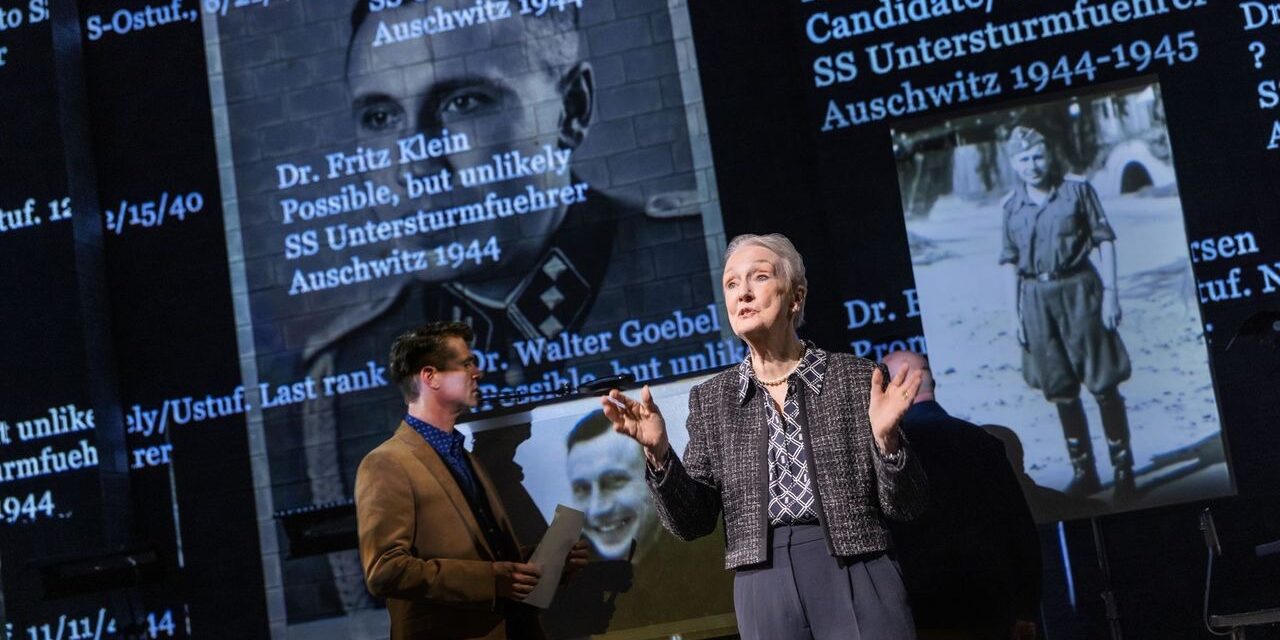
Numerous images, mostly from the album, support the narrative in David Bengali’s striking projection design—perfectly complemented by David Lander’s lighting—as the eight-member cast, playing multiple roles, stands—in Derek McClane’s clinical scenic design—around waist-high, glass-topped desks on casters. These the actors move about in carefully choreographed sequences on the otherwise bare, brick-walled stage, as the tale of the album’s provenance is narrated by Rebecca Erbelding (Delia Cunningham), actual head intake archivist of paper materials at the United States Holocaust Memorial Museum.
The album—compiled by Karl Höcker (Scott Barrow), adjutant to Commandant SS Major Richard Baer (the head of Auschwitz and a prewar candy maker)—was brought to the attention of Erbelding in 2006. That happened when the anonymous former American lieutenant colonel (Michael Cerveris) who discovered it in a trash can in an abandoned Frankfurt apartment in 1946, and kept it among his possessions for 60 years, inquired if the museum would be interested in it.
Erbelding was initially skeptical that the pictures were from Auschwitz, but quickly realized her mistake. Yet even after she and her superior, Judy Cohen (Kathleen Chalfant), authenticated the album—first via a photo of Dr. Josef Mengele, the notorious “angel of death” and then by a photo of Rudolph Höss, the man who created Auschwitz—the question of whether to accept the album is raised.
While many would think such a rare artifact—photos of daily life at an infamous place of which precious few photos exist—would be a blue-ribbon acquisition, the museum’s ethical positions on such matters made it more ambiguous. A guiding principle insisted that the museum’s mission was to concentrate on the victims and survivors, not the perpetrators, whose exposure might normalize them. (No trace of the horror carried out is present in any photos.) Erbelding’s argument on behalf of acceptance, “Six million people didn’t murder themselves,” captures the day.
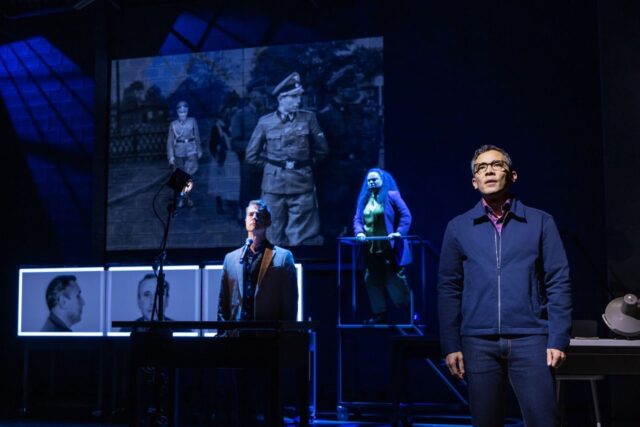
This is only one of the various moral dilemmas raised in this intellectually compelling, if dramatically static work, which focuses on the archivists’ feats of scalpel-sharp research to identify the people in the photos, taken between June 1944 and January 1945, as they relax in the sun, sing songs, even eat blueberries, and hang out at a nearby lodge as if on vacation.
The researchers discovered the mundane work these people—accountants, bankers, etc.—did before joining the SS, what their Auschwitz roles were (the happy women shown—called the Helferinnen— handled communications by running the switchboards), and what responsibility they may have had for the genocidal exterminations going on under the noses. Only the male staff members were prosecuted after the war.
Often, specific faces are spotlighted among the assembled groups projected on a background, so we can stare into their everyday faces searching for whatever clue might betray their inner monstrosity. It reminded me of the way some people I know look at the faces of certain politicians and are convinced they can tell which party they belong to. The superficially benign depiction of Nazi camp workers blithely enjoying themselves, as if the smoke rising from the furnaces were burning garbage instead of human beings killed by poison gas, recalls Jonathan Glazer’s 2023 film, The Zone of Interest, based on Martin Amis’s novel of that name. The film presents a ruthlessly objective picture of the family life of head Commandant Rudolph Höss in the gemütlichkeit house across from where the chimneys and watchtowers towered in plain sight.
Again, the controversial phrase coined by Hannah Arendt in the subtitle of her book on Adolf Eichmann springs to mind–“the banality of evil.” This idea—which has been sharply debated—suggests that history’s most horrendous deeds are carried out not by psychopaths but by otherwise ordinary people who simply believe their behavior to be normal when in the service of leaders or policies they respect. The parallels to current events are easy to spot.
A few moments in the 90-minute work rise above the archivists’ detective work to help personalize the events, like those involving a German named Tilman Taube (Conrad Ricamora), who, with the public revelation of the images, is shocked to recognize the face of his own grandfather amid the Nazi doctors. Similarly personal is the story of prisoner Lili Jacob (Delia Cunningham), who found an album of photos when the camp was liberated, photos that showed the precise day she and her eventually liquidated family came to Auschwitz from Hungary. Her slender young figure, highlighted against hordes of new arrivals, provides an indelible image.
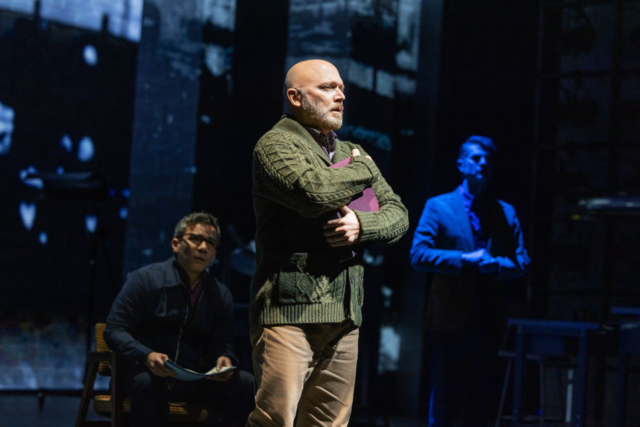
Otherwise, the material, despite being based on one of the most malevolent practices in recorded history, is presented mainly on an essentially educational level. The writing and pacing bring dramatic tension to the archivists’ research work, as they piece together an explanation of the album, but the tension is intellectual, not emotional, except perhaps for those triggered by the mere mention of the Holocaust.
But, although always delivered with a highly polished level of artistic skill, the play is narrated and the transcribed scenes spoken in a tone more of dramatized information-sharing than realistic reenactment, filling our minds somewhat more readily than our hearts. Which is not to deny the power of what is said and its thought-provoking impact, especially in view of the debates being argued in today’s world, especially regarding conflicts in the Middle East, to determine questions of guilt and responsibility. In which hearts is evil lurking? Even the Shadow doesn’t know.
At the Ethel Barrymore Theatre, 243 W. 48th Street, NYC through January 10, 2027. For further information visit Here There are Blueberries.
Photos by Matthew Murray.
Headline photo: Kathleen Chalfant.