By Carol Rocamora…
Emma Rice’s exhilarating Tristan & Yseult transforms a medieval love story into a dazzling theatrical spectacle of music, dance, humor, and breathtaking stagecraft at St. Ann’s Warehouse.
From the moment you enter the St. Ann’s Warehouse auditorium, you know you’re in for a thrilling theatrical ride, and a unique one.
Acclaimed English director Emma Rice has brought her exuberant production of Tristan & Yseult to Brooklyn. It’s a show she created in 2003 for her Cornwall-based Kneehigh Theatre company. “I love this show…with all my ageing heart,” she writes today, 23 years later.
Indeed, “Love” is the key word that defines it. It’s the love between its title characters, born from a medieval myth, immortalized by Wagner in his magnificent opera (which premiered in 1865). It’s the complexity of love, with all its joys and pain. And it’s the love of this theatre company (now renamed for this director) that has inspired them to revive it and bring it here.
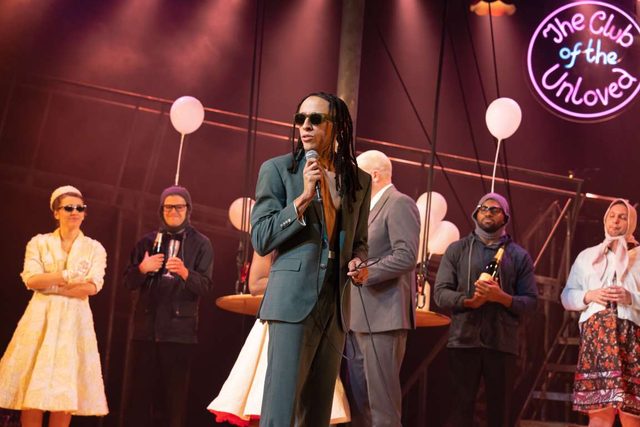
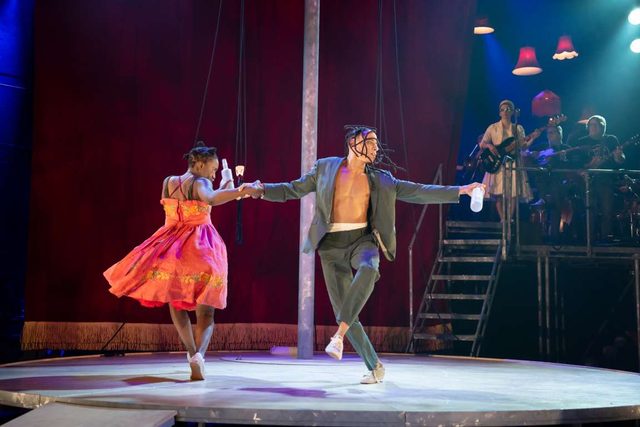
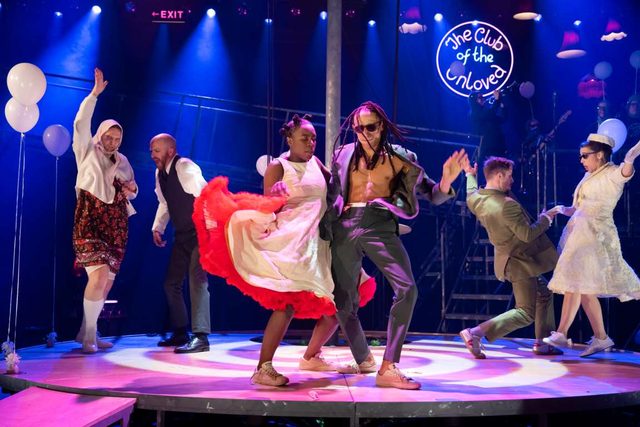
Upon entering, you find the twelve-member ensemble of actor-musicians already inhabiting the entire theatre. They are called “The Love Spotters.” Some are seated on the balcony of Bill Mitchell’s multi-level set, featuring a long gantry (aka platform), an area for a six-piece band, and another runway leading down to a circular stage with a central flagpole. Others are milling about the audience wearing hoodies. (One caught me by surprise, asking: “Am I going to get love today?”) The ensemble gathers on the circular area to sing a pre-show song entitled “Love Hurts.” E presto: we have the theme of the play! Another Love Spotter takes out a vinyl record album titled “Tristan und Isolde” by Richard Wagner, puts it on a record player, and the play begins with that immortal musical introduction.
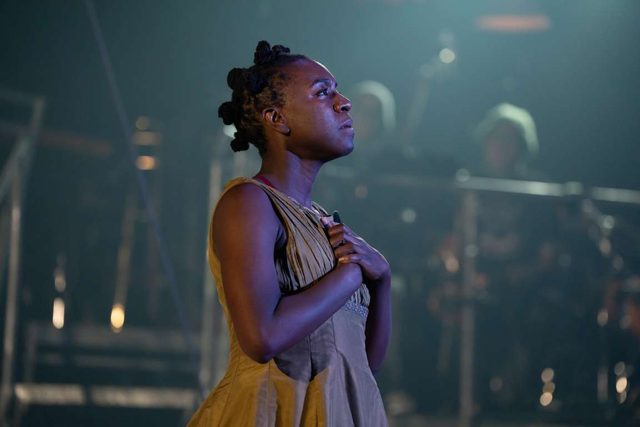
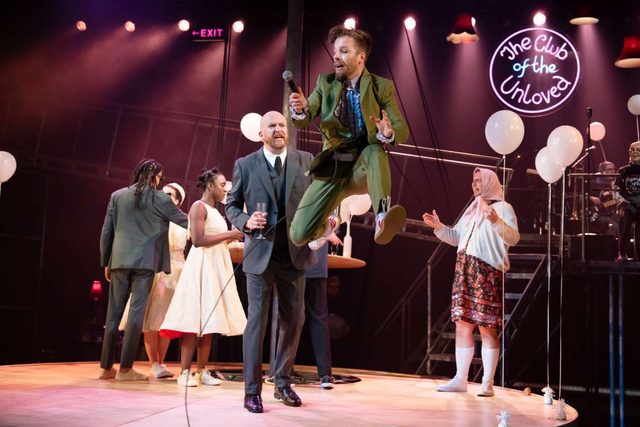
The narrator named Whitehands (an authoritative Stephanie Hockley, dressed in white) introduces the show and its ensemble. “We are the unloved,” the Love Spotters sing, longing for love and all the “blood and fire” that comes with it. Next, Whitehands introduces King Mark (an imperious Edward Rowe), dressed in a sharp business suit and wearing dark glasses to mask his aggression. He speaks in Cornish, warning the invading Irish who are arriving on their ships that he’s ready for battle. (The stage movement is magical. Actors carry toy ships around the circular stage, as characters “cross the sea.”) His aide Frocin (Matthew Churcher, a dynamite dancer) proceeds to capture one of the invaders, hangs him from the center-stage mast, and slaughters him with a knife.
Next to arrive is Tristan (John Leader), “né en tristesse” (“born in sorrow”), as he introduces himself in French, offering his services to the King. He’s followed by Morholt, the invading Irish King (an imposing Tom Fox), with his fierce henchmen, who attack King Mark. Tristan takes Mark’s side and heroically engages the Irish in battle, defeating them. Victorious, Mark vows to have the hand of the defeated Irish King’s sister, Yseult. Mark sends Tristan, though wounded in battle, to Ireland to bring her back to Mark in Cornwall.
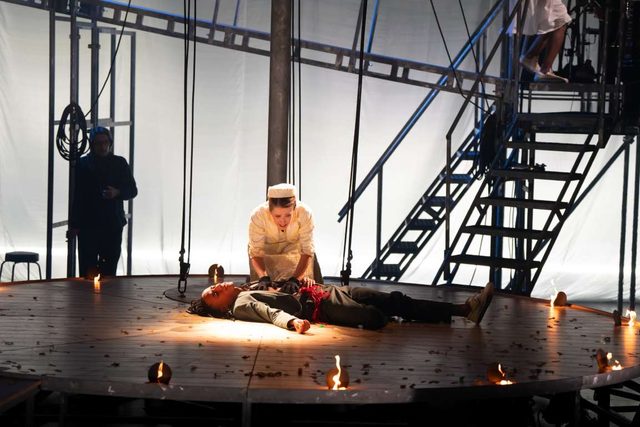
Upon arrival in Ireland, the compassionate, Gaelic-speaking Yseult (Nandi Bhebhe) heals Tristan of his mortal wounds, with the help of her maid Brangian (a hilarious 6-foot-tall Tom Fox again, who also played Morholt). Upon learning, however, that Tristan has killed her brother, she attacks him. But when Tristan explains his mission, to bring her back to Mark, she’s prepared to face her fate, provided that Brangian finds her a love potion to help her accept the Cornish King. What follows is a mad tango of intoxication, where the love potion is accidentally drunk by both Tristan and Yseult, and they fall into a mad, passionate embrace “like puppets on a string.”
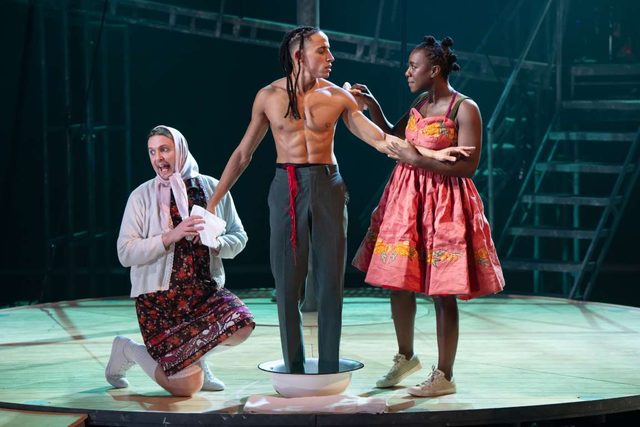
Back in Cornwall, Brangian prepares the reluctant Yseult for her marriage to King Mark. A balloon-filled wedding ensues, followed by wild dancing, while the heartbroken Tristan looks on. But Yseult concocts a plan: on her wedding night, she enlists Brangian to take her place in Mark’s bed (Tom Fox at his most hilarious), so the unsuspecting Mark won’t discover that she had already lost her virginity (to Tristan). While Whitehands sings “Wild Nights” (lyrics by Emily Dickinson), the unsuspecting Mark and Brangian (in disguise) make love. Ultimately, Mark discovers the truth and threatens to kill both Tristan and Yseult, but relents in the end.
Alas, the potion wears off, and the lovers part. Yseult returns to Mark, her husband/protector, while the dejected Tristan sets sail again. But there’s more to come. The final scene is a surprise, a joy, a heartbreak, and yours to discover (small spoiler: the circular stage is lit with a ring of fire, as Wagner’s ecstatic finale soars).
As history has proven, Richard Wagner’s opera based on this medieval myth is one of the greatest pieces of music ever written. But Emma Rice’s version is a modern theatrical triumph of its very own. It’s told spectacularly, exuberantly, artfully, and playfully, on the fabulous multi-level set (designed by Bill Mitchell, refreshed by Vicki Mortimer). Rice masterfully combines the styles of commedia dell’arte and circus arts in an intoxicating, original mix. The ensemble is superb, playing instruments, cavorting, dancing (choreography by Etta Murfitt).
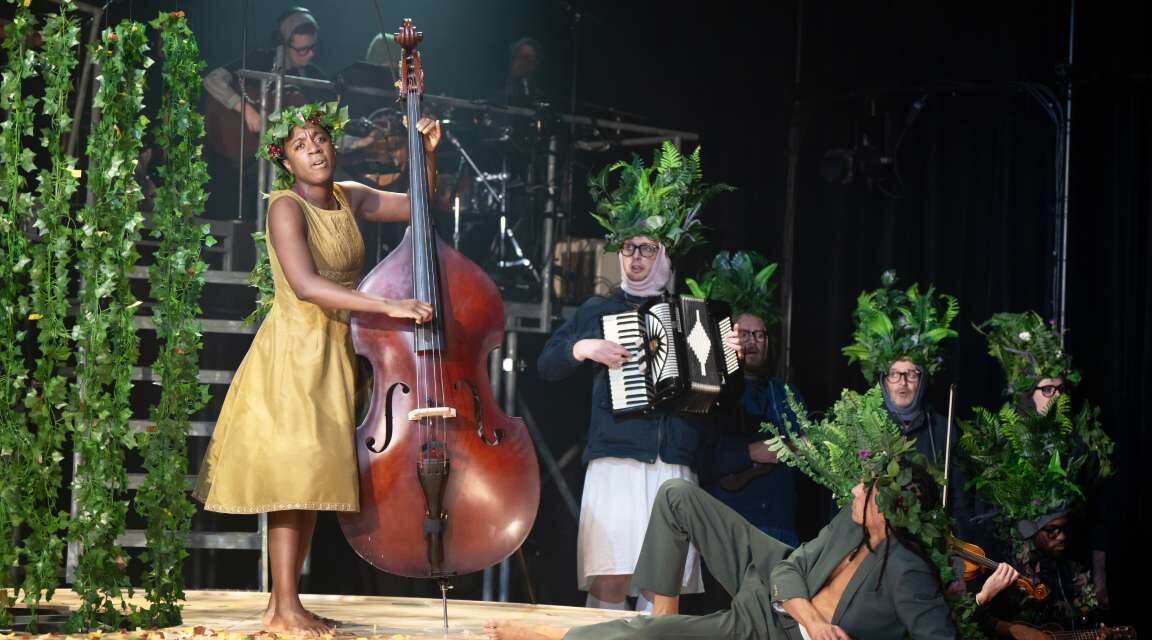
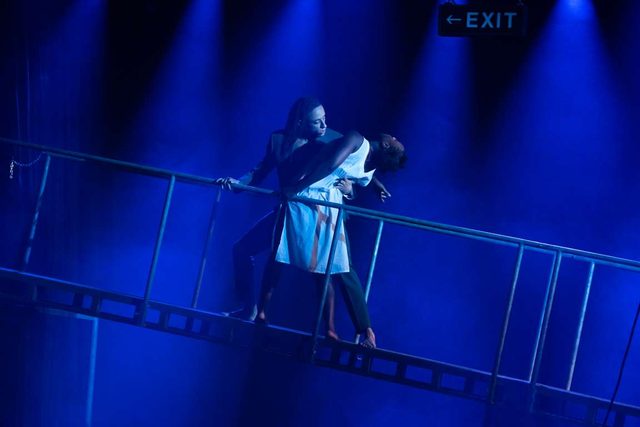
There are some spectacular moments, when, for example, Tristan and Yseult are both strung on wires and hoisted up on the central mast high above the stage, airborne in ecstasy. Another scene in the forest features actors and musicians with tree branches on their heads (colorful costumes by Bill Mitchell, again refreshed by Vicki Mortimer).
When have you recently seen a classical tale retold in four languages (English, French, Cornish, Gaelic)?! (The script is written by Carl Grose and Anna Maria Murphy, adapted by Rice.) Above all, there is the universal language of music, featuring both original music (by Stu Barker) and classical excerpts from Wagner’s opera and Orff’s Carmina Burana.
And let’s not forget the audience participation, wildly encouraged by the energetic cast throughout, making us part of the unforgettable experience. In short, it’s all passion and joy, even for the so-called Love Spotters in the Club of the Unloved, who are, in the end, lovingly embraced by all of us in the audience.
There should be a name for this thrilling new genre that Emma Rice has created, with her imagination, creativity, artistry, and passion. Call it the Theatre of Exuberance.