Review by Samuel L. Leiter . . .
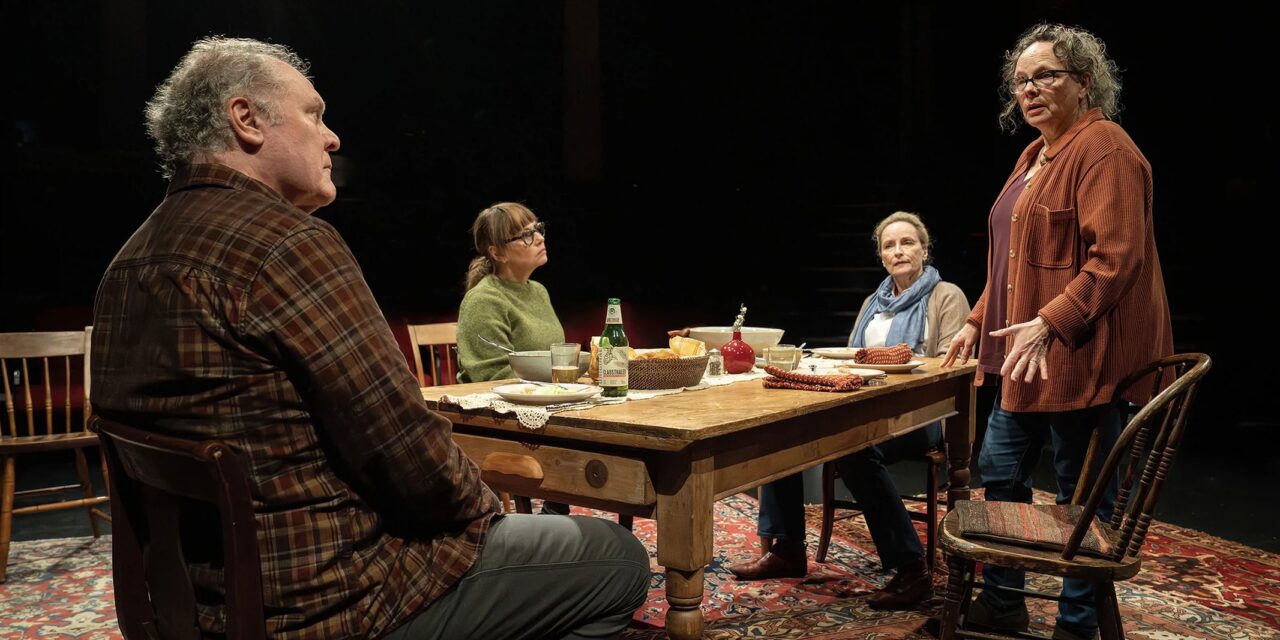
We’ll See; Conversations among the Apple Family on the Night of the Midterm Elections is the eighth play in director-playwright Richard Nelson’s continuing Public Theatre epic of periodically visiting the fictional Apple family of Rhinebeck, NY, to observe them gathering around a kitchen table to discuss topics of the day. Opening nights of the Apple plays usually have some immediate connection to a particular event, this one being election night 2026, with the characters, like the audience, preoccupied with the outcome. In We’ll See five people, four seen in previous Apple plays, gather to set the table, eat dinner, put aside devices, and talk about this and that, only some of it related to the election, with most having left to watch the news when the polls close near the end.
The characters, all in everyday wear by Susan Hilferty, are retired lawyer Richard Apple (Jay O. Sanders); his sister Barbara, a high school English teacher (Maryann Plunkett, married to Sanders in real life); another sister, Marian Apple Platt (Laila Robins), a second-grade teacher; yet another sister, nonfiction writer Jane Apple Halls (Sally Murphy); and Yvonne Winters (Yvonne Woods), Richard’s partner, an actress recovering from a serious illness. Each of the first four characters and the actors who play them have appeared in multiple, if not all, the previous Apple plays; the only new character and actor is Winters/Woods.
The Apple plays are about the closest thing the theatre has contrived to resemble a TV soap opera series, separated as its episodes may be by years, not days or hours. Audiences who have seen the entire series feel connected to these people, whose naturalistic conversations often seem so much more like living than acting that you feel you’re that proverbial fly on the wall. In We’ll See they sit or move around the old wooden table, surrounded in pure arena style by four tiers of seats. Nelson’s direction consistently finds engaging ways of keeping the blocking and tableaux attractive on the sceneryless space (credited to Jason Ardizzone-West), aided immeasurably by the sensitive lighting of the great Jennifer Tipton.
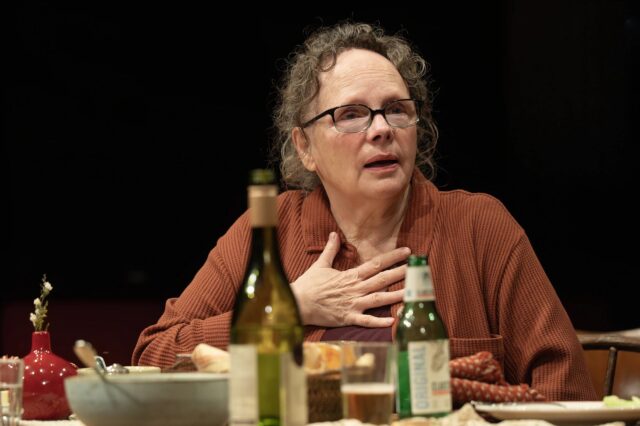
The Apple plays often have been called Chekhovian because of the convincing way their typically low-keyed discussions present an impression of real life, but the comparison is superficial. Nelson’s plays, finely crafted as they are, don’t have the theatrical structure, dramatic confrontations, and heightened characterizations of Chekhov, where, for all the subtlety, the stakes are much higher. Still, it’s absorbing (to a point) to overhear these urbane, liberal-leaning folks from suburban New York chat away about issues of both personal and broader significance,
Regardless of the offstage election, the conversations range widely over things such as immigration policy, voting, politics, aging, education, poetry, religion, family relations, Trumpian omnipresence, human kindness, Ukraine, Europeans’ view of America, Rhinebeck, the therapeutic effects of theater, and, among many others, the struggle to retain hope in a frightening world.
Light satire is pointed at woke theatrical practices when we hear a report about a rehearsal consumed by land acknowledgments, harassment training, and cultural-transformation exercises. At a couple of moments, an Irish song, “The Emigrant’s Lament,” is introduced. Naturally (or maybe not so naturally), the singing is perfectly on pitch.
Emotions are heartfelt but—apart from a disagreement about allegiance to a political party—confrontations are mostly absent and temperaments are cool, even when recounting unfortunate events, as when Barbara describes the classroom circumstances regarding an errant piece of chalk that led to her being forced into retirement at 74. Some of the topics talked about might create serious tensions in real life, but the Apples are too controlled to allow that to happen. They listen politely, express their concerns, and move on to the next subject. Admittedly, 110 uninterrupted minutes of this can have its longueurs, no matter how excellently it’s expressed or performed. At the end, with the election still to be decided and everything else unresolved, Barbara looks directly at us and repeats the title: “We’ll see.” Lights.
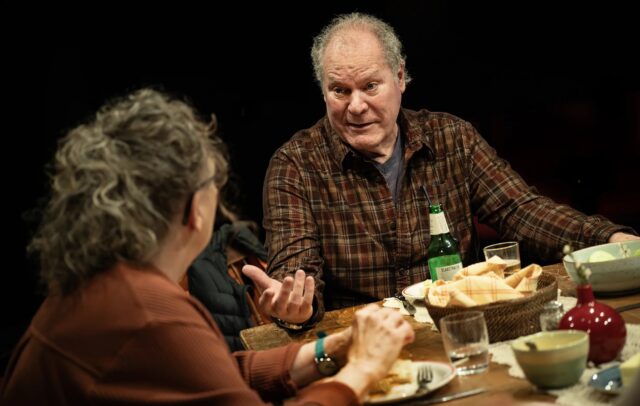
Nelson effectively interweaves public and private anxiety, each character consumed by both the common sense of apprehension and their own private burden regarding the future. The election itself is only a small part of the sense of dread pervading the zeitgeist. The attitude toward Trump is a given, so nothing substantive about him—not even his name—is provided. Humor sometimes lightens the mood, and the familial aura of mutual regard, including kidding, is strong.
None of which absolves the play of being undramatic, a string of topics and stories, some going on at length, before the next character chimes in with a related (or not) anecdote. You listen attentively to each because they’re usually compelling, but they serve more to evoke a feeling than to establish a dramatic arc. The result resembles a collection of interesting dinner-party stories, many sounding more like well thought out set pieces than spontaneous contributions.
All in all, We’ll See offers a good example of Richard Nelson’s unique vision. His ability to search for how we can remain human in times of despair is touching. And while his theater as conversation is no substitute for Chekhov, it does come with its own particular pleasures.
At the Public Theater/Barbaralee Theater, 425 Lafayette Street, NYC, through November 29th. For further information, visit We’ll See; Conversations among the Apple Family on the Night of the Midterm Elections.
Photos by Joan Marcus.
Headline photo: Jay O. Sanders, Sally Murphy, Laila Robbins, and Maryann Plunkett.