By Samuel L. Leiter . . .
Oskar Eustis, renowned artistic director of the Public Theater, has a gift for writing strongly supportive program notes for the shows he presents; he could have been New York’s premier press representative had he chosen. Take, for example, his comments on Ryan J. Haddad’s Good Time Charlie, which he calls “a kind of mirror-image of the greatest American play, Long Day’s Journey into Night,” apparently because both deal with the effects of familial love, negative in the one case, positive in the other. I doubt many visitors will be ready to compare Mr. Haddad to Eugene O’Neill after seeing this overlong, overly familiar play, his first full-fledged one after several earlier ones, like Hold Me in the Water, written for solo (or nearly) performance.
As in those works, none of which I’ve seen, Good Time Charlie is autobiographical. Haddad, disabled since birth by cerebral palsy, is a Lebanese-American actor-writer (not that his ethnicity has anything apparent to do with his play) from Shaker Heights, Ohio. Using a walker to get around, he plays himself, the genial narrator of a meta-theatrical work that, with lots of direct address, suggests it can be revised as we watch it. The actors discuss the writing, discard and add scenes, and so forth, in order to reenact experiences through which the characters presumably lived.
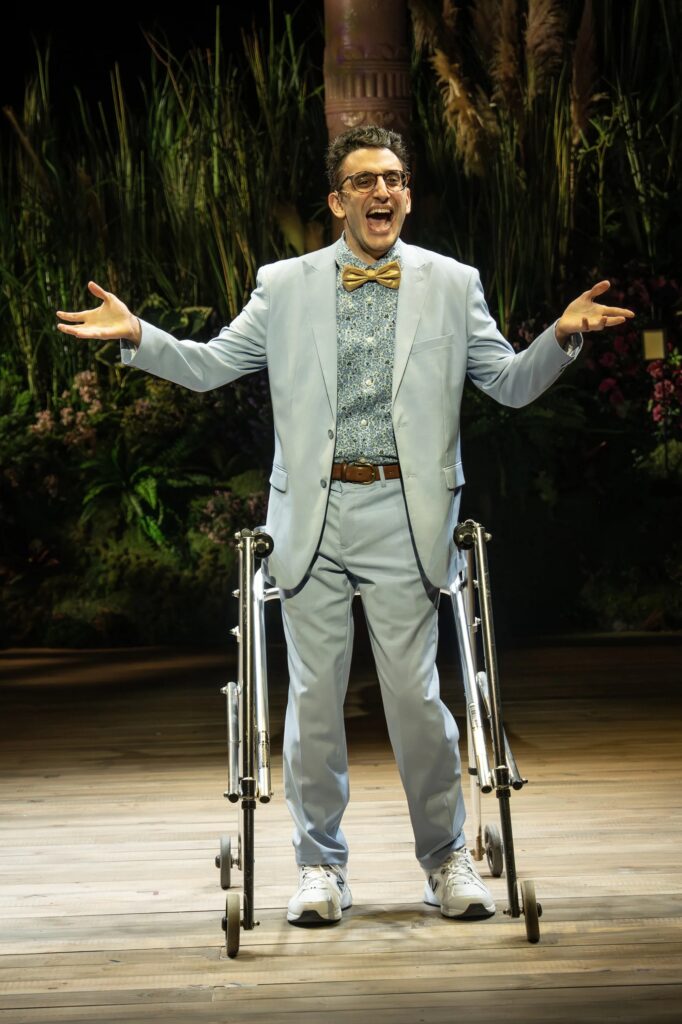
Essentially, it’s a coming-out-of-the-closet play, a rather tired theme by now. Haddad even defends his subject, his onstage avatar, Ryan, saying, “I apologize for polluting the earth with yet another gay male play. But I am a gay man, so I will probably keep writing gay male plays.” However, the central character is not Ryan, but Charlie (Jonathan Raviv), his father, Bob’s (Nael Nacer), first cousin, the play saying this makes Ryan Charlie’s nephew. Reference sources, however, say such a relationship is that of first cousins once removed, not uncle and nephew. Regardless, Ryan’s story is as central as Charlie’s, both of them enduring parental resistance, one even involving violence, followed by grudging approval, when they reveal their sexuality.
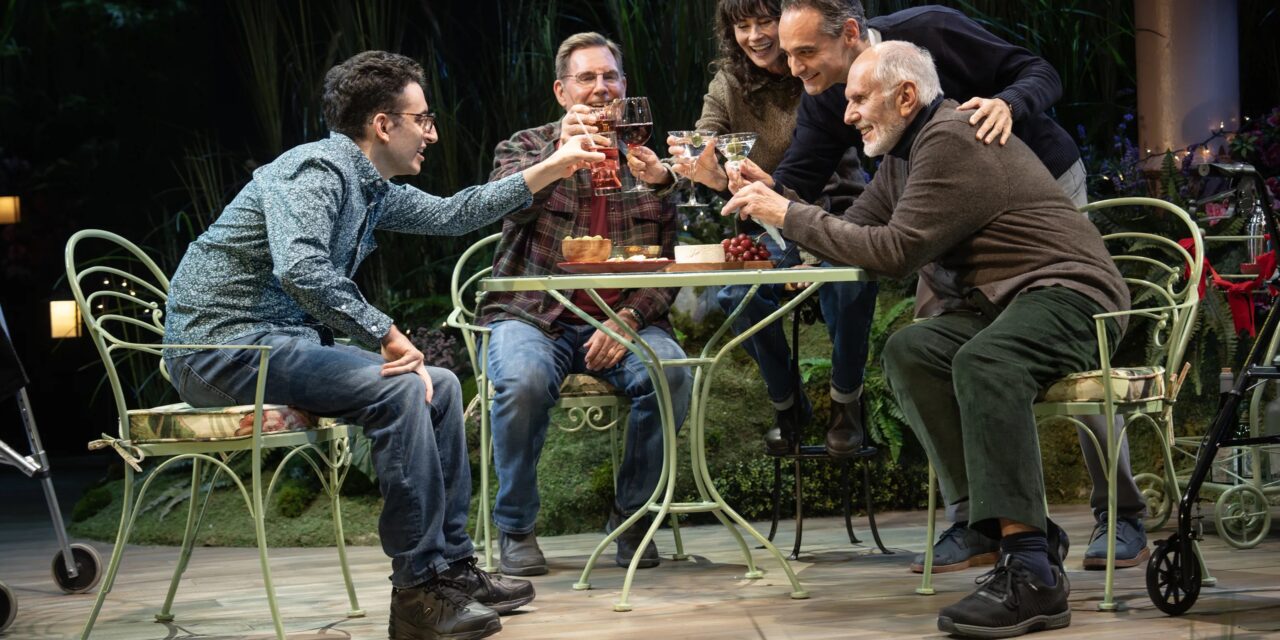
The episodic play’s many scenes are enacted against what is described as a Japanese-inspired garden, designed by Afsoon Pajoufar, which serves as both itself and a neutral background for all the scenes, with furnishings brought on and off as needed. It’s all very pretty, especially as lit by Barbara Samuels, but the only thing overtly Japanese about it is an authentic red torii gate I’d like to have in my own backyard. Costumer Enver Chakartash provides suitable clothes for everyone, Robert Pickens’s wig designs come in handy for four characters doubled by two actors, and Ryan Gamblin’s sound and original music contributes nicely to the ambience.
Good Time Charlie covers three decades, beginning in 1998, when six-year-old Ryan gets his family, including Charlie’s mom, Joan (Artemis Pebdani), and lesbian aunt, Janice (Beth Malone), to assist in reenacting the TV movie Rodgers and Hammerstein’s Cinderella. Little Ryan is a theatre nerd, and given his pronounced proclivities it’s a bit odd that, years later, his parents find it difficult to accept his being gay. It’s also hard to buy their extreme reactions, as when Judy (Pebdani again), his mother, responds to his request that a framed picture on his wall of Pamela Anderson be taken down with “WHY? WOULD YOU RATHER HAVE A HARD COCK ON THE WALL INSTEAD?” Cheap comments like these—and there are several—may earn a laugh or two but they are hard to reconcile with the middle-class suburbanites characters we see. It would have made more sense for her to say “Would you rather have Paul Newman on the wall instead?” since Newman came from Shaker Heights. But poor Paul gets not a mention.
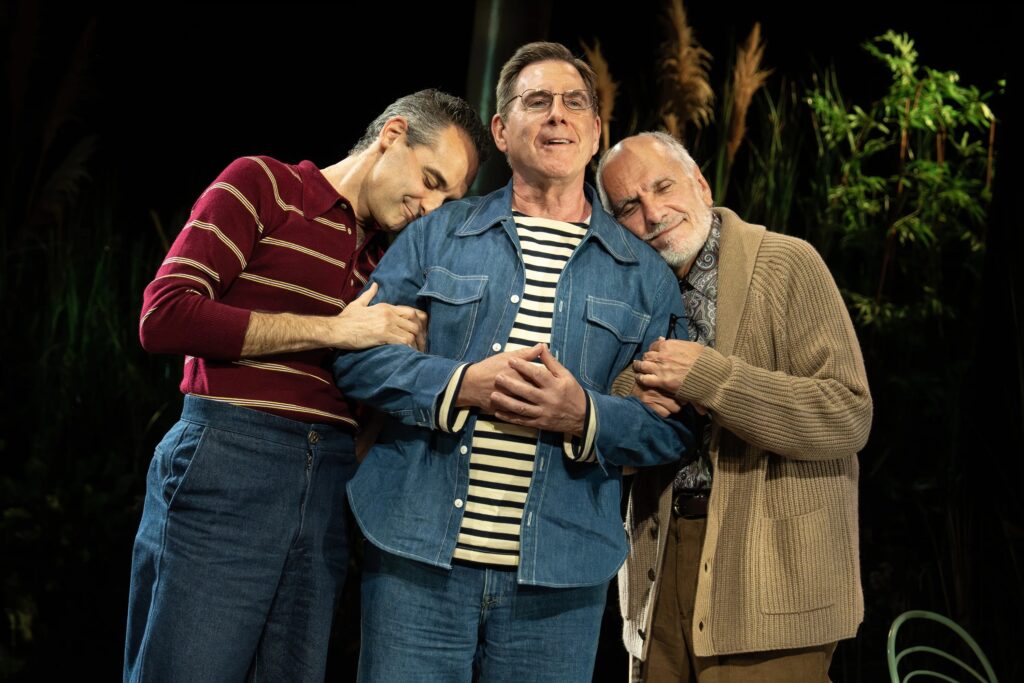
What is supposed to be the much older Charlie’s play follows his trajectory over the same time period as he is deflected by parental objections to studying theatre into a career as a dentist. Like Ryan, he is forced to confront parents unable to accept his orientation, a conflict that takes years to resolve, but he finds love and stability with Lou (Tim Bagley), a film professor, who formerly had been married to a woman and had a child. Another wheel to this train of relationships is added with Sheldon (Michael Cristoffer), an older gay man who gives film talks at a Cleveland cinema. Sheldon’s presence is the launching pad for precious moments of stage time being consumed with showbiz trivia as Ryan, a wannabe film buff, falls under the cinephile’s mentorship, leading to too many stereotyped allusions to the names (like Bette Davis) and stage and film titles that consumed gay fanboys in the last century. Ryan even asks Sheldon if he attended Judy Garland’s Carnegie Hall concert.
Whatever nostalgic humor such conversations may rustle up, they amount to little more than filler in a play inflated to two hours and fifteen minutes, much of it draggy and undramatic, notably a long scene near the end that had me checking my watch every two minutes. The loneliness of these long distance homosexuals is not particularly riveting. Similarly, just because a play celebrates the significance of art and the value of family and friendship is not reason enough to celebrate the play. Haddad shows promise and I’m sure he’ll be heard from again, but he needs a stronger shovel with which to dig than a meta-theatrical premise.
Today, famous men casually mention their husbands, and women their wives, in public fora; gay characters appear without scandal in countless plays, films, and TV series; and presidential candidates don’t hide their same-sex partners. However, while there are surely many boys and girls today struggling to gain acceptance of their sexual orientation from parents who consider them not “normal” (an oft-referenced trope in the play), Good Time Charlie offers a familiar dramatic situation without finding enough that is fresh in it. Consequently, while the subject may retain some pertinence, its treatment seems dated.
Ryan J. Haddad is a pleasantly authentic participant in a reenactment of his own life, and he’s surrounded by a highly qualified company. Everyone, under Danny Sharron’s enthusiastic direction, provides an efficient, if not especially illuminating performance, although a touch of hamminess creeps in at times. But then, as a “mirror-image” of Long Day’s Journey into Night, isn’t that to be expected?
Public Theater/Martinson Hall
425 Lafayette Street, NYC
Through October 25